



The Crow's Nest
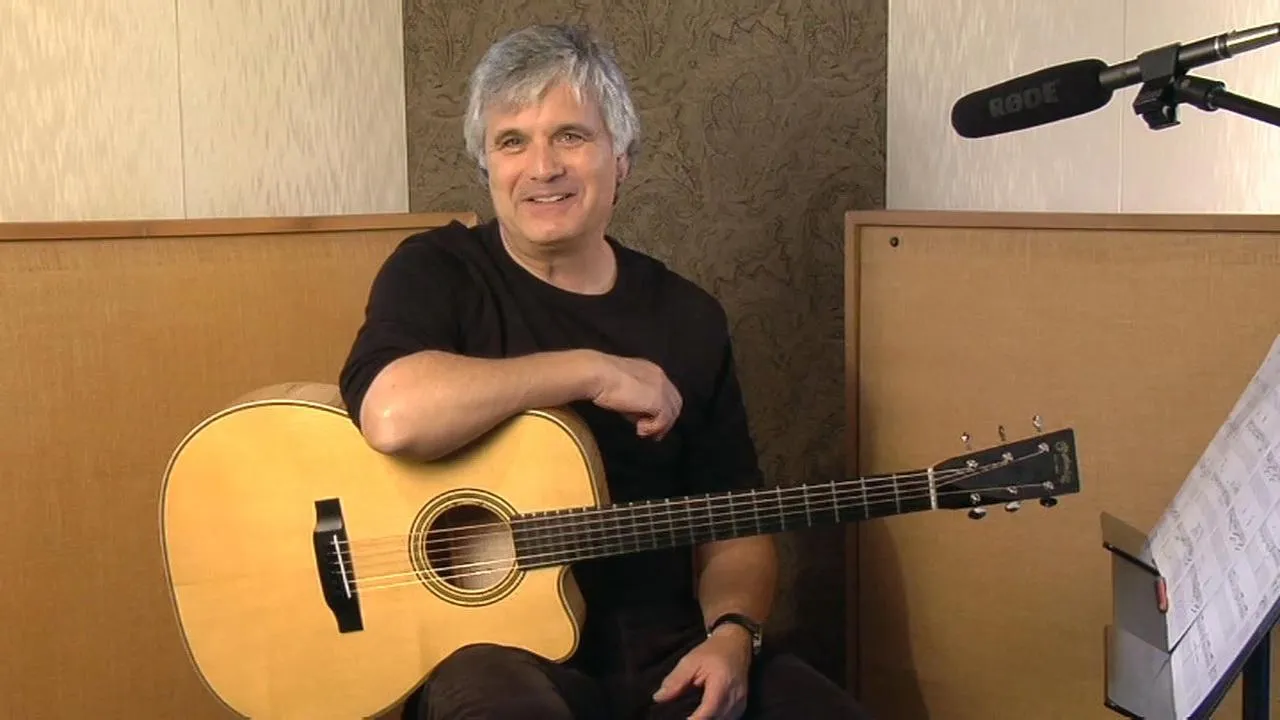
Laurence Juber erläutert die Techniken hinter seinem Fingerstyle-Stück The Crow's Nest: das Picking-Muster in ständiger Bewegung und seine Nagel-Strumming-Technik, auf der Akustikgitarre.
Das steckt im Kurs
14 Lektionen (1h 33m) · 1 gratis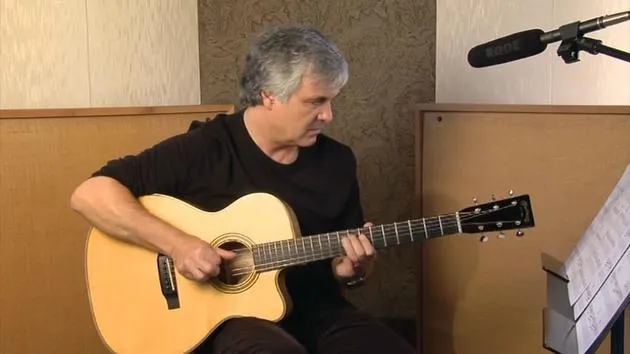
01. Enough Is Never Enough
8:12
02. Guitar Noir
5:34
03. The Crow's Nest
Du bist hier5:15
04. Maple Avenue Strut
9:05
05. The Ornament Waltz
10:38
06. Rufus
7:19
07. Highway 17
8:38
08. Being Here With You
4:51
09. Wooden Horses
7:42
10. Double Agent
7:01
11. Shebeg & Shemore
4:44
12. Around The Block
6:39
13. Portobello Road
6:28
14. Abschließende Gedanken
1:03
Transkript der Lektion
Lesson Overview: "Crow's Nest"
So next up on the album is a tune called Crow's Nest. For licensing reasons, I'm not able to give you an in-depth breakdown of the tune, but I will discuss some of the techniques involved.
Perpetual Motion Energy
- This tune has a kind of perpetual motion energy to it; it doesn't really stop very often.
- There's a basic pattern:
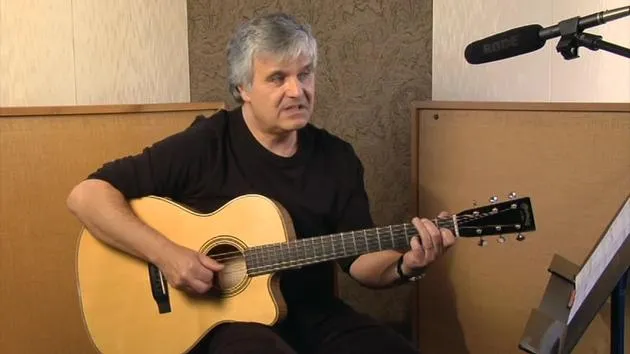
- You're picking out a melody with the thumb.
- Then, with the index and middle fingers, you're carrying the extra sixteenth notes that keep the momentum going.
For example, on a scale, that would be the approach.
Strumming Techniques
- There are places with strums and melodies that are harmonized, let's say here in thirds.
- When I strum, I use the backs of my fingernails for both up and down strokes:
- The upstroke comes with the back of the thumb.
I don't use my fingernails for much else, but I do for strumming.
Analyzing Chord Sequences
I recommend looking closely at some of the chord sequences because:
- Although there's a lot that really sits on a kind of drone, there are other spots, for example, the sequence starting at measure 17, where I have some progressions that follow chord sequences without fully articulating a chord.
Notable Measures:
- In measures 20 and 21, it transitions from 6/8 to 5/8 and then back to 4/4:
- 6/8: 1, 2, 3, 4, 5, 6
- 5/8: 1, 2, 3, 4, 5
- 4/4: 1, 2, 3
- It's tricky because you could think of it almost as 12/16:
- 1, 2, 3, 4, 5, 6, 7, 8, 9, 10, 11, 12
But I'm counting it instead as 1, 2, 3, breaking it down to half speed. You'll figure that out from the recording. Just observe what's going on with the harmonies.
Key Progressions
In measure 25, take note of these chord transitions:
- A minor to G over B
- G minor to D over A
- One of my favorite progressions is a diminished chord, in this case, a G sharp diminished in measure 26, transitioning to an A7B9 to D.
Pay attention to the underlying chords.
High Neck Technique
Another point of interest is in the bridge section, bottom system, measure 51:
- I'm moving to a G chord but playing it high up the neck.
- This G here on the fifth string is the same note as the open G string.
- What you get is a G but broken up with this perpetual motion concept.
Conclusion
Well, good luck with that one! It was originally written for guitar and string quartet, and I've adapted it for solo guitar. Pay attention to what's on the recording.
14 Lektionen
1 Std. 33 Min. strukturierte Videolektionen
Erweiterte Videofunktionen
Verlangsamen, Passagen loopen, mitlesen
Handy, Tablet & Desktop
Üben, wo du willst
100 % Zufriedenheitsgarantie
30 Tage Geld-zurück-Garantie
Lern deinen Guru kennen

Lern deinen Guru kennen
Laurence Juber wurde zunächst als Leadgitarrist in Paul McCartneys Band Wings bekannt. Seither hat er sich eine Karriere als Fingerstyle-Gitarrist, Komponist und Arrangeur aufgebaut und arbeitet vorwiegend in der DADGAD-Stimmung, die ihm den Beinamen 'the Duke of DADGAD' einbrachte.
Von den Lesern des Fingerstyle Guitar Magazine wurde er zum Gitarristen des Jahres gewählt und vom Magazin Acoustic Guitar zu den besten Gitarristen gezählt – dazu kommen eine lange Liste von Soloalben und Welttourneen.
In seinen Kursen vermittelt er seine Fingerstyle-Technik und die DADGAD-Stimmung, für die er bekannt ist, wie man Melodie, Harmonie und Bass für die Solo-Gitarre zusammenführt, und die Stücke – wie sein charakteristisches 'Wooden Horses' –, die all das vereinen.







