



Ein paar Anmerkungen zu Stimmung und Theorie
Laurence Juber wechselt von der Standardstimmung zu DADGAD, indem er das tiefe E einen Ganzton auf D herunterstimmt und Oktaven vergleicht, damit du hörst, wie die Stimmung zusammenpasst.
Das steckt im Kurs
16 Lektionen (1h 6m) · 1 gratis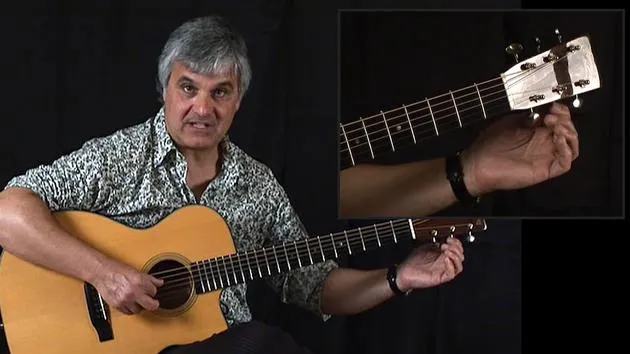
01. Ein paar Anmerkungen zu Stimmung und Theorie
Du bist hier6:11
02. Amazing Grace (Lektion)
10:51
03. Amazing Grace (Interpretation)
1:19
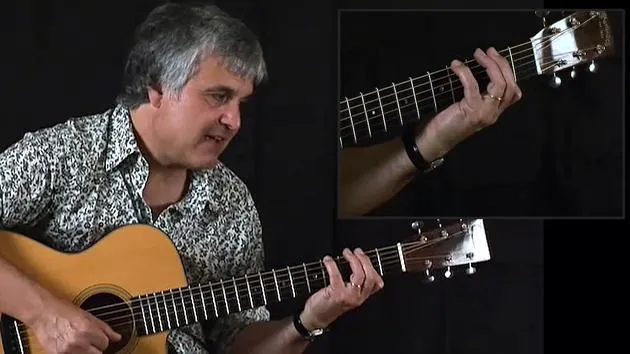
04. Greensleeves (Lektion)
8:36
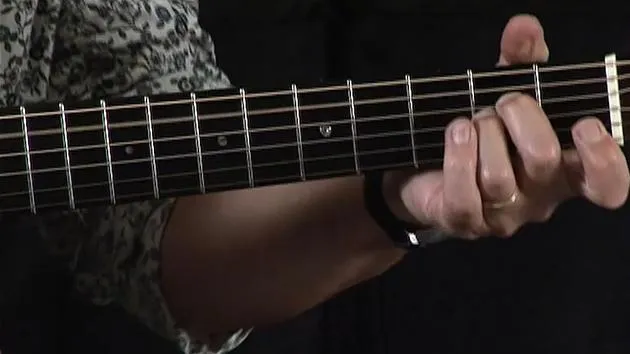
05. Greensleeves (Aufführung)
1:12
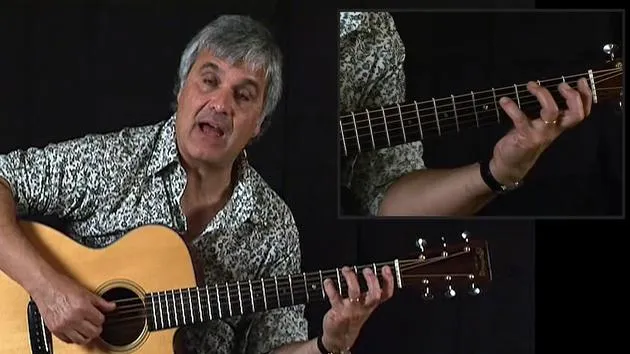
06. Shebeg & Shemore (Lektion)
6:53
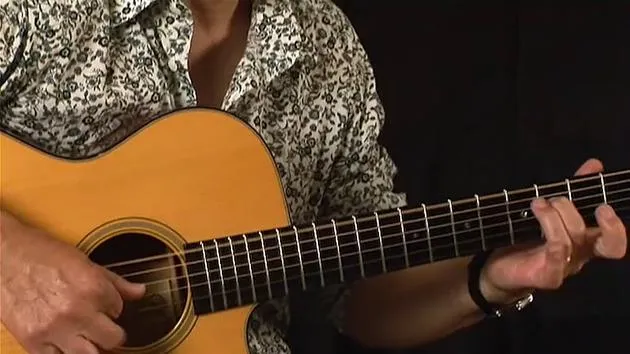
07. Shebeg & Shemore (Aufführung)
1:54
08. Wayfaring Stranger (Lektion)
7:35
09. Wayfaring Stranger (Performance)
2:36
10. Shenandoah (Lektion)
5:34
11. Shenandoah (Performance)
1:55
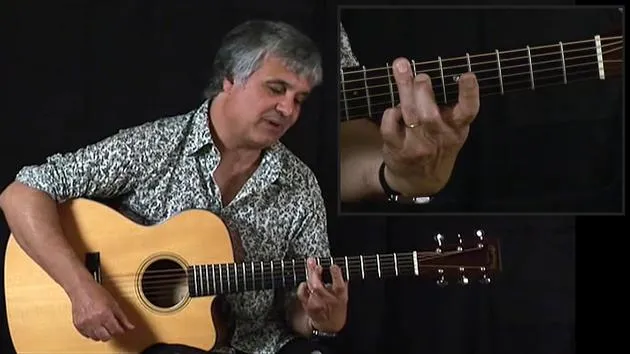
12. When The Saints Go Marching In (Lektion)
3:47
13. When The Saints Go Marching In (Performance)
0:43
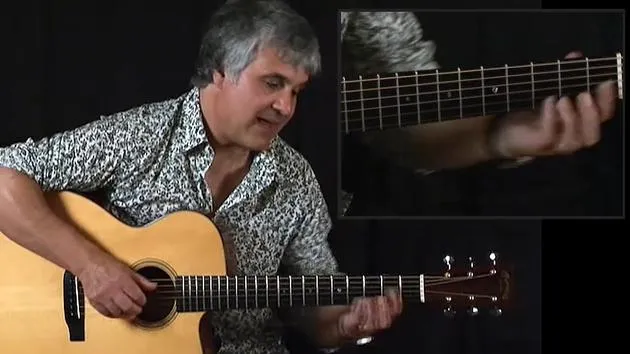
14. Take Me Out To The Ballgame (Lektion)
4:14
15. Take Me Out To The Ballgame (Aufführung)
1:26
16. Ein paar Anmerkungen zur Tonart d-Moll und Verabschiedung
1:40
Transkript der Lektion
DADGAD Tuning Music Lesson
Strangely enough, for a DADGAD project, I'm actually starting in standard tuning. I have a reason for doing that.
Getting Started
- Bottom E in Standard Tuning:
- Tune it down a whole step.
- This gives you a D1, which is the equivalent of 2 frets up from the E.
Now, I go up 2 frets, and I'm back to an E.
Tune and Compare
What I'd like you to do is:
- Tune that string down.
- Compare the notes on that string with those on the fourth string, which is very familiar territory.
Here's your fourth string. Play that same pattern on the bottom string, and you can hear it's just one octave lower, same fingering, one octave lower.
So, nothing unfamiliar about that; it's familiar territory.
Tuning the Top String
Now, we're going to take the top string (the E) and tune that down to a D also. You'll notice the fingering is the same:
- 3 D strings in DADGAD tuning.
- Then, we take the second string (B string) and tune that down a whole step.
Now, the tuning of that is the same as the fifth string.
This means:
- Anything I finger on the second string is the same but an octave lower on the fifth string.
So now we have:
- 3 D strings (D, D, D)
- 2 A strings
- The G (third string) hasn't changed.
In many respects, the individual string fingerings in DADGAD are already familiar territory.
- Anything on the top string or the bottom string is fingered the same as you would normally do on the fourth string (since those are all Ds).
- On the second string, everything is the same as on the fifth string in standard tuning (both A strings).
- The G string hasn't changed.
Experimenting with DADGAD
To get a little familiar with the sound of DADGAD, why don't we just pick across the strings?
You'll notice that, if you treat this as an open chord, this is a D sus chord:
- You have a D (the root)
- You have the ingredients of a D triad, but instead of having an F sharp as a major third, you have the fourth, which is the sus four.
So just to strum the open strings gives you a sus4 chord.
Playing Up the Neck
If you bar up the neck, for example, at the 5th fret:
- Now you have a G sus 4 at the 7th fret.
- An A sus 4 at the 12th fret (with the harmonics).
This openness of the tuning creates a suspended feel to it.
Understanding Adjacent Scale Tones
There is a very, very useful and musical thing that happens:
- You have a G and an A as adjacent scale tones.
- They are both open strings.
Here's my G, here's my A. This quality becomes very useful.
Let's say, for example, we're going to construct a scale of D. You'll notice that you have two of those scale tones that are on open strings:
- D
- E
- F sharp
- G
- A
Now, if I add an E to that, I have four adjacent scale tones, and then I let me say, play the open fourth string as the D.
So it goes:
- D, E, F sharp, G, A.
If I continue going up the scale, I added a B, a C sharp, and a D.
Conclusion
This progression gives us a very characteristic sound in DADGAD tuning.
This kind of cascading, cross-fingered pattern is very typical of how you can use the tuning to gain extra sustain in the melodic passages that you might play.
16 Lektionen
1 Std. 6 Min. strukturierte Videolektionen
Erweiterte Videofunktionen
Verlangsamen, Passagen loopen, mitlesen
Handy, Tablet & Desktop
Üben, wo du willst
100 % Zufriedenheitsgarantie
30 Tage Geld-zurück-Garantie
Lern deinen Guru kennen
Lern deinen Guru kennen
Laurence Juber wurde zunächst als Leadgitarrist in Paul McCartneys Band Wings bekannt. Seither hat er sich eine Karriere als Fingerstyle-Gitarrist, Komponist und Arrangeur aufgebaut und arbeitet vorwiegend in der DADGAD-Stimmung, die ihm den Beinamen 'the Duke of DADGAD' einbrachte.
Von den Lesern des Fingerstyle Guitar Magazine wurde er zum Gitarristen des Jahres gewählt und vom Magazin Acoustic Guitar zu den besten Gitarristen gezählt – dazu kommen eine lange Liste von Soloalben und Welttourneen.
In seinen Kursen vermittelt er seine Fingerstyle-Technik und die DADGAD-Stimmung, für die er bekannt ist, wie man Melodie, Harmonie und Bass für die Solo-Gitarre zusammenführt, und die Stücke – wie sein charakteristisches 'Wooden Horses' –, die all das vereinen.







