



2. Aufwärmen
Mit
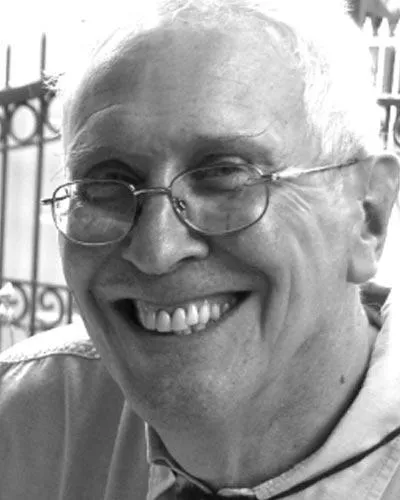
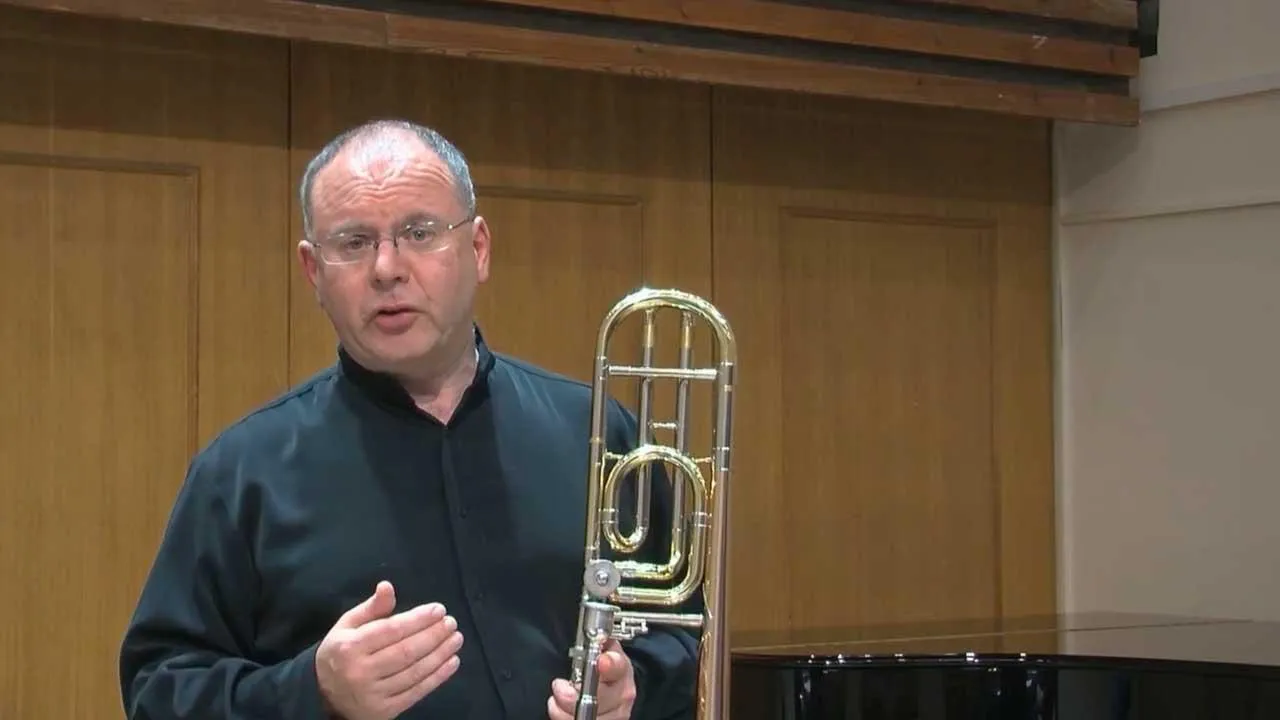
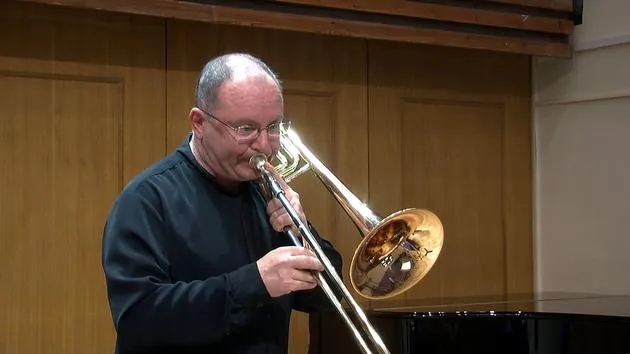
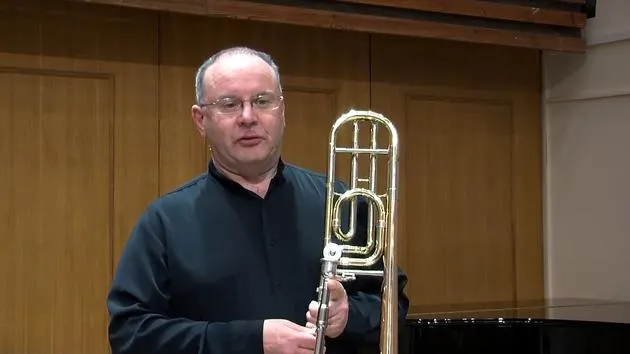
Peter GanePeter und Chris sprechen darüber, wie du Bauchmuskeln und Zungentechnik richtig kombinierst, um Töne mit einer gleichmäßigen Klangqualität zu erzeugen.
Das steckt im Kurs
10 Lektionen (1h 33m) · 1 gratis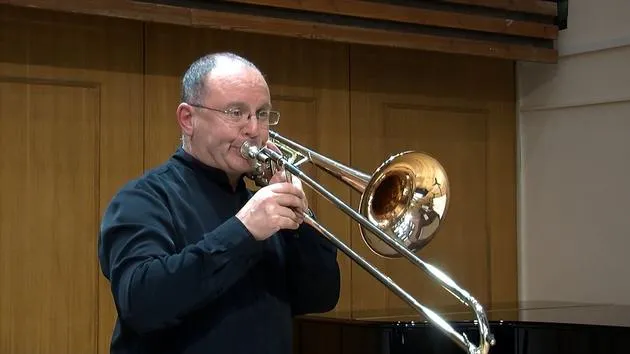
Transkript der Lektion
Circuit Training Unit 2: Warming Up the Motor
Introduction
Hello and welcome to Circuit Training Unit 2. Today, we will focus on warming up the motor.
Key Principles
When playing separate notes, we really concentrate on getting the abdominal muscles working well so each note has weight and identity.
Demonstration
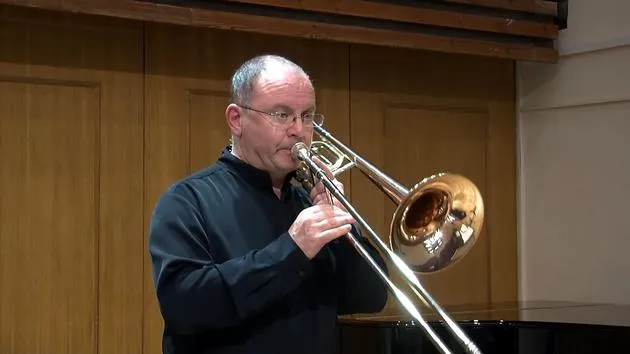
Chris, could you demonstrate the following?
- Figure One: Just with tummy pushes, no tongue.
- Figure Two: Half without tongue and the rest with tongue.
The tummy pushes create the body of the note.
- Notice how I'm pushing out, rather like sighing, and not sucking in.
- I'm also being careful not to use my embouchure and tongue to create a purring effect.
- Additionally, I'm trying to keep the corners of my embouchure set with no air pockets.
Useful Exercises
Another useful exercise is to practice panting like a dog:
- For low register notes: A slow pant like a big dog.
- For middle register notes: A slightly faster pant like a medium-sized dog.
- For high register notes: A faster pant like a little dog.
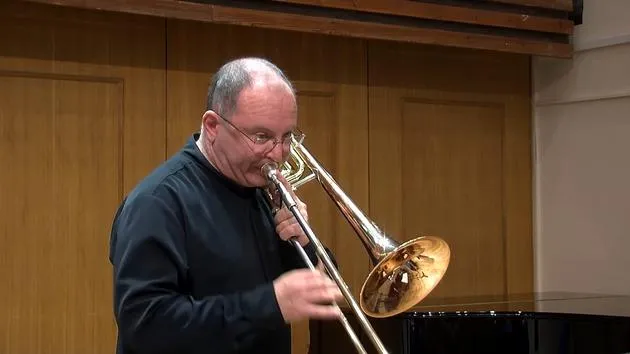
Now, I will play figure two:
- First half without tongue, second half with tongue.
Having a free and well-supported low register is a fundamental building block.
Support Techniques
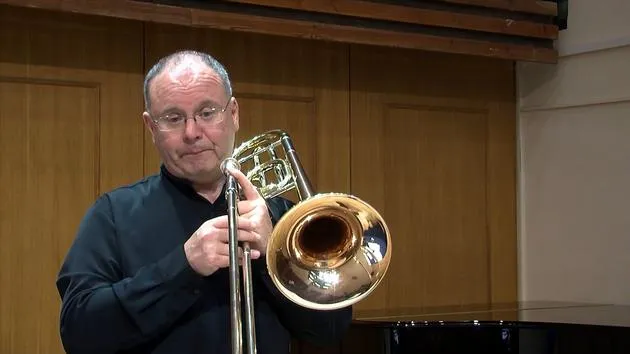
Chris, could you demonstrate how you support loads in the low register?
To acquire the tone in the low register, I'm using body resonance, that is, opening the throat like an actor or a singer, and not over-opening the aperture.
- If I over-open my aperture, the note dips down below the pitch, making it very hard to focus.
To find out for yourself just where the embouchure should be, try a basic glissando from Bb to F:
- Here, I coordinated the lowering of the jaw, the opening of the aperture, relaxing the lips a little bit forward, and allowing my body resonance to produce the note without over-opening to maintain focus.
Cheek puffing can also add limited benefit to your low register.
However, be cautious:
- There is a serious side effect: your embouchure virtually completely collapses, so try to avoid this one.
Chris, moving forward, your Bb to F glissando.
A good way to encourage the low notes and develop the low register is to practice playing the false harmonics.
- Chris, could you show us how you approach figure 2, the moving on section?
Yep. As I referred before, I'm:
- Coordinating the lowering of the jaw, moving the lips slightly forward, and pushing the instrument very slightly away from me.
That's excellent.
Having a full and well-supported lower distance also acts as a springboard for the high register.
- Chris, could you expand on this by playing maybe, say, exercise seven?
Tone Quality
Before I do, I want to emphasize the importance of getting a good tone throughout the register.
- Try to avoid pinching with the embouchure and throat.
To help this, you can do a little buzzing exercise to highlight the importance of the abdominal support:
- Try resting the mouthpiece on the top lip and half buzz, half play up two octaves.
This simulates the abdominal support I'm going to use in this next exercise in Unit 2.
Summary
In Warming Up the Motor, we have covered:
- Tummy pushes, both with and without tongue.
- Morning yawns exercises, including supporting low register notes.
- False harmonics and expanding your range to consolidate.
Play the complete unit once again.
And don't forget, all we have talked about can be found in Circuit Training, Volume 2.
10 Lektionen
1 Std. 33 Min. strukturierte Videolektionen
Erweiterte Videofunktionen
Verlangsamen, Passagen loopen, mitlesen
Handy, Tablet & Desktop
Üben, wo du willst
100 % Zufriedenheitsgarantie
30 Tage Geld-zurück-Garantie
Lern deinen Guru kennen
Lern deinen Guru kennen
Peter Gane ist einer der führenden Blechbläser-Spezialisten und Posaunisten Großbritanniens. Mit 19 Jahren wurde er Mitglied des London Symphony Orchestra. 1971 wurde er Professor an der Guildhall School und ist es bis heute. 1981 wurde er zum Fellow der Guildhall School gewählt und war von 1988 bis 2008 Leiter der Abteilung Holz, Blech und Schlagwerk. Er ist künstlerischer Berater des Combret Music Festival in Aveyron, Frankreich.
Als Gründer und ehemaliger Präsident der British Trombone Association ist Peter ein renommierter Pädagoge. Er ist seit Langem mit dem National Youth Orchestra of Great Britain und dem European Union Youth Orchestra verbunden, wo er seit 1977 bzw. 1984 Professor für Posaune ist.
Als Lehrer, Blechbläser-Spezialist und Dirigent hat er Meisterkurse und Workshops an zahlreichen europäischen Konservatorien und mit professionellen Ensembles in Deutschland, Frankreich, Dänemark, Schweden, Norwegen, Spanien, den Niederlanden, Österreich, Italien und den USA gegeben. 1996 wurde sein internationaler Ruf durch die Verleihung des Neill Humfeld Award für herausragenden Posaunenunterricht durch die International Trombone Association bestätigt.
Zu Peters Veröffentlichungen zählen: The Good Brass Guide, Trombone Books 1 & 2, erschienen bei Trinity Guildhall; Circuit Training for Trombone, volumes 1 and 2, Slide Systems, Five Games, Guildhall 125, World in Motion, Mansion House Fanfare, alle erschienen bei Warwick Music; How Trombonists Do It, erschienen bei Brass Wind; und Brass Medals, erschienen bei der Associated Board.
Genau diesen Circuit-Training-Ansatz teilt Peter hier mit dir: gezielte, wiederholbare Übungen, die die Zugpräzision, Atemkontrolle, Flexibilität und den Ton aufbauen, die du brauchst, um die Posaune wirklich zu beherrschen - ganz gleich, auf welchem Niveau du bist.







