



10. Ensemble-Fähigkeiten
Lesson time: (20min 45sec)
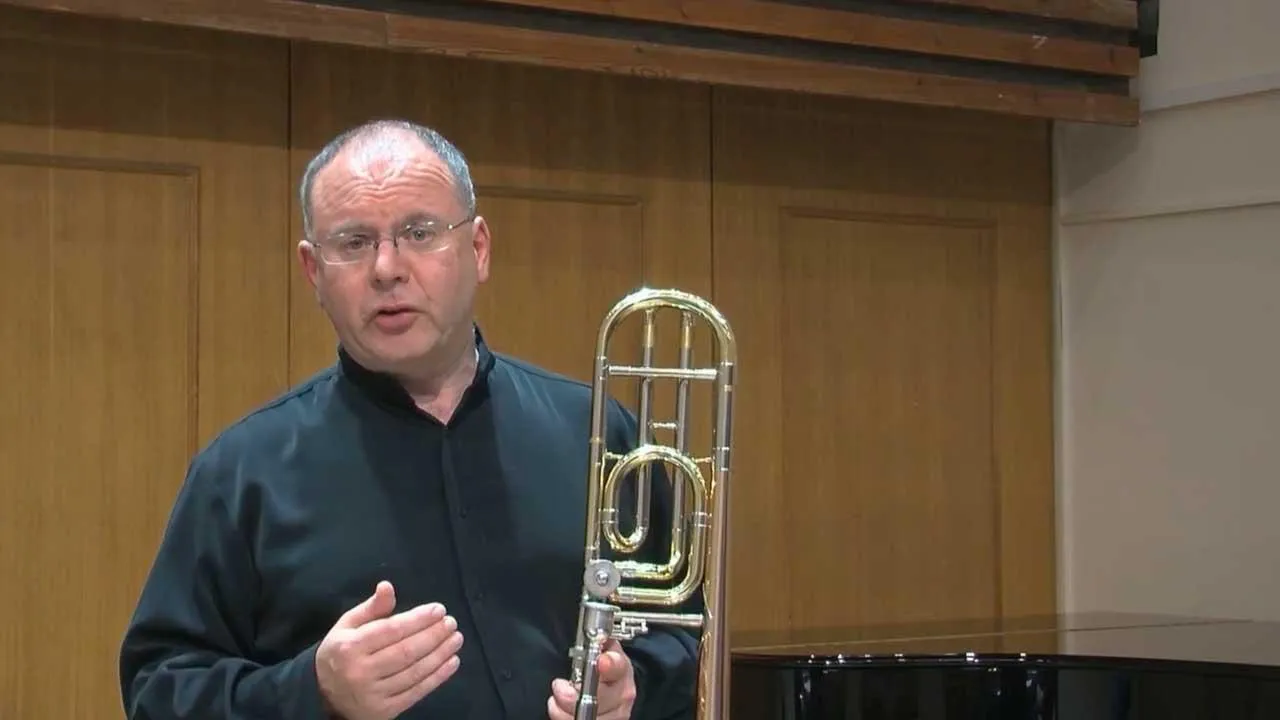
Chris schließt sich einem Posaunenquartett an, um über das Zusammenspiel im Ensemble zu sprechen, wie du das Beste aus dir und anderen im Ensemble herausholst und wie man als Gruppe übt
Course preview
This lesson is part of the course Zirkeltraining für Posaune
Watch a preview of the full course below.
Lesson transcript:
Unit 10: Ensemble Skills
Hello and welcome to Unit 10, Ensemble Skills, the last unit of this circuit training DVD. Chris, with the help of three students from the Guildhall, is going to explore some fundamental ensemble playing skills.
Starting Together
Chris, let's get the ball rolling by demonstrating starting together. One of the biggest problems for any chamber group or section in an orchestra is starting together. In the absence of a conductor, one of the group must take responsibility for leading.
- We have our eyes, we have our ears, and we have something also very special between us: our radar.
Now, it's not always going to be possible to give a lead that is visually very obvious. You may also not be able to use your ears too much to get this lead. So you've got to use this kind of special radar that we have, which, I think, that time you did quite well on it.
So, shall we try the opening again? I want you to just be incredibly aware of my intake of breath so that you're getting to know me as I'm getting to know you.
When you hear my breath, just take full responsibility and play. If you're a bit early, you're a bit early, but it's much more likely you're going to be late. So have the confidence to just place it straight there.
Let's give that a try.
Good. Okay. I think that one was much better. Did you feel more comfortable with that?
Yes.
The Importance of Chamber Music
The great thing about chamber music is that it's the ultimate group collaboration, combining solo playing with ensemble skills. Here, you need to have your own personality to a certain extent. In an orchestra, this has to be controlled. But in a chamber group, you're here in your own right, so feel the confidence to play.
We couldn't do this without all four of us. A trombone quartet is not complete with three, is it? So you've got to have the confidence to really go for that. Well done.
Phrasing and Breath Control
The next thing is, in a popular melody like this, the phrasing in the melodic line is quite regular. However, with only four of us, the accompaniment needs to be as sustained as possible. So we're going to try and organize the breathing from the three accompanying parts, not to breathe at the same time as I am.
- Johnny, do you think you could get through the first three bars before breathing, so that you play into the triplet on the fourth beat of the second bar? Just float it. Should we try that?
Let's play the first four bars again.
Good. Okay. You know what we talked about earlier, to me, it feels as if your chops are a little bit too stretched. You're trying too hard. Just imagine:
Do you ever remember that game called blow football? It's like a straw and a ping pong ball. Did you ever play the recorder? I think so, yeah. I mean, you know how little air you actually need. Just keep it nice and flowing. Let's try that. Good. Well done.
Did we also feel that was much more comfortable?
Definitely. It's incredible when there's only four of you. When there's anything going wrong or something going very right, it makes a point. Big difference for us. That's terrific, Johnny. Well done.
Musical Judgment and Style
In popular music and quartet music, quite often there is little in the way of slurs or phrase marks. In this piece, we've got some guidance, but you need to use your musical judgment regarding the nature of the piece.
This is why we need to have a good background in music. When you first heard music, it did something to your emotions. All you have to do is listen to your emotions when you hear the chord change and see how it makes you feel inside.
Now, let's look what we've got here.
A very simple melody using a sequence: de da da da da da da de da da da da da.
It's very simple, isn't it? But did you feel that when the sequence was repeated in the third bar, it had a slightly different color?
I even moved it on a little bit. Let's give that a try. Good. Well done.
Now we can see how we're using our natural skills of human interaction and radar to create something that is technically and musically pleasing to listen to.
Understanding Balance
Now, it's very rare in a group that you get four exactly equal players. This is probably not terribly desirable anyway. We have four distinct characters performing slightly different roles within the quartet.
- I'm playing the melody, giving me the advantage since I'm playing the higher frequencies, making my line easier to hear.
- Johnny, you're often playing a little duet line, like a counter melody under me, supporting very nicely.
- Jane, you have a crucial role, filling the gap between the duet on top and the bass line on the bottom.
Quite often quartets go wrong because the third player is a little afraid to play. You're playing in a register that takes a lot of air, increasing the chances of a weaker third player. However, you're quite experienced, and I think you're doing wonderfully but could do even more.
Josef, your role is perhaps the most important of all. You are the rock of stability under the group; your part determines the flow.
Using the intensity of your tone through each note can indicate to us when you're going to change. Did you feel that I was supporting right to the end? This is the signal for us that you're supporting the group from the bottom.
So let's see if we can play it now with some really good balance.
Dynamics and Phrasing
Now, a very important thing we talked about is phrasing. In an orchestra, especially a brass section, doing crescendos and diminuendos together is crucial.
- Check where those dynamics are.
- Ensure you're playing the piano.
- Be sensible at the end; remember that pianissimo is not just quiet; it's a color.
If you think you need to play quietly, you'll do that. But if you think of it as a very pale color, you'll play with that color and still maintain support.
That's the hard part, playing quietly while supporting. Your airspeed has to be electric, even when playing quietly. Let's watch that at the end.
Final Performance Preparation
We are almost ready for our little performance. The last thing we need to focus on is moving together. We talked about this earlier regarding the movement of the sequences and tension in the harmonies.
Now, let's see if we can feel exactly when to move together. Shall we?
We'll now try a staple in any trombone quartet training: a Bach chorale. We'll use all the ensemble techniques we've already learned and develop them further.
Interpretation and Phrase Management
One of the biggest aspects of a Bach chorale is that each line is very independent in its own right, and often the bass line is a better melody than the top line.
- Josef, interpret this as if you are a bass singer in the low register, giving us flow and enjoyment, especially in the passing notes.
- Johnny, your part is similarly important; play it as you would sing it.
Remember:
If you breathe mid-phrase, do so quickly and efficiently. If you take too big a breath, you create a big hole in the texture, which we can't afford with four of us.
Maintaining balance is crucial, as any Bach chorale is difficult to sustain. With fermatas in the piece, ensure you have enough air to sustain them right through.
Maintaining Rhythm
Finally, one of the challenges of playing without a conductor is staying in time and not slowing down. Observe the hierarchy of the beats.
Keep it moving!
Now, let's interpret this Bach chorale with the words included.
The way we interpret it, the dynamics we use, and the little stresses will add significant contrasts. Shall we give it a go?
About the instructor
Peter Gane ist einer der führenden Blechbläser-Spezialisten und Posaunisten Großbritanniens. Mit 19 Jahren wurde er Mitglied des London Symphony Orchestra. 1971 wurde er Professor an der Guildhall School und ist es bis heute. 1981 wurde er zum Fellow der Guildhall School gewählt und war von 1988 bis 2008 Leiter der Abteilung Holz, Blech und Schlagwerk. Er ist künstlerischer Berater des Combret Music Festival in Aveyron, Frankreich. Als Gründer und ehemaliger Präsident der British Trombone Association ist Peter ein renommierter Pädagoge. Er ist seit Langem mit dem National Youth Orchestra of Great Britain und dem European Union Youth Orchestra verbunden, wo er seit 1977 bzw. 1984 Professor für Posaune ist. Als Lehrer, Blechbläser-Spezialist und Dirigent hat er Meisterkurse und Workshops an zahlreichen europäischen Konservatorien und mit professionellen Ensembles in Deutschland, Frankreich, Dänemark, Schweden, Norwegen, Spanien, den Niederlanden, Österreich, Italien und den USA gegeben. 1996 wurde sein internationaler Ruf durch die Verleihung des Neill Humfeld Award für herausragenden Posaunenunterricht durch die International Trombone Association bestätigt. Zu Peters Veröffentlichungen zählen: The Good Brass Guide, Trombone Books 1 & 2, erschienen bei Trinity Guildhall; Circuit Training for Trombone, volumes 1 and 2, Slide Systems, Five Games, Guildhall 125, World in Motion, Mansion House Fanfare, alle erschienen bei Warwick Music; How Trombonists Do It, erschienen bei Brass Wind; und Brass Medals, erschienen bei der Associated Board. Genau diesen Circuit-Training-Ansatz teilt Peter hier mit dir: gezielte, wiederholbare Übungen, die die Zugpräzision, Atemkontrolle, Flexibilität und den Ton aufbauen, die du brauchst, um die Posaune wirklich zu beherrschen - ganz gleich, auf welchem Niveau du bist. read more