



Honky Tonk: Banks of The Ohio - Intro und Outro
Lesson time: (4min 3sec)
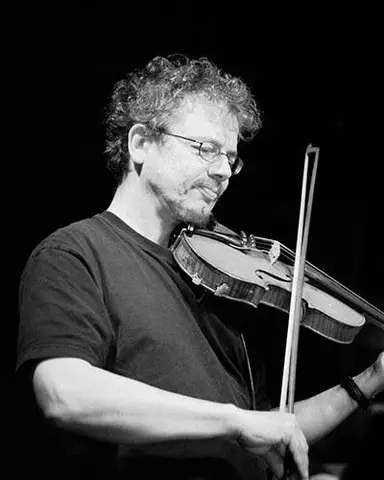
Chris Haigh baut das kurze viertaktige Intro und Outro für das Honky-Tonk-Stück Banks of the Ohio auf und nutzt Staccato-Ansätze, harte Chops und Bordunklänge unter der Melodie.
Course preview
This lesson is part of the course Bluegrass- und Modern-Country-Fiddle
Watch a preview of the full course below.
Lesson transcript:
Music Lesson: Intros and Outros
In this lesson, we're going to look at the intro and the outro, both of which are simple, but neither of which is absolutely obvious.
The Intro
-
Length: The intros are normally very short, often just four bars, typically the last four bars of the verse or chorus.
-
Creating the Intro:
-
In this case, we're going to have the following:
-
We can add a staccato attack, similar to what we had for the bluegrass kickoff.
-
Play C over an E down at the heel, and chop hard, using a drone for the D underneath the B.
-
-
Timing:
- This is "third of a second", four over three, three over two.
- So that's 1, 2, 3.
-
Alternate Option:
- If you find that four over three is a bit too hard, an equally valid intro is A over D, which works perfectly and is slightly more interesting.
-
Advanced Technique:
- The hardest technique is to play the harmony not below, but a third above. This involves going into third position: first over third, down to first two over four.
- This is what the pedal steel would typically play.
The Role of Pedal Steel
- Pedal Steel Harmony: The pedal steel almost always plays the harmony above.
- Collaboration:
- One feature of honky tonk music is that the fiddle almost always shares the intros, melody, backing, and solos with the pedal steel.
- If you're lucky enough to play with a pedal steel player, coordinate who will do what, avoid both playing very much at the same time.
- Normally, either the pedal steel or the fiddle will play the intro, backing, or solo. This can be done by looking at one another or arranging it in advance.
Importance of the Intro and Outro
-
Other musicians in the band will greatly appreciate it if you're able and willing to come up with your own intro. In freelance situations, where not everyone in the band knows what's going on, take the initiative.
-
If you say, "I'll do the intro," and execute it in a way that's obvious to everyone, they'll value your contribution and be more likely to book you again. This is in contrast to another fiddle player who looks around, asking what's going to happen next.
The Outro
- Length: The outro is often only two bars long.
- Typical Structure:
- As in a bluegrass outro, it will often start high, end low, and feature a flattened third on the way down.
Assignment
- Let's try the whole thing through with an intro and an outro.
- For your assignment, listen to the following tracks:
- "Why Don't You Love Me"
- "Wedding Bells"
- "Howling at the Moon"
- "I Saw the Light"
- "Rooty Tootie"
- "Jambalaya"
- "Move It On Over"
Observe what happens in the intros of these songs. When you've done that, you'll have a pretty good idea of what you're aiming to achieve.
About the instructor
Chris Haigh ist seit 25 Jahren professioneller Fiddle-Spieler mit Erfahrung in vielen verschiedenen Genres. Er hat auf über 75 Alben gespielt und dabei mit Künstlern wie Alison Moyet, Bob Geldof, All About Eve, Michael Ball, David Soul, Oumou Sangare, The Quireboys, Riverdance, Morcheeba, James Galway und Steps zusammengearbeitet. Er hat Swing-Jazz mit The Kimbara Brothers, Diz Disley, Le Jazz, The Hot Club of London und den Quecumbar Allstars gespielt und leitet die siebenköpfige sowjetische Swing-Band The Kremlinaires. Chris gibt Unterricht und Workshops zur Jazzgeigen-Technik und hat Jazzgeige an den Universitäten Middlesex, Brunel und Newcastle sowie am Truro College unterrichtet. Zu seinen Veröffentlichungen zählen neun Fiddle-Bücher, darunter The Fiddle Handbook. Außerdem betreibt er Fiddling Around (fiddlingaround.co.uk), vermutlich die umfassendste und meistbesuchte Quelle für Fiddle-Wissen im Netz. read more