



Handhaltung
Lesson time: (3min 12sec)
Course preview
This lesson is part of the course Banjo für Anfänger mit Avram Siegel
Watch a preview of the full course below.
Lesson transcript:
Right Hand Positioning for Banjo Playing
The first thing we'll talk about is just how to hold your right hand.
- It should sit about like this:
- Not too far down
- Not dropped too far
- Not reaching up too high
People usually get in trouble by setting their hands so they can see their picks. This goes for both hands.
"Your hand should have just about an angle like this to it."
I think of having the strings in my hands, and your hand should have a nice round shape to it.
- Then just bring it around and open it up.
- The best way to place your hand is to have these two fingers resting on the head.
All the legends of the five-string banjo play that way, and it seems to work the best.
Common Hand Position Issues
What happens with most people is:
- As soon as they open their hand up and start placing their fingers on the strings, the first thing that happens is:
- Their thumb jumps up
- Their hand flattens out
At first, you just need to do what you can to play the strings. Hit the right string.
But later, you want to try and get your hand into this round shape.
"It's not something that you'll be able to do right off the bat, but it's something to keep in mind."
So, that's a little bit about the right hand. Place it pretty close to the bridge, not too far up here for just basic playing.
Sometimes you might want to play up here to get certain effects and nice sounds up the neck.
Bridge Positioning Tips
By and large, we want our hand down by the bridge, but don't grab onto the bridge. That's something to watch out for.
Practicing Single Notes
Let's just try playing some single notes with our thumb.
- The thumb will be playing on:
- The fifth string
- The fourth string
- The third string (the index)
- Even on the second string, the thumb can play anything.
That's basically the deal.
The index will be playing mostly on the second string and the third string.
- The fingers strike the strings in an upward motion.
- The thumb strikes the strings in a downward motion.
This is all pretty rudimentary for people who have already played some on the banjo, as is a lot of things we'll be talking about here.
But it's good to think about it anyway, and you might find some new information.
Left Hand Positioning
With the left hand, you're going to place your fingers just behind the fret, really close to the fret without placing your fingers at all.
- You get the open strings, but by placing your fingers, you get an extra note.
That's basically how a stringed instrument works in general.
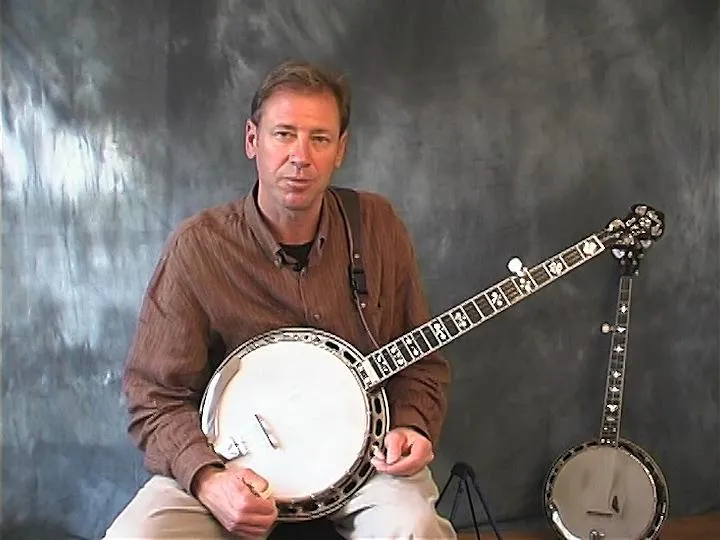
About the instructor
Avram Siegel ist Banjospieler und eine feste Größe der kalifornischen Bluegrass-Szene. Er hat unter anderem mit der Kathy Kallick Band und True Blue gespielt und unterrichtet seit Jahrzehnten - seine Schritt-für-Schritt-Methode hat einige der angesehensten jungen Spieler des Bundesstaates hervorgebracht. In seinen Kursen zerlegt er dreifingrige Scruggs-Rolls, Backup und melodisches Spiel, damit du in deinem eigenen Tempo ein sauberes Timing und einen sauberen Ton aufbauen kannst. read more