



András Schiffs Analyse von Nr. 1 Moderato
Das steckt im Kurs
4 Lektionen (0h 57m) · 1 gratis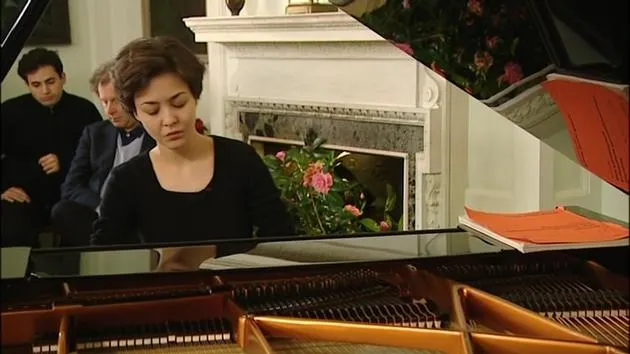
Transkript der Lektion
Musical Moments with Franz Schubert
Now we have here Maumam Musico, a musical moment of Franz Schubert. Wonderful music!
Intimacy in Schubert's Music
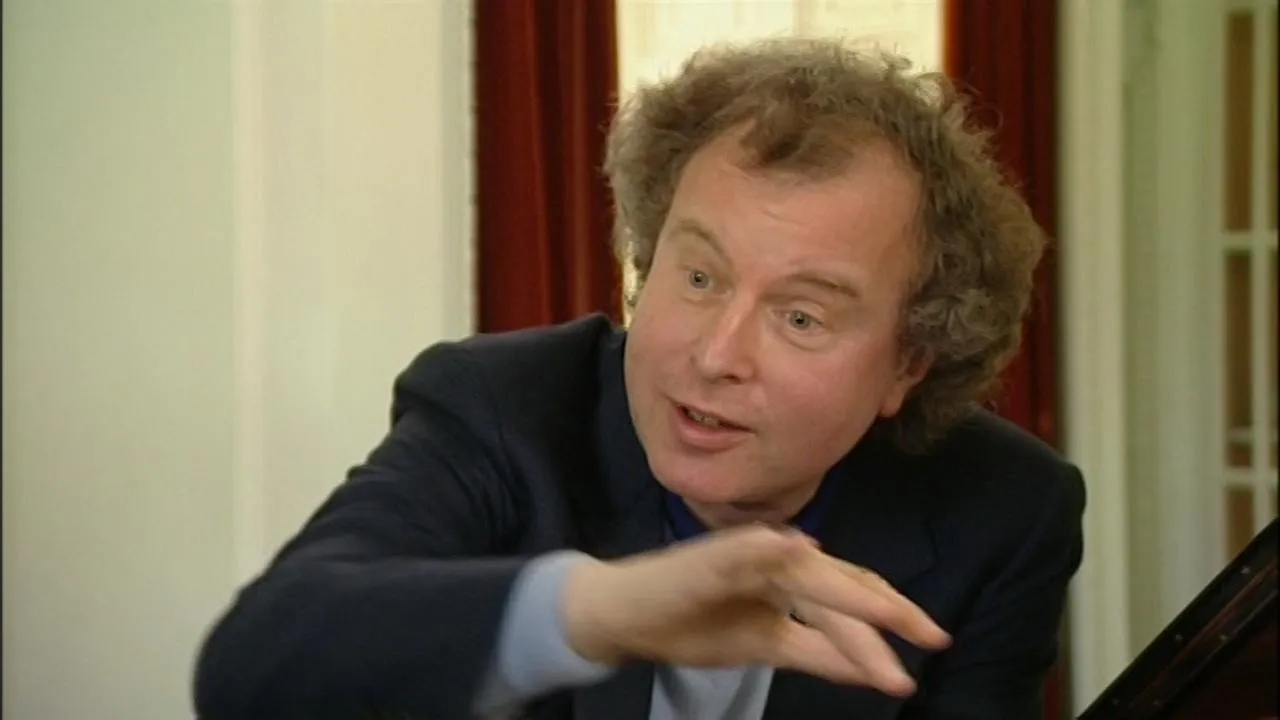
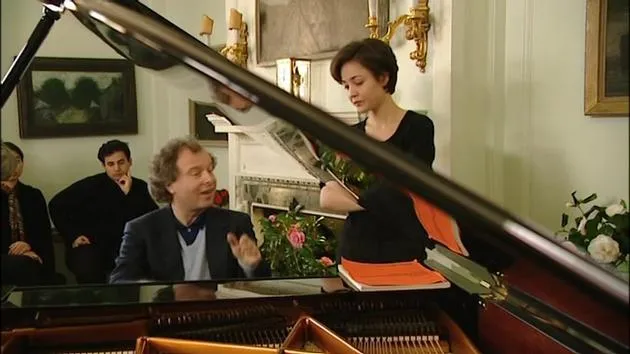
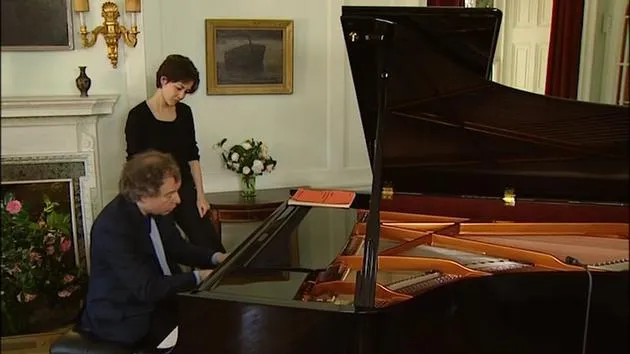
What does this title suggest? It could be called anything, but to me, it suggests intimacy. And we are in a wonderful room here.
- You don't have to play as you would in the Royal Festival Hall.
- You must scale your playing to the room, the acoustics, and the surroundings.
Of course, if you play Maumam Musico in the Royal Festival Hall, it's not a very good idea, mind you. But then you will play it differently.
To me, Schubert's music is the most touching and intimate. It's capable of great dramatic outbursts. But what makes Schubert's music unique is the soft music, how many colors you have from piano downwards:
- Pianissimo
- Triple pianissimo
- Quadruple pianissimo
- Thousands of colors
And you are not using that. It's much too loud for the room and for the music.
The Nature of the Music
Let me show you: while we are playing in a room, the music is about nature.
- We have a horn call.
- I always see pictures of nature in front of me: forests and a horn call in the forest.
These days in Britain, we talk a lot about fox hunting. I am not a fan of fox hunting myself, but in Schubert's days, there was a lot of hunting.
This Jagdorn, we know Schubert's wonderful song cycle Die schTripletne M?llerin, and it's full of these images. To me, this cycle Maumam Musico is very close to the SchTripletne M?llerin.
Schubert is the greatest song composer of all time, and these are songs without words.
Technique and Expression
So please hear accents, but small accents. You must voice your chords. The piano is a polyphonic instrument, so when you play six notes together, you shouldn't play all of them with equal strength.
Here's a cooking analogy:
- If you put a little more salt, a little more pepper, a little more nutmeg, you just taste it.
Alright, let's try from the beginning.
"Please play for me this horn call: Yum Ba Ba. Once more. That's right. Now, from the beginning."
Be careful! We have the triplets. Don't play rubato here, because Schubert composed triplets and duplets.
- 1, 2, 3, 14 , You always change.
I would be much stricter with the tempo. Romantic music is full of emotions, but it doesn't mean it's without tempo.
Balance and Tone
Let's go on. The tone quality is not beautiful. Even if you play forte, not hard, please.
In the forest, you have different birds:
- What's that ugly black bird? A crow.
- And then there are very nice birds.
Play the grace notes gracefully. There is great domestic warmth in this to me.
The SchTripletne M?llerin is in springtime and in summer; then you have Winterreise, the winter journey.
- That one has ice and snow, but this is in springtime. It's all green and flowers.
Adjusting Dynamics
Now the second half, please. Why is this hard?
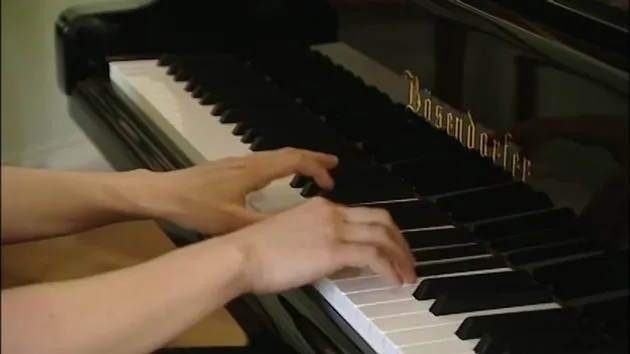
You see, it's because the balance is not right. The left hand is too strong. The modern piano has much thicker bass strings than a piano from Schubert's time. So, you have to watch the left hand.
Really?
- Uh huh.
- Look good, but don't stop all the time.
Come on! 1, 2, 3. I don't hear the bird call. Where is the rest?
If you pedal through the rest, it's not good. We lost the tempo.
You have to lead the listener who doesn't have the score in front of them. They must understand rhythmically, metrically, what you are playing, doing all the details.
Major and Minor
Schubert always plays between minor and major. We often think of major as happy and minor as sad, but it's nonsense.
- I feel that with Schubert, the major is the tragic one, so the minor is more...
You have to play rhythmically. And here, this can only...
You have this move, this wonderful flowing triplet. It always means water, you know, a brook flowing.
So do the middle section, please.
- No G major.
Alright. Can this be a gentle brook? It's a very loud one.
Please play. You don't have to whisper, but I think that the palette of colors of a pianist is very important.
Technique and Imagination
Technique is not just about playing fast and loud and accurately, but the colors and the imagination.
You also have to trust your listeners. Of course, we live in a world dominated by disco music and rock music, and many people are hard of hearing.
But we have to trust that there are still people out there who can listen to fine nuances.
- Alright? Yes, beautiful! Now all the way through.
This is very typical of Schubert. The fifth of the chord, it's like a bell calling.
- Here. The simpler, the better.
Now again, all the pieces that you play, every piece by Schubert has a basic rhythm.
Just play me the left hand here. You have to have this.
- Don't move from that. Okay?
Very good. Together.
The Reality of Major and Minor
These are again, two horns, the horn quintet. Minor.
To me, the minor is reality. The major is a wish, a dream. We would all like to be somewhere else, but this is where we are.
Life is not so easy to put up with, not for Schubert. But he had his dreams.
So do this, G Minor please.
But there's breath.
Again, the opening of...
You have to think. If I was the director of Austrian Radio, I would make this the signal. A beautiful signal.
Why have they never thought of this?
Please.
But you see, what's most important is the rest. If you take away your hand, there is no tension.
This frozen time is very important, so the listener remembers this outburst.
Final Touches
Not... and the transfiguration. It's a different world. Very good.
Now, the accented notes are not with pedals.
Alright? Just a little more cozy. Gem?tlich.
You don't have to write a four-hour long opera like Mr. Wagner to achieve something great. You can do it in two minutes. That's Schubert's unique greatness.
4 Lektionen
0 Std. 57 Min. strukturierte Videolektionen
Erweiterte Videofunktionen
Verlangsamen, Passagen loopen, mitlesen
Handy, Tablet & Desktop
Üben, wo du willst
100 % Zufriedenheitsgarantie
30 Tage Geld-zurück-Garantie
Lern deinen Guru kennen
Lern deinen Guru kennen
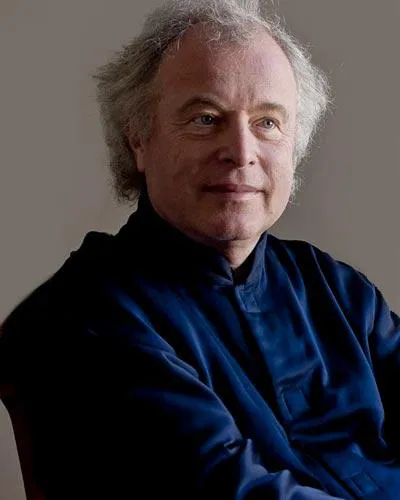
András Schiff ist eines der herausragendsten Mitglieder einer Generation ungarischer Pianisten, die in den Jahren nach dem Zweiten Weltkrieg geboren wurden, neben Künstlern wie Zoltán Kocsis, Dezso Ránki und Jenő Jandó. Aus dieser bemerkenswerten Gruppe hat Schiff das größte internationale Ansehen erlangt, nicht nur wegen seiner Entscheidung, seine Karriere außerhalb Ungarns zu verfolgen, sondern auch dank seines fein abgestuften Anschlags und eines beeindruckenden Gedächtnisses, das es ihm erlaubt, in Konzerten und Aufnahmen große Teile des Œuvres eines Komponisten darzubieten.
Schiff wurde am 21. Dezember 1953 in Budapest geboren und studierte beim ungarischen Komponisten Pal Kadosa und bei Ferenc Rados (die beide auch Kocsis und Ránki unterrichteten) sowie beim englischen Cembalisten George Malcolm. Sein Debüt gab er mit 19 Jahren in Budapest, gefolgt von Konzertauftritten in ganz Europa und den Vereinigten Staaten. Sein Ansehen wuchs mit preisgekrönten Auftritten beim Moskauer Wettbewerb 1974 und beim Leeds Festival 1975.
András Schiff arbeitet mit den meisten großen internationalen Orchestern und Dirigenten, doch die meisten seiner Aufführungen von Klavierkonzerten von Bach, Beethoven und Mozart leitet er selbst. 1999 gründete er sein eigenes Kammerorchester, die Cappella Andrea Barca, mit der er jährlich als Dirigent und Solist arbeitet, ebenso wie mit dem Philharmonia Orchestra und dem Chamber Orchestra of Europe.
Schiffs Stil, in dem sich ein ungewöhnlich sensibler Anschlag mit einem Gespür für kontrapunktische Klarheit verbindet, hat ihn zu einem der bedeutendsten Bach-Interpreten der Gegenwart gemacht. Er hat die gesamte Klaviermusik von Bach eingespielt, ebenso wie die vollständigen Sonaten und Sonatenfragmente von Franz Schubert, dessen introspektive Klaviermusik Schiffs Temperament gut entspricht. 2009 vollendete er bei ECM einen Beethoven-Sonatenzyklus, und 2011 wurde ihm der Schumann-Preis der Stadt Zwickau für seine Interpretation und Förderung der Musik Schumanns verliehen. 2001 begann Schiff, die Werke Bachs erneut zu betrachten und neu einzuspielen. Neben den erwartbaren mitteleuropäischen romantischen Werken nimmt die Musik von Béla Bartók und Leos Janácek einen prominenten Platz in Schiffs Repertoire ein.
In seinen MusicGurus-Kursen zu Schuberts Moments Musicaux Nr. 1, 3 und 4, Bachs Partita Nr. 2 und Beethovens späten Klaviersonaten holt Schiff dich in diese interpretatorische Welt – er teilt, wie er über Stimmführung, Anschlag, kontrapunktische Klarheit und Struktur denkt, damit du diesen Werken am Klavier echte Tiefe und echtes Verständnis verleihen kannst.







