



Exploring 'rolling' chords

With
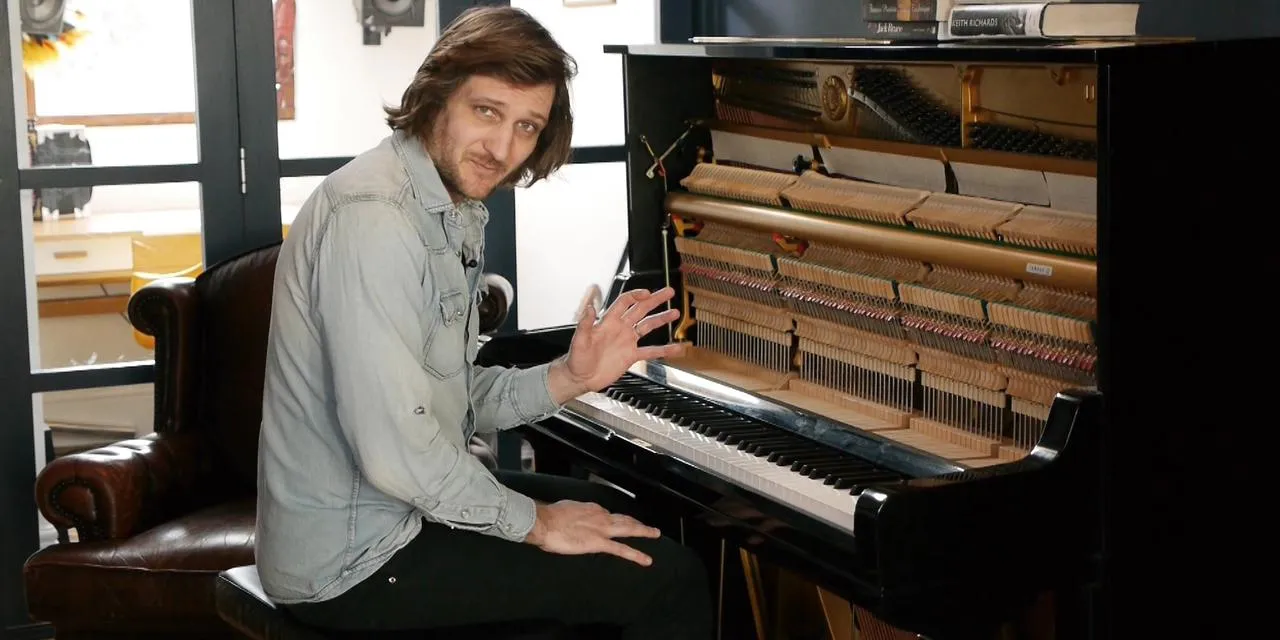
Paddy MilnerPaddy Milner breaks down the rolling-chord technique from his opening tune and shows how to carry it across a 12-bar blues.
What's in the course
14 lessons (2h 17m) · 2 free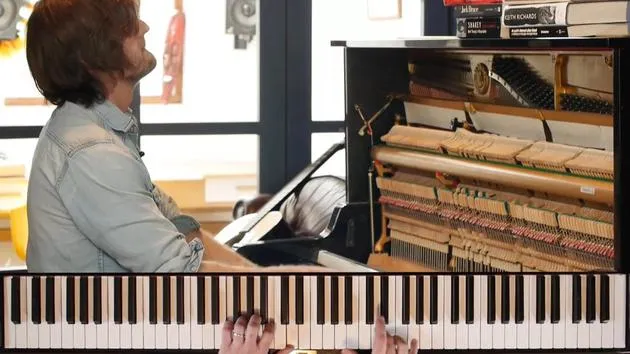
01. Demonstration - let's play some blues
Free lesson3:48
02. Exploring the 'Pinetop Smith' riff
Free lesson15:29
03. Mixing it up with the 'Pinetop Smith' riff
7:59
04. Riffs based on a second inversion chord
20:24
05. Exploring descending 3rds
15:28
06. Ideas for an introduction
9:34
07. The engine room - left hand bass
10:59
08. Ideas for chords V-IV (bars 9-10)
12:00
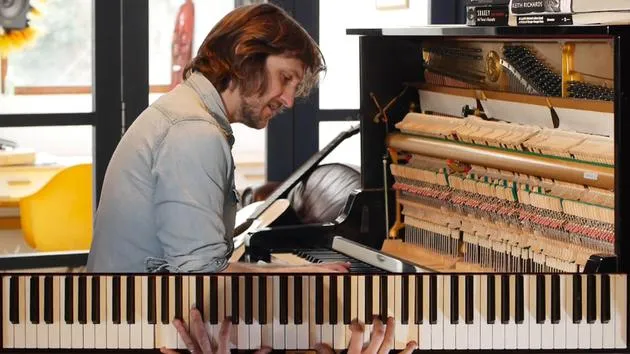
09. Exploring 'rolling' chords
You are here7:24
10. Piano break no.1
8:58
11. Piano break no.2
6:15
12. Exploring endings
10:25
13. Some extra ideas
6:53
14. Everyday I'm Shufflin' - The Blues Shuffle Challenge
1:35
Lesson transcript
Exploring Rolling Techniques in Music
Cool. In this video, we're going to be looking at the rolling technique that I demonstrated in that first tune I played for you. This concept is based on the material I used, and I extended it throughout the entire 12-bar progression.
Refreshing Your Memory
Let me refresh your memory with what I played, which went something like this:
- A three, four and up to the four, etc.
As you play, focus on accelerating the pace of those notes towards the end, moving from:
- Minims down to triplets.
Understanding the Harmony
Now, let's look at the harmony. Here are the chords:
- The G is constant.
- I'm playing the octave at the same time.
- On the first one, I'm hitting the B flat as a passing note.
Dissonance and Context
Here's how it sounds when we focus on it:
- On the third time, we're carrying on.
- It may sound a bit dissonant if you slow it down, but in the context of the 12-bar speed, you won't really notice that dissonance, it adds to the tension.
Going up to the four:
- Actually, I think on the recording, the tune I did went back down to that sixth.
Then the second time went back or...
And this is where I sped up.
- Just moving up and down those harmonies, I think I added a little E flat at one point.
Then we're back onto some other riffs or musical ideas.
Exploring Variations
So there you go! That's one way of exploring this technique.
Alternate Approaches
Of course, there are all sorts of ways you could take that. You don't have to always go up. For example:
- You could do something like this, using different variations.
So it's the same kind of idea, playing the octave.
The Importance of Melody
In a way, the importance lies in the octave and the melody that it creates, depending on the line you choose. You can create all kinds of lines, and this is a great opportunity for you to explore using that technique and hand position to discover your own melodies.
Encouragement to Experiment
Maybe start on the third.
- Go crazy with your ideas!
- Try different things.
Using the Technique
You could do something based on that idea using the octave concept or adding a passing note.
I hope this gives you a few ideas for using that technique.
Practice in Different Keys
Also, try it in different keys, like B flat, for example.
- Playing in different keys is crucial as a musician, especially once you start playing with other people.
Cycle of Fifths
You could even try going around the cycle of fifths. Here's a quick idea (a couple of little fluff notes there, but you get the general idea):
- Try to get as much under your fingers as possible.
Yeah, I think that's enough on that. Let's go and have a look at something else!
14 lessons
2h 17m of structured video lessons
Advanced video features
Slow down, loop a passage, follow along
Mobile, tablet & desktop
Practise wherever you are
100% satisfaction guarantee
30-day money-back guarantee
Meet your guru
Meet your guru
Paddy Milner is recognised as one of the leading blues piano players in the world - he is currently keyboard player of choice for Sir Tom Jones, following several years with the late, great Jack Bruce - but he is also a superb original songwriter and a distinctive singer. Just read the praise from the likes of Dave Brubeck below! His playing was featured on the soundtrack for the hit 2019 film 'Rocketman'.
He has twice won the award for Best Keyboard Player in the British Blues Awards, and he holds a long-standing residency as a founder member of the Ronnie Scott's Blues Explosion at the world-renowned Ronnie Scott's club.
His current group LONDONOLA plays homegrown British music with a strong dose of New Orleans spirit, and his collaborative group JAWBONE goes from strength to strength following the release of their self-titled debut album.
- "I love it... there's a guy who can really play the piano" - Dave Brubeck
- "I highly recommend it. Somehow things start to feel much better!" - Jack Bruce
- "The best blues piano player in Europe..." - Blues Access, USA
- "Impressive & original" - The Times
- "Dazzling" - The Independent
Across his courses, Paddy breaks down authentic blues shuffle, slow blues, boogie-woogie, rock 'n' roll and New Orleans piano - right down to three classic boogie-woogie songs - so you can learn these styles from one of the very best in the business.







