



Superstition – Stevie Wonder (Analysis)
Stu Roberts analyses the drum part for Stevie Wonder's 'Superstition', from the count-in and pickup to its famous syncopated groove, for Rockschool Drums Grade 6.
What's in the course
29 lessons (2h 46m) · 1 free
01. Chameleon - Herbie Hancock
2:55
02. Superstition – Stevie Wonder
3:00
03. Dutch Flowerz – Skream
2:42
04. Ziggy Stardust – David Bowie
2:46
05. Rock The Bells – LL Cool J
3:04
06. I Got You (I Feel Good) – James Brown
2:51
07. Mohair Mountain
3:01
08. Pop It In The Top
Free lesson2:59
09. Mind Sweeper
2:35
10. Favela
2:41
11. Space Future
2:47
12. You Can Call Miguel
2:30
01. Ziggy Stardust – David Bowie (Analysis)
9:38
02. Dutch Flowerz – Skream (Analysis)
10:44
03. Superstition – Stevie Wonder (Analysis)
You are here11:12
04. Chameleon - Herbie Hancock (Analysis)
11:20
05. I Got You (I Feel Good) – James Brown (Analysis)
9:37
06. Rock The Bells – LL Cool J (Analysis)
12:16
07. Mohair Mountain (Analysis)
12:25
08. Pop It In The Top (Analysis)
7:14
09. Mindsweeper
10:40
10. Favela (Analysis)
6:42
11. Space Future (Analysis)
4:50
12. You Can Call Miguel (Analysis)
8:24
Lesson transcript
Lesson on Superstition - Grade 6 Drums
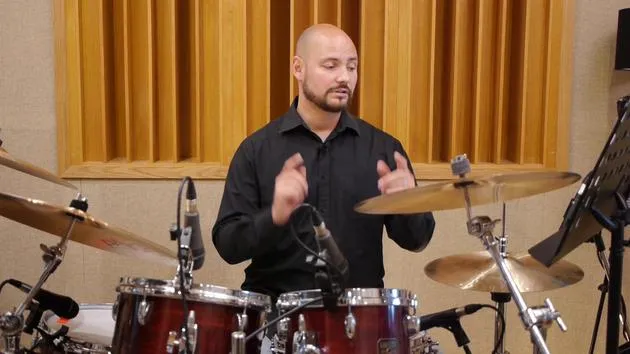
Hi, welcome to our lesson on superstition for Grade 6 drums.
Introduction
The fact is, Grade 6 drums helps us very much with this introduction because we have six beats at the start from the click track before we come in with the pickup.
-
If you look at that first bar, you can see that it's notated as being 4/4, but actually only has two beats in it. That's because it's a pickup.
So at the start, we're going to have:
1, 2, 3, 4, 1, 2, ba, ba, ba, ba.
Important: When you're performing this, if you're doing the Rock School exam, make sure you don't come in after four beats with a click because there's no verbal count.
Getting into the Groove
When we get into the groove, we'll focus on swung 16th notes.
-
Instead of playing one E, a two E and a three and a four, play:
one E and a two E and a three E and a four E.
This gives a swung feeling throughout. It's a little bit loosey goosey, funky, and not overly strict.
- If you listen to the original recording, it's super hip and vibey, but it's definitely not quantized.
Human Touch in Playing
When you're going for this type of feel:
- Don't be afraid to play in time, but remember, you're not trying to match a computer.
- Aim to give a lot of that human feeling, what I like to call, "goose fat and gravy", and focus on momentum in the music as it moves forward.
Expression in Drumming
There's lots of scope for expression on the chart.
This is a nice chart to look at as a drummer because:
- From bar six (the second measure of rehearsal letter B), we see our develop sign and some slash marks.
This basically means groove along to the music and have fun!
Keep your ears wide open all the time. When I tracked this, I just played it while looking at the chart, exactly as I would on a gig.
- If I hadn't heard the vocal come in, I might have just adjusted the drums as needed to compliment what was going on around me.
Supporting the Melody
As a drummer, you're often an instrument that accompanies other musicians. Your goal is to:
- Support the melodic information happening around you.
When improvising, remember:
- You don't want to spoil the top line of the music.
While some players on Instagram or YouTube might show off with fast, complex drumming, remember:
- Most hit records feature simpler, effective parts.
Key Point: Melody is king! Everything we do as drummers should support the song and its melody.
Rocky Arrangements and Hi-Hats
This arrangement is a bit more rocky than the original Stevie Wonder version.
- At letter D, we have the hi-hats opening. It's written as quarter notes, but I add a ghosted eighth note in between to keep the pulse moving along.
Playing the Hi-Hats
What you'll notice by isolating the hi-hat is that what you're hearing is a quarter note, but:
-
What I'm actually playing includes an eighth note underneath, which helps solidify the groove.
-
In the second bar of rehearsal letter D, there's a recurring ensemble figure: 2/8 notes followed by a quarter note over beats 3 and 4.
As it says in the chart:
- Incorporate rhythm slashes.
I kept playing the groove and used the crash cymbals to highlight that rhythm with the bass drum underneath.
Simplicity is Key
Often, especially in a bigger ensemble, the more simple the drumming is, the more effective and powerful it sounds when recorded.
- Incorporate those rhythms into the main groove without going overboard.
Fill and Variations
At the fourth bar of Rehearsal Letter E, there's a 6-sixteenth note fill. This includes a snare drum going up to Tom 1, Tom 2, and then the floor tom.
Play it with strength:
1, 2, Shankadinkadinkading.
Intentionality in Drumming
Ensure that it's played with intention:
- Avoid mumbling through it. It should have purpose to carry the rhythmic propulsion forward for the whole piece.
If you look at bars three and four of Rehearsal Letter F, you'll see a two-bar drum fill. My approach:
- Keep elements of the groove in mind and make it musically sensible over the two bars.
You can add variations, such as toms or a choke cymbal, to create interest while staying connected to the rhythm of the song.
Listening and Adaptation
Around Bar 41, the bass player played a cool ad lib. I added a crash cymbal on beat two to punctuate the moment:
- Musical spontaneity is okay, especially during sections with slashes.
Remember, 95% of the music is not on the page. It's what you hear and the decisions you make based on that.
Final Tips
As grades increase, these drum parts act more as guides than transcriptions.
In the real world:
- Most parts are treated as guidelines rather than exact transcriptions.
Considerations:
- Drum kits differ, so adapt parts to suit your specific drum setup.
- Be mindful of the environment you're playing in; adjust accordingly.
Supporting the Ensemble
From Bar 57 onwards, your role is to provide nice time to support the horns.
Even though it says "develop," don't go overboard. It means develop the groove within your context.
Repetition and Conclusion
When looking at the third bar of rehearsal letter J, you'll encounter a two-bar repeat.
- Memorize it! It just means to play the previous two bars again.
In the final bar, with two diagonal slash marks and the word fill written above, play a fill that fits stylistically.
- What I play is what I'd call a "here comes the end, guys" type fill, secure and straightforward.
Final Thoughts
As you play through this piece, always:
- Think about the ensemble you're working with.
- Consider how your choices affect the overall sound.
These are my top tips for playing Superstition for Rock School Grade 6.
- Have fun and enjoy yourself!
- Listen to as much music as possible.
- Record your practice and analyze it.
If it stops being fun, rethink your approach.
Remember: Playing drums is great! Enjoy!
Thanks for watching.
29 lessons
2h 46m of structured video lessons
Advanced video features
Slow down, loop a passage, follow along
Mobile, tablet & desktop
Practise wherever you are
100% satisfaction guarantee
30-day money-back guarantee







