



Rebel Without A Pause – Public Enemy (Analysis)
Stu Roberts breaks down this debut-level drum arrangement of Public Enemy's 'Rebel Without A Pause', a simplified take on the Funky Drummer sample at its core.

What's in the course
28 lessons (1h 32m) · 1 free
01. My Name Is – Eminem
1:00
02. Yellow – Coldplay
1:05
03. Untitled How Does It Feel – D’Angelo
1:06
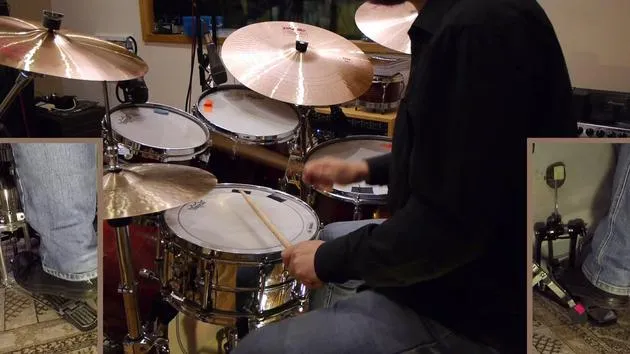
04. Rebel Without A Pause – Public Enemy
0:57
05. People Get Ready – Curtis Mayfield
1:03
06. The Dock of the Bay – Otis Redding
1:01
07. Full Rudder
1:01
08. Z
1:07
09. Rattlesnake
1:03
10. Big Ideas
1:06
11. Hazee Daze
1:02
12. Hoedown
Free lesson0:58
01. My Name Is – Eminem (Analysis)
6:46
02. Untitled How Does It Feel – D’Angelo (Analysis)
2:48
03. People Get Ready – Curtis Mayfield (Analysis)
3:42
04. Yellow – Coldplay (Analysis)
4:15
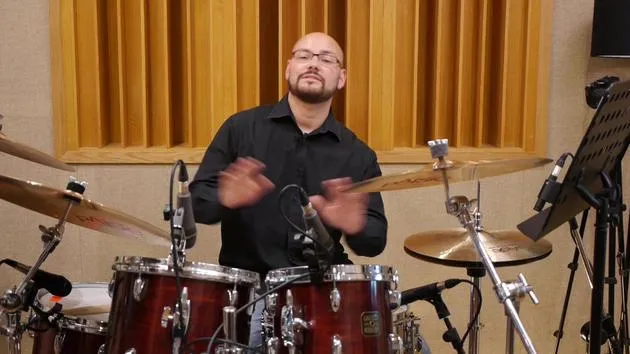
05. Rebel Without A Pause – Public Enemy (Analysis)
You are here13:38
06. The Dock of the Bay – Otis Redding (Analysis)
3:27
07. Full Rudder (Analysis)
4:19
08. Z (Analysis)
4:10
09. Rattlesnake (Analysis)
8:56
10. Big Ideas (Analysis)
3:34
11. Hazee Daze (Analysis)
5:47
12. Hoedown (Analysis)
6:37
Lesson transcript
Music Lesson: Rebel Without a Pause
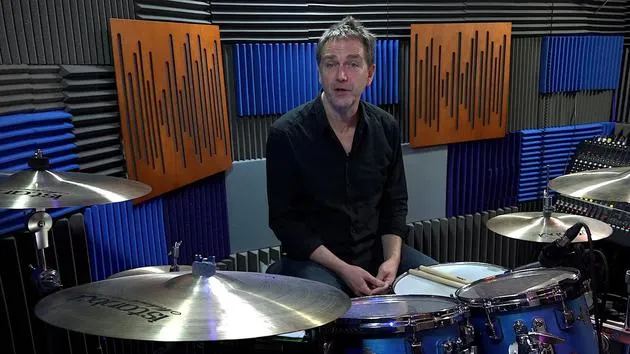
Hi, welcome to another music guru lesson. Today, we're looking at Rebel Without a Pause, which is a Public Enemy hip-hop track. This is a debut-level drum piece.
Overview of the Track
One of the important things to point out is that it's a distilled arrangement. What that means is some of the more challenging technical elements present in the original recording have been reduced to make it more playable and accessible for a debut level.
- Original Sample: The original record features a sample of the Funky Drummer by Clyde Stubblefield, a James Brown track. Clyde Stubblefield is a very important drummer. If that name is new to you, get yourself on Google and check out Clyde Stubblefield because there is a wealth of information that you should really explore.
Analyzing the Chart
When we look at this track, if you're referencing your Rock School books, I'm looking at rehearsal letter A. I'm going to talk you through this chart as if I was seeing it for the first time, highlighting aspects that may be helpful for you to consider when looking at music.
Tempo
- Looking at the very first bar, the first thing I see is a metronome mark: 97 beats per minute. This tells me the tempo of the piece.
Note: It's crucial when you're sight-reading or learning any music to know the tempo at which you're going to play. Misjudging the tempo could lead you to play much faster or slower than intended.
Time Signature
- The time signature is another vital element.
- The top number indicates the amount of beats in a bar (4 beats).
- The bottom number indicates the type of beats (4 quarter note beats).
So, in each bar, there are four evenly divided beats: 1, 2, 3, 4.
Genre Indication
- Something unique to these fantastic Rock School books is the indication of hip hop written above the stave in the first bar. This matters because, as a rhythm section player, the parts can look similar across different genres.
Important: Knowing that this track is hip hop tells us to play with a slightly different intention and feel compared to rock music.
Bar Analysis
Bar 2: Layered Drum Groove
- In bar two, there's a layered drum groove. This means the hi-hat plays alongside the bass drum and snare drum parts.
Tip: Ensure that the notes line up. Just like playing a chord on a piano, aim for everything to land together.
You want to achieve a crisp, tight sound, avoiding a scruffy vibe that's easy to fall into as a beginner.
Counting Hi-Hat Notes
- In this pattern, there are eight consistent hi-hat notes per bar. An easy way to count that is:
- 1 and 2 and 3 and 4 and.
Understanding Backbeat
- The term backbeat refers to the second and fourth quarter notes of every bar, typically played on the snare drum.
Exercise:
- Count the eighth note subdivision: 1 and 2 and 3 and 4 and while playing the hi-hat and snare together.
Adding Bass Drum
- To incorporate the bass drum, count as follows:
- 1, 2, 3, 4 (for the bass drum).
Next Step: Put everything together and repeat for the next eight bars.
Repeating Patterns and Drum Fill
- Moving on, in bars 10, 11, and 12, we'll repeat the same section.
- In Bar 13, we have a drum fill. Here's how it's noted:
- Two beats of the drum groove, followed by two «slash marks» with the word fill written above, indicating that you play a drum fill in that space. A simple yet effective pattern is:
- two eighth notes followed by two sixteenth notes and an eighth note: Ba ba ba ba ba.
- Two beats of the drum groove, followed by two «slash marks» with the word fill written above, indicating that you play a drum fill in that space. A simple yet effective pattern is:
Tips for Drum Fill
- Although toms aren't written out in the Rock School pieces, you can orchestrate patterns around the toms as you gain confidence.
- Ensure you keep one ear on the click if playing along with a backing track and one ear on the instrumentals to stay locked in.
Section B: Syncopation
- In section B, we delve into syncopated bass drum patterns.
- The term syncopated refers to rhythms that fall off the main beats.
New Rhythmic Patterns
- In bar 14, there's an extra bass drum hit on the and of four:
- Follow this with a combination of off-beat syncopated bass drums.
Bar 18 Challenge
- In bar 18, we encounter eight bass drum notes. Focus on two main objectives:
- Accurate beat placement: Ensure the bass drum aligns perfectly with the hi-hat.
- Even tone: Aim for a machine-like punch to your bass drum notes.
Conclusion
This lesson serves as your introduction to hip hop drumming. I recommend that you:
- Listen to as much hip hop music as possible.
- Pay attention to the intentions of the rhythm section players.
- Observe how the hi-hat interacts with the bass and snare drums.
Final Thought: Keep your ears wide open and enjoy playing the track. Have fun!
28 lessons
1h 32m of structured video lessons
Advanced video features
Slow down, loop a passage, follow along
Mobile, tablet & desktop
Practise wherever you are
100% satisfaction guarantee
30-day money-back guarantee







