



Beyond flams drags & ruffs
With
Paul ElliottPaul Elliott shows how to drop flams, drags and ruffs into a groove without letting the embellishments overshadow the underlying pattern.
What's in the course
10 lessons (0h 46m) · 1 free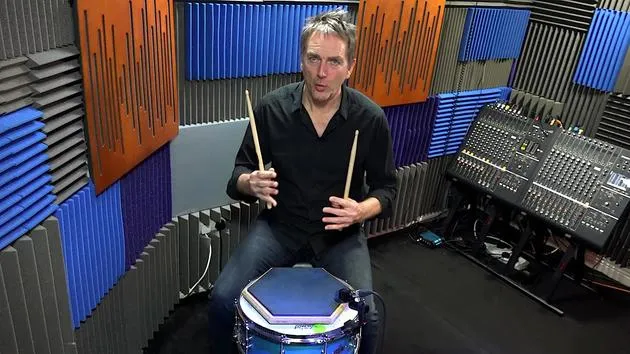
Lesson transcript
Music Lesson: Understanding Embellishments in Drumming
Now, regardless of the embellishments that you're going to use, these should not overshadow the main pattern.
Main Patterns
- Whether it's a flam tap,
- a flam accent,
- a pater fla fla,
- a flam paradiddle,
- or the various ratamaque rudiments,
it's the same principle throughout.
Take Your Time
You can really take your time just working on the underlying patterns, and I think that's really important. I talked about this in the stroke roll section: feel that underlying pattern, and then add the embellishment.
- Add the flam
- Add the drag
- Add the rough to the pattern.
Examples
For example, if you're playing a flam paradiddle, let's take the paradiddle:
- If I'm going to drop that flam in, I need to know what the underlying pattern is.
- It's really great just to break things down, strip them down to that underlying pattern, and drop in whatever it is you need to drop in.
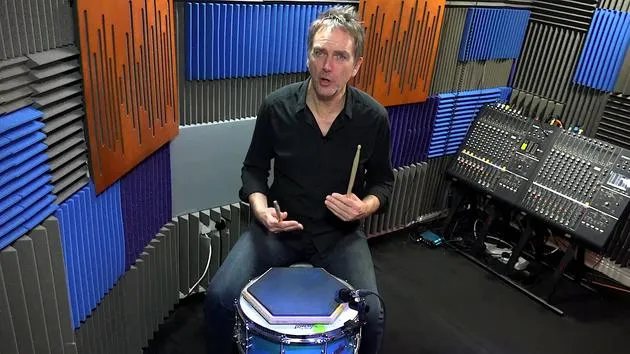
- You can widen the flam a little bit, slow it right down, and then piece it back together.
Take a Pat a Fla Fla
Same kind of idea:
- Break it down into those single notes.
- We've got this accent on the 1st and last 16th.
- Drop those flams in before the accents.
- Then slow down, widen it, whatever it takes before you piece it back together to kind of get the feel of those different strokes and the flow of those notes.
Various Rata McCue Combinations
- Get those double taps in before those notes.
- It's not always on a quarter note, of course.
- You've got various rhythms, but essentially, it's a good place to start.
I mentioned this earlier, but as you go through the technical studies, you'll see that there are various rhythms that you need to flam, drag, or rough.
- In the early grades, while you're getting used to this, it's predominantly on a quarter note, and that's a good place to start.
Understanding Ratama Q Ideas
If you get a single, double, or triple ratama Q, it's just a case of adding:
- One, two, or three lots of drags.
- We need to hear the double drag.
So check out the underlying rhythm and then drag into that; that would naturally alternate or we can double that up.
Conclusion
Essentially, it's the same concept throughout all of these embellishment rudiments. It's just a case of getting close to the note, which is a great way to control coordination:
- Right, left, playing doubles.
- Getting those embellishments in so you're definitely hearing what it is you're trying to do.
I think that's a really important consideration.
That's it. Here are the technical exercises for your grade, played at the tempo stated in the book. I wish you good luck.
10 lessons
0h 46m of structured video lessons
Advanced video features
Slow down, loop a passage, follow along
Mobile, tablet & desktop
Practise wherever you are
100% satisfaction guarantee
30-day money-back guarantee
Meet your guru
Meet your guru
Paul Elliott is a respected drum educator and clinician whose students hold top gigs across the industry, including drummers for Kylie Minogue (Tom Meadows), Ricky Martin (Laura Fares) and The Cure (Jason Cooper). He has shared clinic stages with Steve Smith, Manu Katché, Simon Phillips and Gary Husband, and his own playing career included work with Frank Gambale, Guthrie Govan and Shaun Baxter. Drummers such as Phil Selway (Radiohead) and Ash Soan (Adele) come to him for technical advice. In his courses he works through the technical requirements grade by grade, demonstrating each rudiment and explaining not just how to play it but what mastering it lets you do on the kit.







