



Folk Rock 1
Lesson time: (7min 26sec)
Chris Haigh führt in den Folk Rock auf der Violine ein und erklärt den Unterschied zwischen amerikanischem Folk Rock und britischem Electric Folk sowie die traditionellen Reels, Jigs und Hornpipes hinter dem Stil.
© 2011 Schott Music Ltd, London
Course preview
This lesson is part of the course Rock-Violine: Stile & Performance
Watch a preview of the full course below.
Lesson transcript:
Folk Rock Lesson
Introduction
Hi! In this lesson, we're going to talk about folk rock. This genre developed in the 1970s and has two different meanings, depending on whether you're in America or over here in Britain.
Definitions
-
In America:
Folk rock refers to singer-songwriter styles. For example, The Byrds were described as folk rock, which aligns more with country rock. -
In Britain:
We refer to folk rock as electric folk. This involves English, Irish, or Scottish traditional music presented in a folk context, which is our focus today.
Traditional Folk Music
Traditional folk music has its own forms and dance styles, including:
- Reel
- Jig
- Hornpipe
Each of these has a different approach when turned into rock and includes a repertoire of traditional melodies and ornamentations. We'll explore these in the next lesson.
The Evolution of Folk Rock
Folk rock or electric folk performed very well commercially in the 1970s but declined in the face of punk rock in the mid-70s. Both genres had overlapping audiences. Despite this decline, folk rock has persisted to the present day.
Notable Bands
- Steel Ice Band
- Fairport Convention
Watch out for these bands, as they mastered this kind of music.
Tune Introduction
Now, I'm going to play you a tune called "Tempony Bit." I'll start by playing it in a traditional form with rock backing.
Jig Rhythm
You can hear that the jig rhythm, which is a 6/8 rhythm, works effectively in a folk rock context, sounding much like a boogie:
Danka donka takatanka.
It fits perfectly with that boogie rhythm. The jig is a suitable choice for rock, although the reel (which is in 4/4 time) also works well.
Bowing Technique for a Jig
When playing a jig, you'll initially struggle with the bowing technique.
- What to Remember:
Six quavers to a bar should not be played with equal length bows.
Bowing Pattern
- First Note: Stronger action on the first note (longer).
- Next Two Notes: Play them short.
So, think of this as:
Down (long), up (short), down (short), up (short).
Your priority, especially if you're new to folk music, is to master that bowing technique.
Rock Version of the Tune
Now, let's explore some rock ways to play the tune. Here's the second version, which I'll play through slowly first.
-
Introductory Riff:
Incorporate a bit of syncopation. Instead of the basic rhythm, we replace it with a double E riff and slide down. -
Variation:
The second half has slight variations, including more syncopation and a rock riff to replace the next three bars. -
Slideshow Ending:
We'll finish off with a slide and a double A.
Let's try that up to tempo with the backing. I think you'll agree it creates quite an exciting sound!
Improvisation
To wrap up, I'll improvise using the minor blues scale over this backing. This is the kind of thing that, in my ceilidh band, we occasionally break into when the audience is enthusiastic and supportive.
Caution:
If you overdo this in a proper Celtic context, you may find yourself in trouble. So, be careful about who you're playing with and for.
Assignment
-
Learn the Melody:
Practice the basic melody of "Tempony Bit" with the backing. -
Try the Second Version:
Play along with the backing. -
Improvisation:
Try improvising using a blues solo over the backing. -
Extended Play:
If you have the chance, create a longer version that moves from the melody into a solo and then back to the melody.
Happy playing!
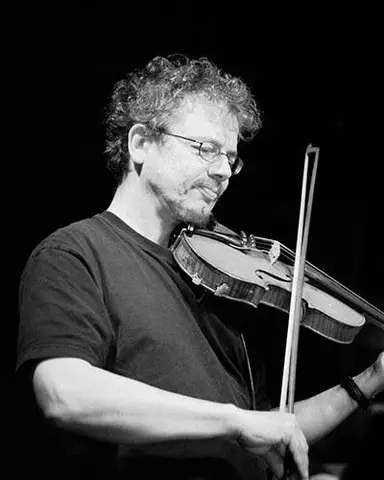
About the instructor
Chris Haigh ist seit 25 Jahren professioneller Fiddle-Spieler mit Erfahrung in vielen verschiedenen Genres. Er hat auf über 75 Alben gespielt und dabei mit Künstlern wie Alison Moyet, Bob Geldof, All About Eve, Michael Ball, David Soul, Oumou Sangare, The Quireboys, Riverdance, Morcheeba, James Galway und Steps zusammengearbeitet. Er hat Swing-Jazz mit The Kimbara Brothers, Diz Disley, Le Jazz, The Hot Club of London und den Quecumbar Allstars gespielt und leitet die siebenköpfige sowjetische Swing-Band The Kremlinaires. Chris gibt Unterricht und Workshops zur Jazzgeigen-Technik und hat Jazzgeige an den Universitäten Middlesex, Brunel und Newcastle sowie am Truro College unterrichtet. Zu seinen Veröffentlichungen zählen neun Fiddle-Bücher, darunter The Fiddle Handbook. Außerdem betreibt er Fiddling Around (fiddlingaround.co.uk), vermutlich die umfassendste und meistbesuchte Quelle für Fiddle-Wissen im Netz. read more