



Effects
With
Chris HaighChris Haigh walks through the effects you can use on an amplified violin, from building your own pedalboard to running everything through a single multi-effects unit.
© 2011 Schott Music Ltd, London

What's in the course
18 lessons (1h 41m) · 1 free
Lesson transcript
Final Lesson: Exploring Effects for the Amplified Violin
Hi! In this final lesson, I'm going to talk to you about effects that you can use on the amplified violin. Now, as I said in the last chapter, I'm not an expert on this kind of thing, but there is a lot of stuff that you do need to know, and I'm going to share my limited knowledge on effects.
Pedal Boards vs. Multi-Effects Units
-
I used to have a pedal board, which is a board on which you attach a whole load of different pedals. This is what guitarists often use.
-
For each individual effect I'm going to talk about, you can buy lots of different pedals which do the job of that particular effect.
-
If you're a thorough electrifier of the violin, you're going to try half a dozen different pedals for each of these effects and end up with a vast array of pedals.
-
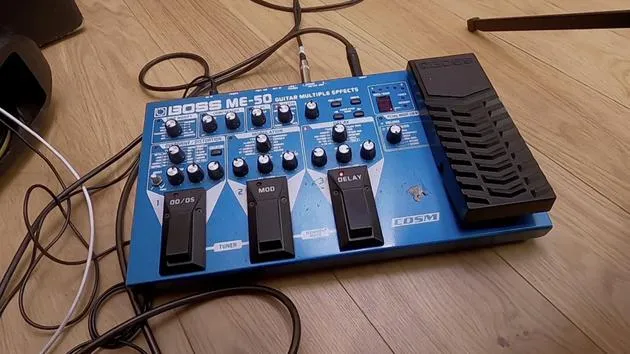
The budget version of that same job is to buy yourself a multi-effects unit. This is what I have here: a Boss ME-50. Although it might no longer be in manufacture, they do make something similar.
-
It incorporates a whole lot of different effects at what is quite a decent price.
-
The cost of all these effects as separate pedals would probably exceed a thousand pounds, whereas this multi-effects unit is probably only a couple of hundred pounds.
-
So, this is your starting point. If you're really going into effects and want to get the exact sounds you want, then separate pedals are the way to go.
Different Effects Overview
1. Reverb
-
Dry Sound: This is a sound with no reverb, akin to what you would get in a small padded cell.
-
Medium Room: In a medium-sized room, you can just hear a little tail at the end.
-
Large Room: Now imagine a large hall; you can hear more coming back.
-
Spring Reverb: This is meant to be an imitation of the reverb on a guitar amp.
-
Modulated Hall Reverb: Adds extra modulation to the hall reverb for a nice hiss at the end of the note.
"As you listen to that sound coming back, you're not hearing an echo. What you're hearing is just like a warm glow of the sound from that distant wall."
2. Delay
-
This effect creates an actual separate sound, like a proper echo.
-
Adjusting the Delay:
- Slow Echo: Between 400 and 2000 milliseconds.
- Short Delay: Creates the sound of a small room.
- Long Delay: Can make it pretty extreme but might not be useful for many applications.
-
Envelope Level and Feedback: These will affect how powerful the returning signal is.
-
Reverse Delay: An interesting effect that flips the sound backward.
3. Overdrive and Distortion
-
This is the crunchy, distorted sound that guitarists love.
-
With overdrive, it can be difficult to control these sounds. They often sound great alone but may disappear in a band setting unless you turn the treble up full.
"It certainly is possible to get a decent sound, and some people get amazing distorted violin sounds."
4. Modulation
- Includes effects like Chorus, Phaser, and Flanger.
Chorus
-
Fattening up the sound as if two different sounds are played slightly out of phase.
-
Modulation effects can effectively replace vibrato, allowing you to play a long note without needing vibrato.
Phaser
- This also plays two versions of the sound slightly out of phase, with adjustable speed and depth.
5. Additional Features of the Multi-Effects Unit
-
The big right-hand pedal can act as:
- A volume pedal
- A switch for various effects
- An FX pedal itself
-
Octave Effect: Play down an octave for a rich sound.
-
Wah-Wah Effect: Another fun feature to explore.
-
Presets: You can store up to 30 different combinations of sounds, making it easy to switch between settings.
"Using one of these, you could spend hours, days, months, or even years learning how to use it and getting all kinds of amazing effects."
As I've mentioned, I don't use these effects often, so I don't know the ins and outs very well. However, there is a plethora of options available. As a violinist in rock, remember that simply sounding like a classical violin probably won't help you along the way!
18 lessons
1h 41m of structured video lessons
Advanced video features
Slow down, loop a passage, follow along
Mobile, tablet & desktop
Practise wherever you are
100% satisfaction guarantee
30-day money-back guarantee
Meet your guru
Meet your guru
Chris Haigh has been a professional fiddle player for 25 years, with experience covering many different genres. He has played on over 75 albums, working with artists including Alison Moyet, Bob Geldof, All About Eve, Michael Ball, David Soul, Oumou Sangare, The Quireboys, Riverdance, Morcheeba, James Galway and Steps.
He has played swing jazz with The Kimbara Brothers, Diz Disley, Le Jazz, The Hot Club of London, and the Quecumbar Allstars, and leads a 7-piece Soviet swing band, The Kremlinaires.
Chris gives lessons and workshops on jazz violin technique and has taught jazz violin at Middlesex, Brunel and Newcastle universities and Truro College. His writing credits include nine fiddle books, among them The Fiddle Handbook.
He also runs Fiddling Around (fiddlingaround.co.uk), probably the most comprehensive and widely visited source of fiddle information on the web.







