



A brief outline of copyright law
With
Aamir Yaqub
What's in the course
12 lessons (0h 56m) · 1 free
Lesson transcript
Understanding Copyright in Music Sampling
When you're sampling from different places, it's crucial to be aware of the legal implications. You can't simply take anyone's music, pass it off as your own, and re-release it. Doing so would violate copyright law in many countries around the world.
Basics of Copyright Law
It's a good idea to have a basic understanding of copyright law to know what you can and cannot do when it comes to sampling:
- Copyright Law protects the works of a composer.
- For instance, if you record a song, you hold the copyright to that song.
- You have the right to:
- Sell that song
- Make copies of that song
- Create any work that incorporates that song
- You have the right to:
- If someone else uses your work without permission, they must pay you for the privilege of using it.
- If they do it without permission, you can take them to court for compensation.
Important Note: Any existing works released by someone are protected by copyright unless they are royalty-free, like Apple Loops.
Sampling: What You Can and Cannot Do
Unfortunately, you cannot just take anyone's song, sample it, and release it to the public without permission. There are historical cases of artists attempting this and subsequently facing lawsuits.
Bottom Line:
- Be very cautious when sampling other people's music.
- For samples that you create yourself or those that are royalty-free, you have no problem.
Parts of a Song and Copyright Ownership
There are three different parts of a song or a record that can be owned by different people:
-
Performance: Owned by the performers.
- Example: If someone played the guitar on a record, you would need permission from the artist and the performer.
-
Recording: Usually owned by a record company (the master recording).
- Permission is required to use this master recording.
-
Composition: The actual song itself.
- This also has copyright law attached.
When releasing something commercially that contains a sample of someone else's song, be aware of the potential copyright infringement.
Clearing Samples
If you're using a sample that will be featured on a commercial record and may infringe copyright law, you must get the sample cleared.
- Getting the Sample Cleared:
- This means talking to all copyright holders and compensating them for the use of their work.
Success with Royalty-Free Samples
One of the best scenarios is using a royalty-free sample and achieving a huge international hit. For example, with Rihanna's song "Umbrella":
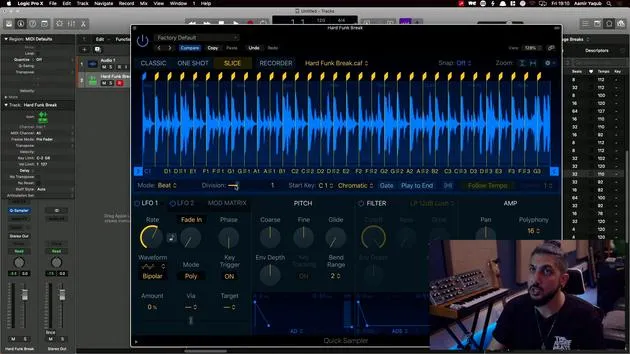
- Load this into your sampler and work with it.
- Go to the Apple Loops browser, type in "vintage funk kit 03," and you'll hear the drums used in that song.
- They didn't pay anything for using or clearing that sample, yet it became a worldwide hit.
Final Thoughts
Now that we've covered the legalities, let's dive into Logic and explore how we can use the sampler available to us!
12 lessons
0h 56m of structured video lessons
Advanced video features
Slow down, loop a passage, follow along
Mobile, tablet & desktop
Practise wherever you are
100% satisfaction guarantee
30-day money-back guarantee
Meet your guru
Meet your guru
Aamir Yaqub is a music producer and engineer based in London. He has worked with some of the biggest names in music, including Alicia Keys, David Guetta, Rihanna, Sia and will.i.am, as well as developing independent artists.
Across his courses he teaches his complete Logic Pro workflow - from the interface and recording through beat-making, synthesis and MIDI effects to mixing and finishing a track.







