



Liquid Amber (lesson)
With
Laurence Juber
What's in the course
13 lessons (1h 28m) · 1 free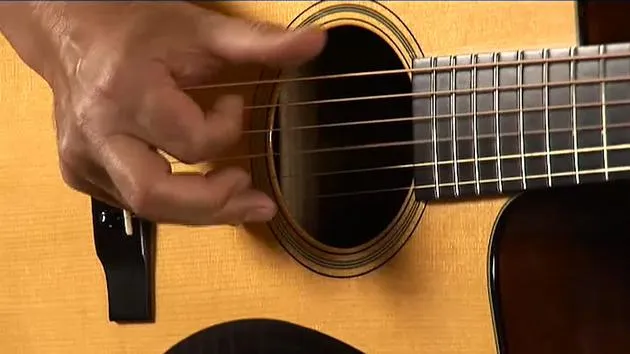
01. PCH (performance)
3:09
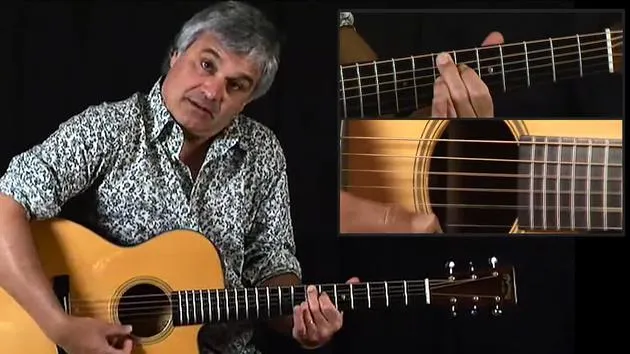
02. PCH (lesson)
Free lesson11:01
03. Liquid Amber (performance)
3:50
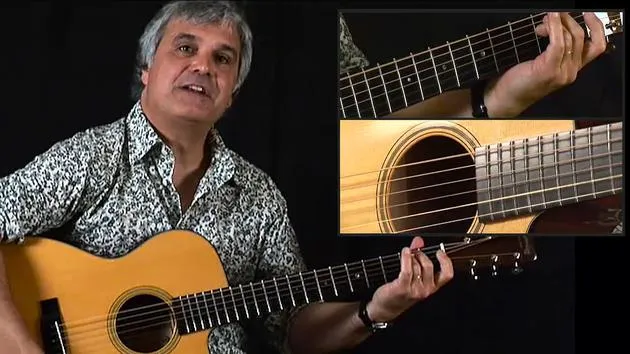
04. Liquid Amber (lesson)
You are here9:19
05. Gardenia (performance)
3:41
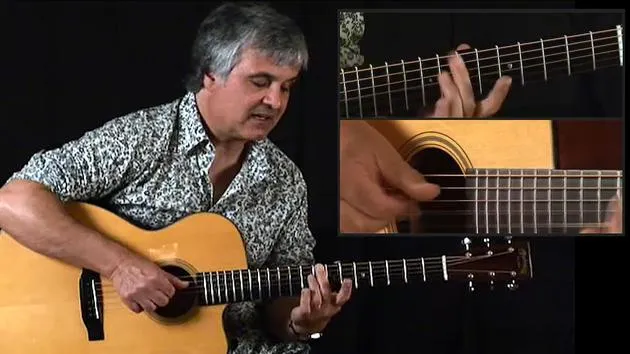
06. Gardenia (lesson)
13:37
07. Mosaic (performance)
3:49
08. Mosaic (lesson)
10:21
09. Stolen Glances (performance)
3:51
10. Stolen Glances (lesson)
11:20
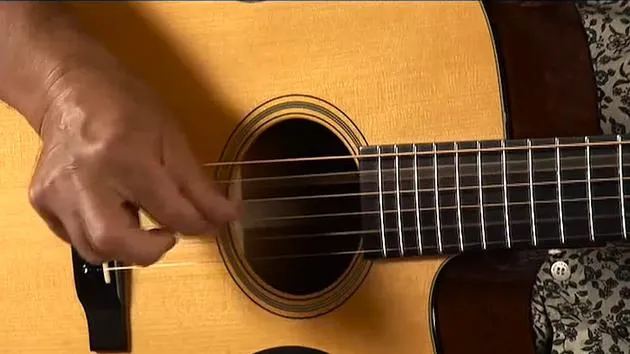
11. Bullet Train Boogie (performance)
3:52
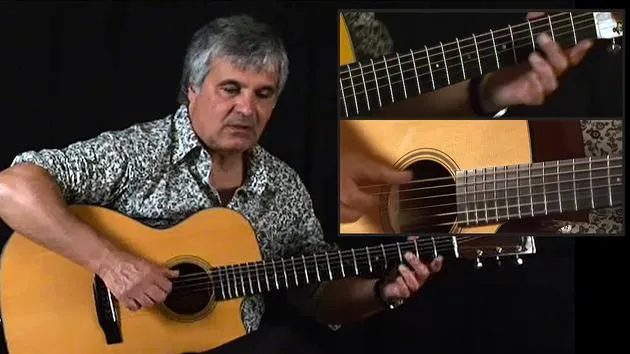
12. Bullet Train Boogie (lesson)
8:42
13. Concluding lesson
1:30
Lesson transcript
Liquid Amber in E Minor: Exploring Melodic Minor Scale
Overview
In this lesson, we will explore the potential of the melodic minor scale in the context of Liquid Amber in E minor.
Review of the E Minor Scale
-
Ascending the harmonic minor scale introduces an augmented second which disrupts the smoothness of scale steps.
-
In the melodic minor scale:
- Ascend:
- At the sixth degree, replace the C with a C#.
- This creates a major sixth and continues to the major seventh.
- Descend:
- Return to the minor seventh, then minor sixth.
- Ascend:
The Blues Element
-
By adding the blues flattened fifth, we can create interesting harmonies. For example:
- In a B chord, combine:
- D# and D
- Include C natural in the melody before transitioning to an E minor 6th chord with a C#.
- In a B chord, combine:
-
For more on these harmonic relations, refer to my Volume 1 Essentials DVD, which contains a lesson on the tune Private Dick.
Main Melody of Liquid Amber
-
Opening Melody:
- Walk down the bass line while spreading the melody across four strings: B, G, F#, E.
- Use three adjacent scale tones on adjacent strings.
-
Bass and Melody Interaction:
- As the melody ascends, the bass line will move in contrary motion.
- Settle on an A first inversion chord, then progress to C7, B, and conclude on a B augmented chord.
-
Swing Repeat:
- Repeat the rhythm with a more swinging feel, leading back down to E minor.
Second Section Details
-
Transition over an A minor chord:
- Voiced with an A minor shape and a hint of A minor 6 an octave higher.
-
Progression includes:
- E minor 6, B augmented 7 sharp 9, then flat 9.
- Incorporate the bass note when needed.
-
Connecting Licks:
- Introduce melodic slides into E minor while the bass moves down.
- Shift to C7 chord, bending to A7 where G and C# form a tritone.
- Follow through to F#7 flat 9, then B7, and up the octave to an E minor 9 with a major 7.
Solo Section
- Alternate between A minor and E minor with variations:
- Example chords include A minor 7, A minor with major 7th and 9.
- Use colorful chords within the harmonic progressions, maintaining a minor 2 - E minor feel.
Coda Section
-
Lead into the coda with a harmonic flourish:
- Pick the harmonic on the third string of the 12th fret, touching with the index finger then plucking with the thumb.
- Combine with a hammer-on to the second fret of the first string followed by a pull-off.
-
Repeat the sequence while moving down the A string, ending with a harmonic on the 12th fret of the bottom E.
Improvised Ending
- The final section involves improvisation over a descending bass line from A, E, D, G#, C#, and C.
- Create flowing melodies, leveraging the dissonance of notes like D bass with a D# on top within the context of the melodic minor.
Conclusion
This lesson provides insights into the melodic minor scale in E minor, offering creative ways to enrich your musical expression.
13 lessons
1h 28m of structured video lessons
Advanced video features
Slow down, loop a passage, follow along
Mobile, tablet & desktop
Practise wherever you are
100% satisfaction guarantee
30-day money-back guarantee
Meet your guru
Meet your guru
Laurence Juber first became known as lead guitarist in Paul McCartney's band Wings. Since then he has built a career as a fingerstyle guitarist, composer and arranger, working largely in the DADGAD tuning that earned him the nickname 'the Duke of DADGAD'.
He has been voted Guitarist of the Year by readers of Fingerstyle Guitar Magazine and named among the top guitarists by Acoustic Guitar magazine, alongside a long list of solo albums and worldwide touring.
In his courses he teaches his fingerstyle technique and the DADGAD tuning he's known for, how to arrange melody, harmony and bass together for solo guitar, and the pieces - like his signature 'Wooden Horses' - that bring it all together.







