



Stolen Glances (lesson)
With
Laurence Juber
What's in the course
13 lessons (1h 28m) · 1 free
01. PCH (performance)
3:09
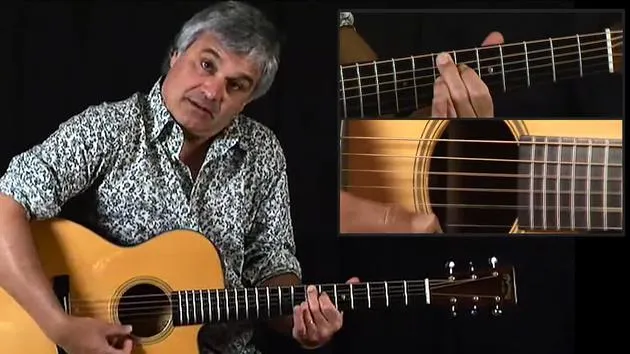
02. PCH (lesson)
Free lesson11:01
03. Liquid Amber (performance)
3:50
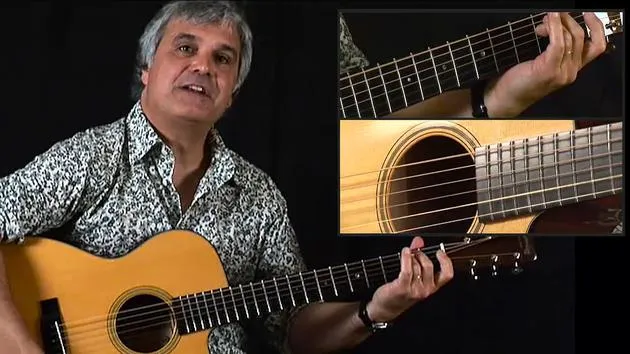
04. Liquid Amber (lesson)
9:19
05. Gardenia (performance)
3:41
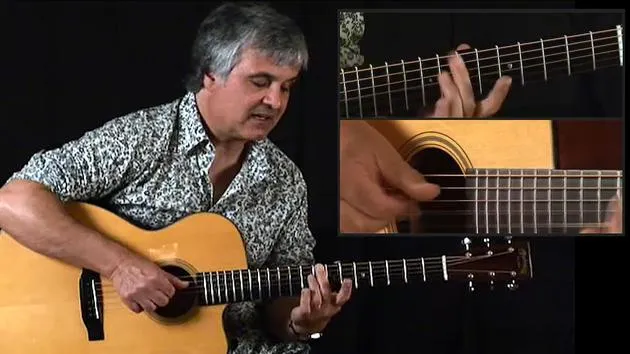
06. Gardenia (lesson)
13:37
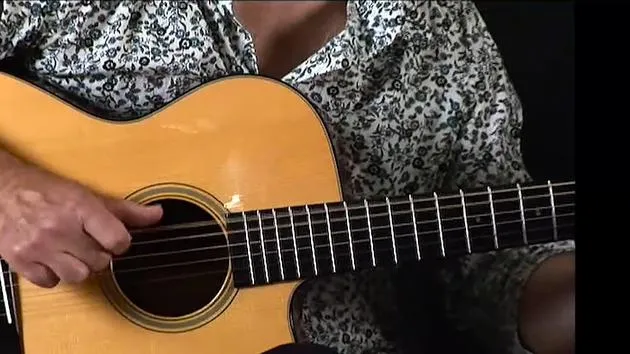
07. Mosaic (performance)
3:49
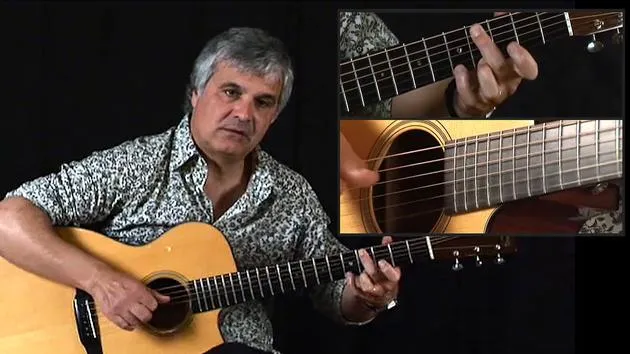
08. Mosaic (lesson)
10:21
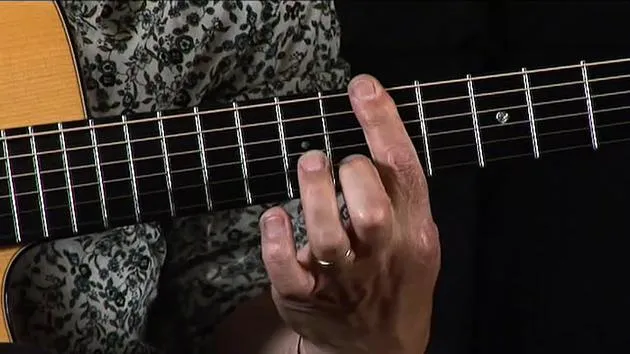
09. Stolen Glances (performance)
3:51
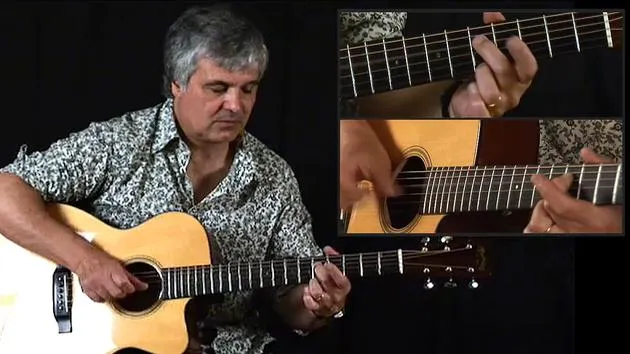
10. Stolen Glances (lesson)
You are here11:20
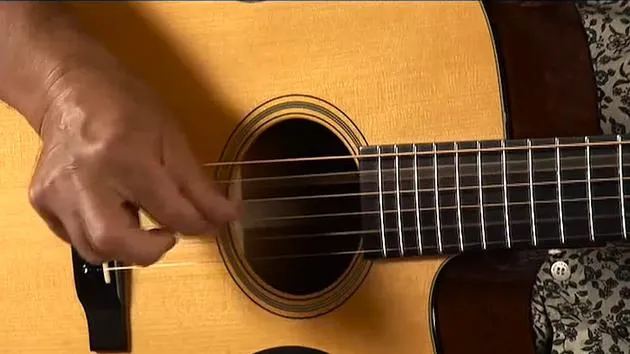
11. Bullet Train Boogie (performance)
3:52
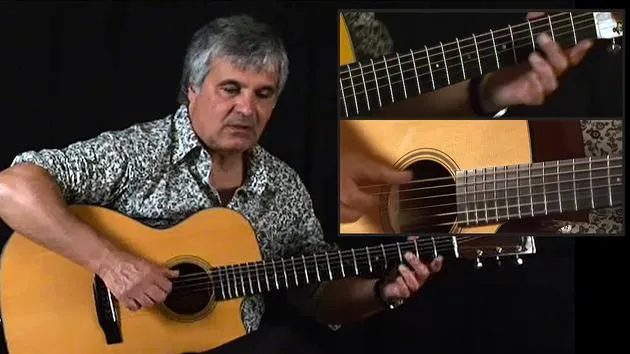
12. Bullet Train Boogie (lesson)
8:42
13. Concluding lesson
1:30
Lesson transcript
Stolen Glances - Music Lesson
Tuning:
- G minor tuning: D, G, D, G, B flat, D
(This is essentially the same as G open tuning, but with a B flat on the second string instead of a B.)
Overview
This piece serves as a study in multiple levels, particularly focusing on:
-
Rasguardo Style Strums:
Using the backs of the nails to roll through the chord. -
Flick Technique:
Quickly transitioning to a flick motion. -
Slap Harmonics:
Applying a slap harmonic at the 12th fret while muting with the left hand.
Basic Pattern
-
Downstroke Technique:
- A downstroke with the middle finger corresponds with a hammer on and a pull off.
- The second time the rhythm changes slightly, adding an extra beat.
-
Stroke Variations:
- Sometimes using an upstroke with the thumb, but generally opting for a downstroke.
- The back of the thumb can act as a pickup stroke akin to using a pick.
-
Octaves:
- Plucking the sixth and fourth strings, followed by hammering on and pulling off.
- Ascending to the octave with the high G during the second rendition.
B Section
-
C Minor Chord:
When barring across at the fifth fret, you form a C minor chord. -
Melody and Picking Pattern:
Adding a melody with a simple picking pattern, including ornamentation moving down to G, and subsequently to D minor with a melodic B flat on top. -
Tonality of Lower Strings:
Allow lower strings to ring out as part of the tonality.
Tricky Lick
-
Sequence: D, C, B flat, G, F sharp, G
(Cross fingered; take caution as it requires focus.) -
Harmonic Technique:
A harmonic is produced with a slight modulation using the forearm, leading into a repeat of the section.
Bridge and Descending Bass Line
-
The section transitions into:
- E flat major seven:
Incorporated with an added note over a D bass note (E flat, G, A, and C).
- E flat major seven:
-
Chord Variations:
It resembles a D Sus chord with a flat nine and the seventh, forming a D seven B nine sus. -
Octave Movement:
The bass line shifts up an octave, moving to upper frets, requiring a cart away for the jump to the 17th fret.
Final Section
-
Alternative Fingering:
A variation incorporating essentially almost a diminished chord. -
Return to the Opening:
Revisiting the chorus section with a cyclical approach, concluding with:- A percussive slap on the body in a semi-flamenco style.
-
Octave Techniques:
Alternating from the octave, hammering, and pulling off while sounding an open string (the tonic, third string, G).
Improvisation & Ending
-
The end section often involves improvisation.
-
Targeting a turnaround landing where the fingering creates a G minor 6 chord and moving it up and down as a thickened line.
-
Final Walk Down:
Utilizing this as a five chord leading to a walk down in octaves back to the opening. -
Ending with a transition from F sharp to G and concluding cold.
And that's "Stolen Glances" in G minor tuning!
13 lessons
1h 28m of structured video lessons
Advanced video features
Slow down, loop a passage, follow along
Mobile, tablet & desktop
Practise wherever you are
100% satisfaction guarantee
30-day money-back guarantee
Meet your guru
Meet your guru
Laurence Juber first became known as lead guitarist in Paul McCartney's band Wings. Since then he has built a career as a fingerstyle guitarist, composer and arranger, working largely in the DADGAD tuning that earned him the nickname 'the Duke of DADGAD'.
He has been voted Guitarist of the Year by readers of Fingerstyle Guitar Magazine and named among the top guitarists by Acoustic Guitar magazine, alongside a long list of solo albums and worldwide touring.
In his courses he teaches his fingerstyle technique and the DADGAD tuning he's known for, how to arrange melody, harmony and bass together for solo guitar, and the pieces - like his signature 'Wooden Horses' - that bring it all together.







