



Gardenia (lesson)
With
Laurence Juber
What's in the course
13 lessons (1h 28m) · 1 free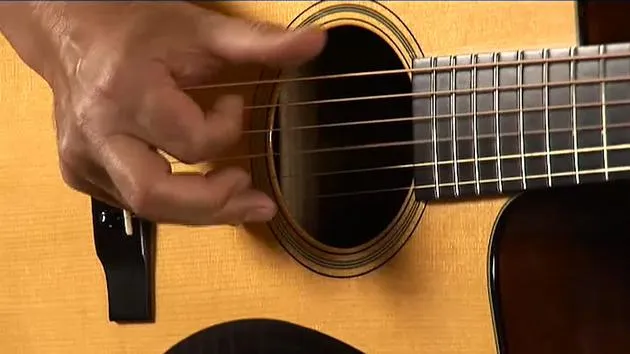
01. PCH (performance)
3:09
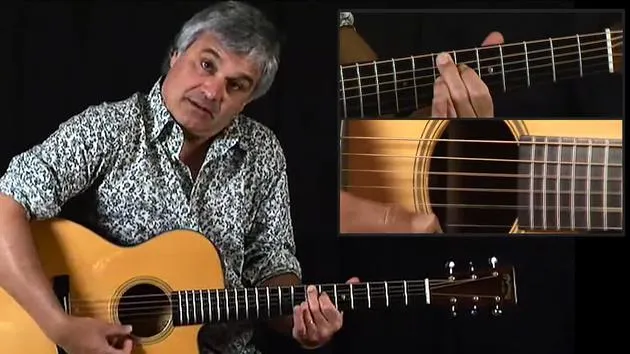
02. PCH (lesson)
Free lesson11:01
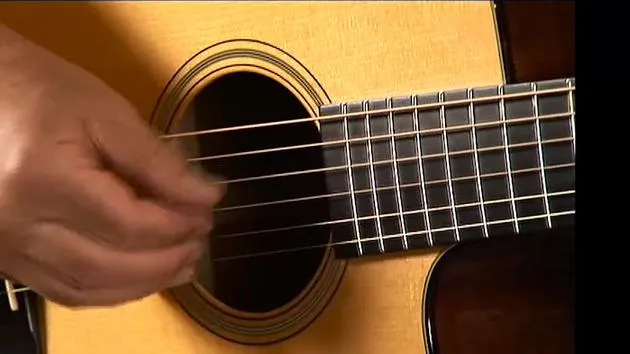
03. Liquid Amber (performance)
3:50
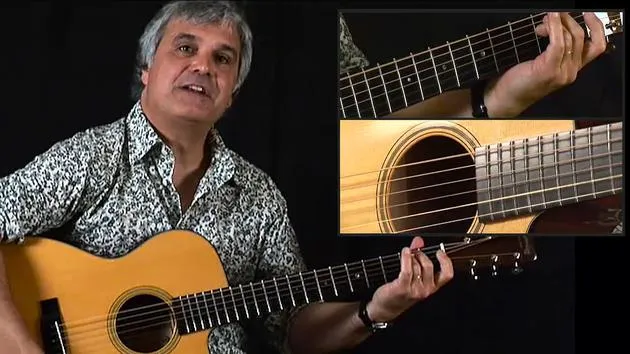
04. Liquid Amber (lesson)
9:19
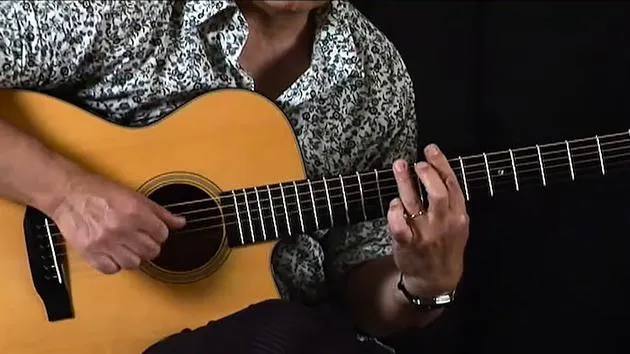
05. Gardenia (performance)
3:41
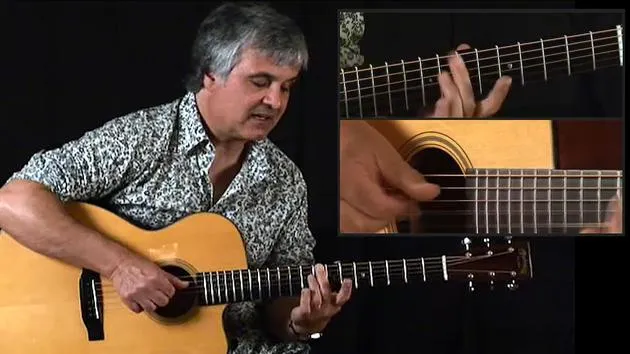
06. Gardenia (lesson)
You are here13:37
07. Mosaic (performance)
3:49
08. Mosaic (lesson)
10:21
09. Stolen Glances (performance)
3:51
10. Stolen Glances (lesson)
11:20
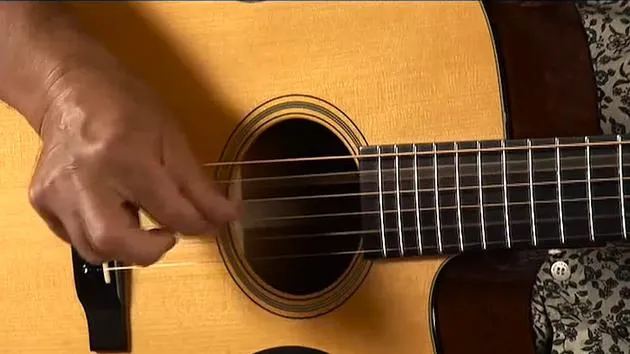
11. Bullet Train Boogie (performance)
3:52
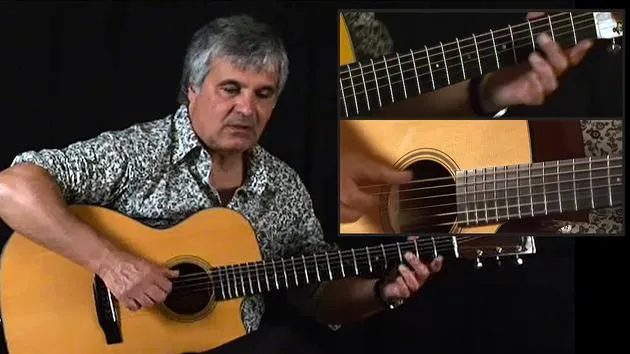
12. Bullet Train Boogie (lesson)
8:42
13. Concluding lesson
1:30
Lesson transcript
Music Lesson: Gardenia in DADGAD Tuning
Introduction
So that's a tune called Gardenia. I mean DADGAD tuning: D A D G A D.
What I'd like to treat this lesson as is looking at the way the melody gets integrated into the texture and how to bring it out of the texture in a smooth and melodic way.
Opening Phrase
Starting off, I have this opening phrase. I'm following a descending bass line.
- You'll notice that there's some cross fingering involved in how the melody is articulated.
- By cross fingering, I refer to moving from the open top string (which is a D) to the third string, crossing the second string.
- I'm sliding down from the sixth fret to the fourth fret.
Here, you'll notice how the melody involves a series of hammer-ons.
- Make sure those hammer-ons are done with a lot of force.
- It's always easier to hammer onto a string that's already sounding.
- Hammering onto a fret without it sounding has a very different effect.
Occasionally, in that section, I will throw in this variation: E, F sharp, G, A.
- So, four adjacent scale tones across adjacent strings.
- Then again B, C sharp, D, E, basically going all the way up the D scale, starting on an E and ending on an E, doing that as a flourish, as a gesture.
B7 Augmented Chord
That's a cool chord in DADGAD: the B7 augmented with a sharp 9.
- I'll hit that as a slap harmonic.
- Here's a technical point: take the index finger of your right hand and slap at the 12th fret.
- This creates a harmonic and reveals some non-harmonic notes, but also emphasizes the fundamental note.
Contrary Motion
Moving into the next bit, I have some contrary motion, going from E and G to F sharp and F sharp.
- Here, I'm doing A, E, D, B, B flat as a melodic fragment with the bass note.
- You'll notice that I'm stretching my fourth finger to reach the G bass note.
This is typical of DADGAD tuning because, if you're in the key of D, your G (the 4) is on the fifth fret instead of the third fret as in standard tuning.
- Anchor with the fourth finger and lean back to reach the lower notes.
Chorus Section
Now moving into the chorus section, this is a B flat chord.
- My melody goes from an A to a D with a B flat bass note along with a G and a B and an A.
- I have two open strings, so...
Let me start that section again.
In the middle, I have a little answering phrase, then I go to an F sharp chord.
- This is where it gets tricky: bringing out the melody to a B minor.
These are the chords, very cool voicings!
- I have an E bass note with a melody going from G sharp to C sharp to D to E to F sharp.
- Keep that E bass note going for resonance.
Then, this is also a little tricky: I've got a third with a G bass note and a B.
- Notice that I'm actually playing an open G while fretting the same note at the 10th fret of the fifth string.
The whole phrase sounds like this.
Transition to F Chord
Now, moving to an F chord, this part is tricky as well because...
- You make a variety of F, which has no actual A in it, so it feels a bit anonymous.
- It's an F major 7 with a G melody note at the beginning, transitioning to an E bass with a B on the fourth string, creating an E minor.
So the whole section transitions smoothly.
Here, I'm going to an E flat, maintaining the same chord form as that F, but with an E flat.
- I have an open G string, the third of the chord, but it again remains a major seven.
So that entire section sounds like this:
- Transitioning from E flat to A, then back to the beginning of that.
Variation and Return
Then, I vary that B minor to E.
- The same thing on the G, settling on a D.
Moving throughout these sections creates intricate resolution and anticipation.
Bridge Section
The bridge section starts on an A13 sitting on an open A bass note.
- It features a cool diminished shape.
- From A7 to A9, which is actually an A13, then to a D added six that has a very Hawaiian sound, a beautiful color in that chord.
Next, I shift to a D major seventh but voiced so that...
- The top note is G, with an F sharp, open D string as the first string, and including a C sharp (the major seventh).
From here, I transition from F sharp to B minor.
Now, I'm going to go to a B flat.
Conclusion
I'll repeat that transition to an A, leading back to the main theme.
Notice how I incorporate a little slide in there.
To finish, I go back to the chorus we've covered and, at the very end, do a little harmonic exploration again.
- Creating artificial harmonics by plucking 12 frets higher than where I fret (the 15th fret here), then the 12th fret with the open strings, and finishing up with a D.
Remember as you play: you're integrating the melody into the chords in a way that's very typical of being in DADGAD tuning.
And that's Gardenia!
13 lessons
1h 28m of structured video lessons
Advanced video features
Slow down, loop a passage, follow along
Mobile, tablet & desktop
Practise wherever you are
100% satisfaction guarantee
30-day money-back guarantee
Meet your guru
Meet your guru
Laurence Juber first became known as lead guitarist in Paul McCartney's band Wings. Since then he has built a career as a fingerstyle guitarist, composer and arranger, working largely in the DADGAD tuning that earned him the nickname 'the Duke of DADGAD'.
He has been voted Guitarist of the Year by readers of Fingerstyle Guitar Magazine and named among the top guitarists by Acoustic Guitar magazine, alongside a long list of solo albums and worldwide touring.
In his courses he teaches his fingerstyle technique and the DADGAD tuning he's known for, how to arrange melody, harmony and bass together for solo guitar, and the pieces - like his signature 'Wooden Horses' - that bring it all together.







