



The Crow's Nest

With
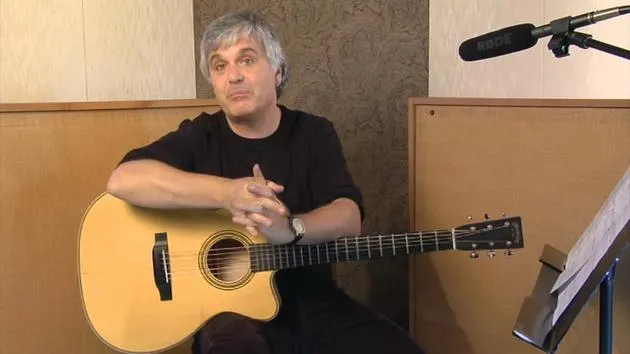
Laurence JuberLaurence Juber talks through the techniques behind his fingerstyle tune The Crow's Nest, the perpetual-motion picking pattern and his nail-strumming approach, on acoustic guitar.
What's in the course
14 lessons (1h 33m) · 1 free
01. Enough Is Never Enough
8:12
02. Guitar Noir
5:34
03. The Crow's Nest
You are here5:15

04. Maple Avenue Strut
9:05
05. The Ornament Waltz
10:38
06. Rufus
7:19
07. Highway 17
8:38
08. Being Here With You
4:51

09. Wooden Horses
7:42
10. Double Agent
7:01
11. Shebeg & Shemore
4:44
12. Around The Block
6:39
13. Portobello Road
6:28
14. Parting thoughts
1:03
Lesson transcript
Lesson Overview: "Crow's Nest"
So next up on the album is a tune called Crow's Nest. For licensing reasons, I'm not able to give you an in-depth breakdown of the tune, but I will discuss some of the techniques involved.
Perpetual Motion Energy
- This tune has a kind of perpetual motion energy to it; it doesn't really stop very often.
- There's a basic pattern:
- You're picking out a melody with the thumb.
- Then, with the index and middle fingers, you're carrying the extra sixteenth notes that keep the momentum going.
For example, on a scale, that would be the approach.
Strumming Techniques
- There are places with strums and melodies that are harmonized, let's say here in thirds.
- When I strum, I use the backs of my fingernails for both up and down strokes:
- The upstroke comes with the back of the thumb.
I don't use my fingernails for much else, but I do for strumming.
Analyzing Chord Sequences
I recommend looking closely at some of the chord sequences because:
- Although there's a lot that really sits on a kind of drone, there are other spots, for example, the sequence starting at measure 17, where I have some progressions that follow chord sequences without fully articulating a chord.
Notable Measures:
- In measures 20 and 21, it transitions from 6/8 to 5/8 and then back to 4/4:
- 6/8: 1, 2, 3, 4, 5, 6
- 5/8: 1, 2, 3, 4, 5
- 4/4: 1, 2, 3
- It's tricky because you could think of it almost as 12/16:
- 1, 2, 3, 4, 5, 6, 7, 8, 9, 10, 11, 12
But I'm counting it instead as 1, 2, 3, breaking it down to half speed. You'll figure that out from the recording. Just observe what's going on with the harmonies.
Key Progressions
In measure 25, take note of these chord transitions:
- A minor to G over B
- G minor to D over A
- One of my favorite progressions is a diminished chord, in this case, a G sharp diminished in measure 26, transitioning to an A7B9 to D.
Pay attention to the underlying chords.
High Neck Technique
Another point of interest is in the bridge section, bottom system, measure 51:
- I'm moving to a G chord but playing it high up the neck.
- This G here on the fifth string is the same note as the open G string.
- What you get is a G but broken up with this perpetual motion concept.
Conclusion
Well, good luck with that one! It was originally written for guitar and string quartet, and I've adapted it for solo guitar. Pay attention to what's on the recording.
14 lessons
1h 33m of structured video lessons
Advanced video features
Slow down, loop a passage, follow along
Mobile, tablet & desktop
Practise wherever you are
100% satisfaction guarantee
30-day money-back guarantee
Meet your guru
Meet your guru
Laurence Juber first became known as lead guitarist in Paul McCartney's band Wings. Since then he has built a career as a fingerstyle guitarist, composer and arranger, working largely in the DADGAD tuning that earned him the nickname 'the Duke of DADGAD'.
He has been voted Guitarist of the Year by readers of Fingerstyle Guitar Magazine and named among the top guitarists by Acoustic Guitar magazine, alongside a long list of solo albums and worldwide touring.
In his courses he teaches his fingerstyle technique and the DADGAD tuning he's known for, how to arrange melody, harmony and bass together for solo guitar, and the pieces - like his signature 'Wooden Horses' - that bring it all together.







