



Rufus
With
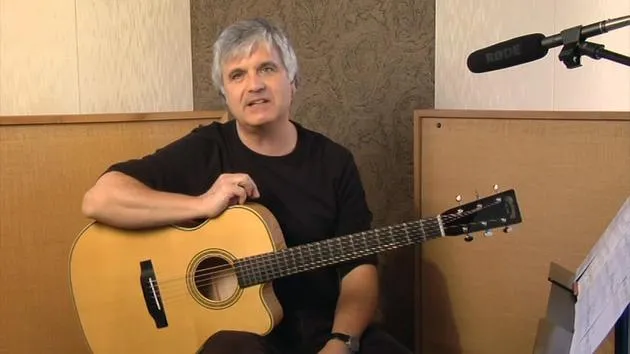
Laurence JuberIn this lesson, Laurence Juber teaches you how to play his tune Rufus on the acoustic guitar.
What's in the course
14 lessons (1h 33m) · 1 free
01. Enough Is Never Enough
8:12
02. Guitar Noir
5:34
03. The Crow's Nest
Free lesson5:15
04. Maple Avenue Strut
9:05
05. The Ornament Waltz
10:38
06. Rufus
You are here7:19
07. Highway 17
8:38
08. Being Here With You
4:51
09. Wooden Horses
7:42
10. Double Agent
7:01
11. Shebeg & Shemore
4:44
12. Around The Block
6:39
13. Portobello Road
6:28
14. Parting thoughts
1:03
Lesson transcript
Music Lesson: Key Changes and Riffs
Okay, Rufus, I'm in DADGAD. This piece is actually in a couple of keys:
- Starts in E minor
- Ends up in C
Opening Voicing
The opening features a very rich E minor voicing:
- Voicing: Two open strings (E minor 9)
- Movement: Moves up one fret to the F6sus2
- Transition: The F6 slides back to the third fret version of an F.
Riff and Rhythm
Now we've got the riff, which I'm muting slightly.
- I'm also doing a little bit of a light backbeat just with my palm.
- Technique: It's really more than the palm; it's almost the weight of the fist.
This creates a combination of:
- Palm mute
- Groove backbeat
When the melody kicks in at 13, you can still hear the bass line underneath.
"Let me play that again."
Key Change
This is where I change key.
- New Chord: D minor 9
- Technique: Everything is played across the strings.
- Next Chord: E minor 7 flat 5
Notice that:
- There's a little inner voice happening.
- It then returns to the riff.
Chorus Dynamics
Observe how, when I play that chorus, the combination of:
- Staccato chords
- Sustained chords
- Backbeat slaps
gives the piece its groove and momentum.
Solo Section
The second time around the chorus repeats and goes into a riff section for solos.
Key Components to Note:
- Chords: E minor moving to an F
- Modality: This is really kind of a Phrygian mode with the E; the F being the minor second of the scale.
Additionally, I've got:
- The bluesy flat 5 (B flat on the E)
- When I go up to the F, I keep that bluesiness in there.
Remember:
- The B is also part of the E minor scale, so it remains within the E minor modality.
I'm sticking pretty close to this shape.
- Maybe I'll go to some octaves or something like that, but the key point is to watch out for how everything can happen in this position.
Conclusion
You don't need to go up the neck to play over these particular chords.
- Last time around: It just walks down to the D, goes back to the chorus, then to the sign, and plays through.
To bring it all together:
- After you've played the solo section, play through the melody once, then just the first two bars of the melody before you end it.
"And that's Rufus."
14 lessons
1h 33m of structured video lessons
Advanced video features
Slow down, loop a passage, follow along
Mobile, tablet & desktop
Practise wherever you are
100% satisfaction guarantee
30-day money-back guarantee
Meet your guru
Meet your guru
Laurence Juber first became known as lead guitarist in Paul McCartney's band Wings. Since then he has built a career as a fingerstyle guitarist, composer and arranger, working largely in the DADGAD tuning that earned him the nickname 'the Duke of DADGAD'.
He has been voted Guitarist of the Year by readers of Fingerstyle Guitar Magazine and named among the top guitarists by Acoustic Guitar magazine, alongside a long list of solo albums and worldwide touring.
In his courses he teaches his fingerstyle technique and the DADGAD tuning he's known for, how to arrange melody, harmony and bass together for solo guitar, and the pieces - like his signature 'Wooden Horses' - that bring it all together.







