



The importance of accurate bending on holes 2 & 3 draw

With
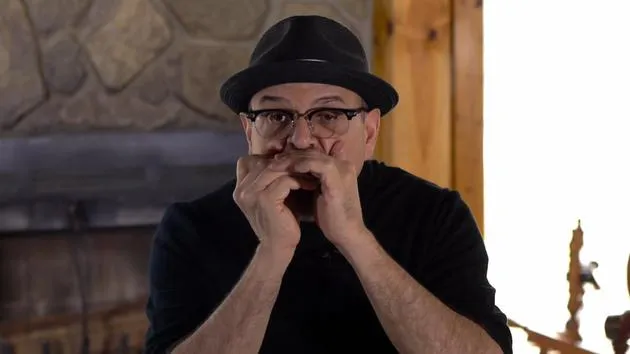
PT GazellPT Gazell on why accurate bending on holes 2 and 3 draw matters - hitting those bends on pitch fills in five notes of the chromatic scale and unlocks melodic playing in second position.
What's in the course
8 lessons (1h 11m) · 1 free
01. Checking the basics
20:08
02. The Gazell method & half valving
Free lesson11:51
03. The 3 advantages that half valving provides
10:58
04. The importance of accurate bending on holes 2 & 3 draw
You are here11:58
05. 2 & 3 Hole Draw Bend Exercises
2:22
06. Learning a jazz blues melody
3:53
07. Soloing over a jazz blues chord progression
3:28
08. Adding a cool horn line to this progression
6:48
Lesson transcript
Lesson Four: The Importance of Accurate Bending on Holes Two and Three
Hi, everybody. Welcome back to lesson four!
Overview of Bending
In this lesson, we will focus on the importance of accurate bending, specifically on holes two and three.
- If you want to play melodies and enjoy playing in the second position, it's critically important to bend accurately on these holes.
- Why is this important?
- You can fill in five of the notes in the chromatic scale by hitting those bends on pitch and holding them accurately.
- We're only missing two notes in the chromatic scale when playing in second position. Accurately bending on holes two and three allows us to fill in many of the blanks without special techniques.
Major Diatonic Scale and Bending
Playing a major diatonic scale is also significant.
- In first position, you need to hit:
- A two draw bend (whole step)
- A three whole step draw bend
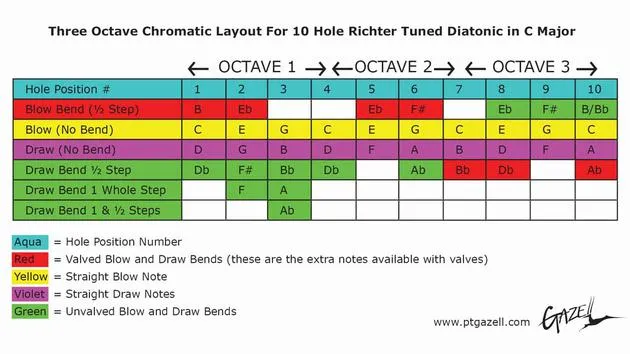
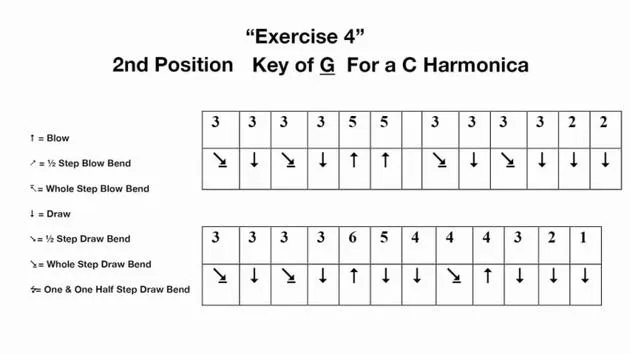
- For instance, to play the major scale in the key of C on a C harmonica, you can refer to the PDF to see how this scale is played.
Second Position Comparison
Interestingly, in second position, you need to play a six blow bend with the valve to perform the diatonic major scale.
- Starting on hole two (draw), followed by:
- Drawing bends
- Valved blow bends
- The "do re mi fa so la ti do" scale in the second octave is very easy.
Practice Tips for Accurate Bending
To improve our bending on holes two and three, consider these practices:
- Play along with a keyboard or instrument that has a precise pitch to check your accuracy.
- Here's a shortcut tip:
- Hole one draw: 1 bend available
- Hole two: 2 bends available
- Hole three: 3 bends available
Demonstration of Bends
Let me demonstrate those for you:
- Hole One: One bend.
- Hole Two: Two semitone bends.
- Hole Three: Three semitone bends.
It's crucial to get them on pitch.
Bending Technique
First, let's revisit our bending technique:
- Relaxation is key! My stomach should be sagging, and my shoulders relaxed to use the entire air cavity for bending notes.
- Maintain good mouth and hand positions.
When bending notes for holes two and three:
- Incrementally change how I'm curving the air in my mouth cavity.
- Picture a visual representation like "da." While that's not exactly what's happening, it communicates that you're changing how you're curving the air for each semitone bend.
Bending Exercises
This bending exercise is effective because you should be able to:
- Transition between semitone bends while checking your pitch.
- Use a keyboard to walk down notes as you bend.
These practices are essential for filling in the chromatic scale. Traditional bends on the harmonica do not require a valve.
Applying Bends in Music
A great example of utilizing semitone bends can be found in the jazz tune "How High the Moon."
- I'll play that in second position:
- Using one of the semitone bends on hole two.
- All three on hole three and a valved bend on hole two blow for the head of the tune.
For clarity: I had to play all three semitone bends on hole three.
Accuracy Matters
As you practice, remember that being accurate is essential to make your playing believable.
- The emotional shading I apply adds depth to my sound.
- A rounder finish on the notes enhances the overall performance.
Chromatic Scale Practice
Finally, let's explore the chromatic scale over a couple of octaves.
- This will not only emphasize the importance of holes two and three draw bends but also the valved bends in play.
Chromatic Scale in Second Position
Starting on the two draw (G note):
- The next note you won't have without a valve requires blowing bend on hole five and a six blow bend to finish.
Here's how the full chromatic scale sounds back and forth in second position.
Remember, you can follow along with the provided PDF to practice.
Chromatic Scale in First Position
In first position, you can also play the chromatic scale:
- Just shift down a hole and start on a different point.
- Notably, only one valved bend is required to fill the gaps, specifically to get the E flat note.
Let me play it in first position one more time.
- We're playing the chromatic scale in the key of C on a C harmonica.
Pretty cool, right? Happy practicing!
8 lessons
1h 11m of structured video lessons
Advanced video features
Slow down, loop a passage, follow along
Mobile, tablet & desktop
Practise wherever you are
100% satisfaction guarantee
30-day money-back guarantee
Meet your guru
Meet your guru
PT Gazell has earned his position as a master of the diatonic harmonica. After years as the sought-after side man and session player for some of Nashville's greatest, PT discovered half-valving and his music literally soared to new heights.
No other player combines his phrasing, melodic style, song choices and improvisational abilities the way he does - in the end, it is a style all his own. Using his own signature instrument, the Gazell Method diatonic manufactured by Seydel, PT proves that the harmonica is capable of far more than most of us believe.
Dig it!
In his courses, PT teaches half-valving straight from the source - so you can get started with the Gazell Method, master valved bends, and bring them into your own songs.







