



Breathing, part 1
What's in the course
10 lessons (2h 21m) · 1 free
01. Breathing, part 1
You are here6:59
02. Rossini, William Tell and The Thievish Magpie
14:54
03. High Range Building
8:50
04. Detached Articulation
18:50
05. Mahler's Third Symphony
22:21
06. Mozart Requiem
13:41
07. Ravel's Bolero
11:35
08. Legato
17:55
09. The Philosophy of Warm Up
14:04
10. Wagner, Ride of the Valkyries and Prelude to Act 3 of Lohengrin
12:20
Lesson transcript
Breathing in Brass Playing
In this video, I'd like to talk to you about one of the hottest topics in brass playing: breathing.
The Importance of Breathing vs. Blowing
- Everybody talks about it.
- Everybody places it as their number one importance.
- In fact, we hear many people saying the most important thing in brass playing is breathing.
Actually, I disagree. The most important thing in brass playing is blowing. But in order to do that, we have to get the air coming in correctly.
Breathing Technique
I'm not one of those people who discusses the diaphragm, positioning, or pushing out here and there. I don't like to keep it as physical as that.
- If we take the air in the way we want a note to sound, we'll breathe properly.
- For example, if we want a note to go like this, you can hear from the way the air comes in how the note is going to sound, as opposed to another style of breath.
You'll notice that both of those breaths are completely different.
Different Breaths for Different Pieces
- Mala 3 breath
- Bolero breath
- Berg three pieces breath
We have three completely different breaths. Basically, the focus of the breathing is in different places. You can think of it being at:
- This point,
- That point,
- Or this point.
This will bring the air in the way we want it to go out.
The Mechanics of Air
The most important thing is that the note begins with the air coming in. It starts here.
There is no single breathing method that fits every entrance we're going to play.
- Sometimes, the air will come in really fast, and then, bang!
- Other times, it's going to go exactly the way you'd speak, just think of it like that.
The most important thing is that the air must come in with no resistance.
- If you hear sounds like "uh" or anything similar, take it out.
- That's no good. We need it to come in completely without resistance.
A Helpful Breathing Example
Now, someone once showed me a fantastic example of how to breathe.
- If I keep talking until there's no more air left in my lungs and I hold that position, when I release it, my lungs automatically fill.
- This will work naturally and is a good way to understand how we actually breathe.
How Do We Release the Air?
This is very interesting. I'd like you to try this:
- Take a full breath of air in, hold it, and then release it.
- Now, did you have to blow the air out? No, you didn't.
The lungs want to exhale.
In many ways, having said that, blowing is more important than breathing, sometimes we don't even need to blow. This brings us to the subject of support.
The Concept of Support
There are two words that I don't like discussing in brass playing:
- One is diaphragm.
- The other is support.
Because what is support? To define it is very, very difficult.
Support is air pressure. It's a quantity of pressurized air within our body.
- Now, bear in mind that these are my words, my ways of explaining.
- I'm sure you can go and ask a doctor, and he'll tell you I'm talking nonsense. But these are my words and my thinking regarding breathing, and it works.
A Demonstration
If we take the air in and just let it release, there's no blowing involved. This is my default setting for how I actually play.
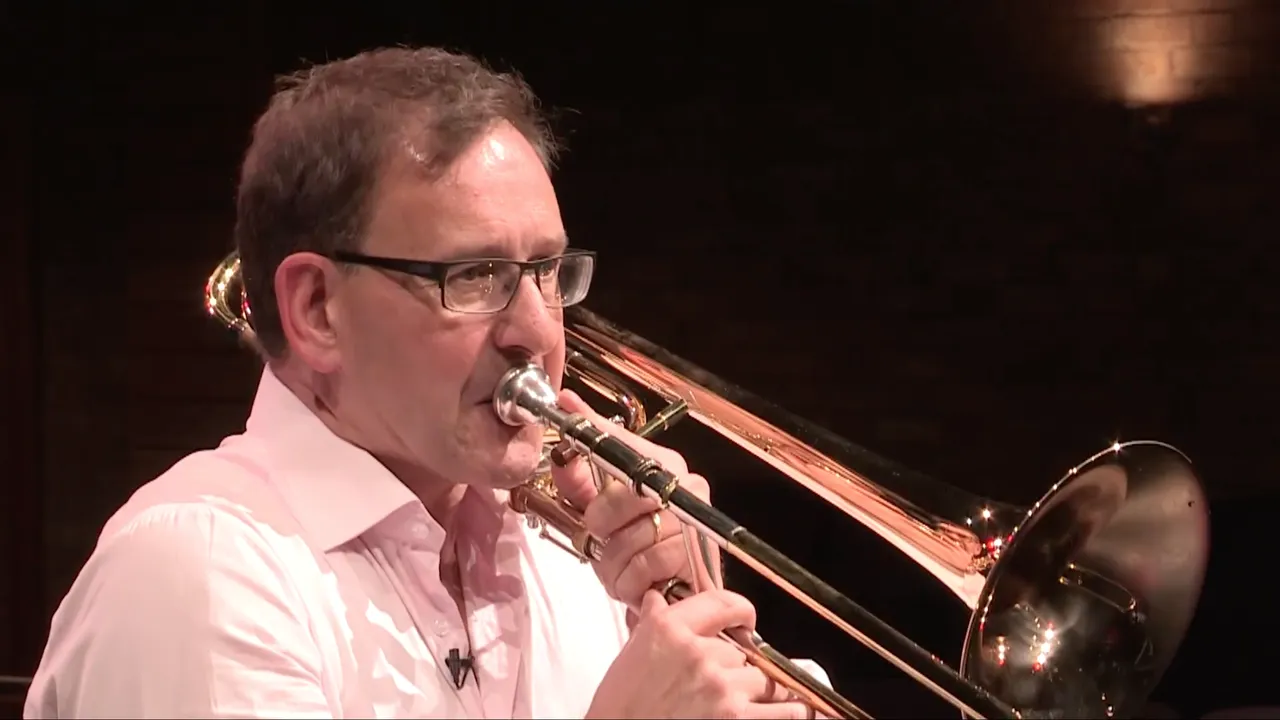
Here's the end of the second movement of the Davide concerto to show how air can just naturally exhale. There are no camera tricks here, so you can see how much air I apparently have if I just let my lungs exhale.
Mustn't do that too often, though. Not good for the blood pressure.
Overcoming Breathing Paralysis
There's one other thing that I'd like to discuss here:
I see so many students I work with who seem to be paralyzed by their breathing technique. Everything happens between here and here.
Let's not forget:
The objective of breathing is for the air to come out this way.
I see so many people, and it stops. The bottom line is we need to take air in, so it can come out through our lips and into the instrument.
Don't forget that. It sounds self-explanatory and simple, but it's often forgotten.
Don't be frightened when you're practicing breathing. Remember that breathing and blowing are linked.
10 lessons
2h 21m of structured video lessons
Advanced video features
Slow down, loop a passage, follow along
Mobile, tablet & desktop
Practise wherever you are
100% satisfaction guarantee
30-day money-back guarantee
Meet your guru
Meet your guru
Ian Bousfield has been at the top of the profession for over one quarter of a century, excelling in perhaps more facets of the music business than any other trombonist to date. His career has included playing in two of the acknowledged top-four orchestras in the world, one of which is recognized as perhaps the greatest opera orchestra, performing as a soloist to the highest possible level with orchestras, brass bands and on period instruments, recording as a soloist on top labels, playing theme tracks to Hollywood blockbusters and teaching at the Royal Academy in London.
As a soloist, Ian has, amongst others, performed with the Vienna Philharmonic, London Symphony, London Philharmonic, BBC Philharmonic, Halle Orchestra, Sapporo Symphony, Austin Symphony. He has worked with the following conductors: Riccardo Muti, Michael Tilson Thomas, Sir Neville Marriner, Kent Nagano, Ion Marin and Matthias Bamert, and EMI, Camerata, Chandos and Doyen are amongst the labels for whom Ian has made several solo recordings over the years. Probably the two highlights of Ian’s solo career to date have been performing the Nina Rota Concerto with the Vienna Philharmonic and Riccardo Muti (2008) three times in Vienna, as well as in The Lucerne Festival and in Tokyo, and giving the world premiere of Jonathan Dove’s Stargazer, written for and dedicated to Ian, with the London Symphony Orchestra under Michael Tilson Thomas (2007). He has performed with all of the world’s major brass bands, recording with many of them. He has appeared as a soloist pretty much everywhere in the world, and as a clinician, it’s probably easier to mention the conservatories and festivals at which he has not appeared!







