



Ravel's Bolero
Le contenu du cours
10 leçons (2h 21min) · 1 gratuites
01. Breathing, part 1
Leçon gratuite6:59
02. Rossini, William Tell and The Thievish Magpie
14:54
03. High Range Building
8:50
04. Detached Articulation
18:50
05. Mahler's Third Symphony
22:21
06. Mozart Requiem
13:41
07. Ravel's Bolero
Tu es ici11:35
08. Legato
17:55
09. The Philosophy of Warm Up
14:04
10. Wagner, Ride of the Valkyries and Prelude to Act 3 of Lohengrin
12:20
Transcription de la leçon
Preparing for Bolero: A Technique Guide
And now guess what? Bolero. That's what we're concentrating on in this video, the excerpt that comes up in every audition, along with the Mozart Requiem, I suppose.
Let's go into how we prepare to do this. Let's not mess around and get straight on with it. If Bolero goes wrong, it usually starts with the first note and goes downhill from there.
The Importance of Repetition
- Repetition is key. Time after time after time, knowing how you do something is essential. We could actually bring out another video about two hours long of me doing that, because I'm not going to miss it.
- The timing is there, the breath is there.
When we play Bolero, our brain asks us a question for the first time when we do it in the concert: How do I play a top B flat? If we don't have the answer, we're in big trouble. So we have to have the answer.
Breath Technique
"I play a top B flat like this, and the way I do it is based on rhythmic breathing."
- If you hear the breathing, it's coming in; it doesn't stop, but it slows down at the top, allowing time for the embouchure to form.
- I'm not holding the air, but it slows down.
After 30 years of playing this, I feel very qualified to talk about the breathing at the beginning of this.
Remember:
- You don't have to play the first B flat the way I play it.
- You don't have to do the breathing the way I do, but you have to know how you do it.
Some people breathe over two beats; I breathe over one.
Maintaining a Constant Flow
The next thing that can go wrong is in the first bar. We must have the air running through in a constant direction with the minimum of movement in the embouchure. If we over-move there, we're in big trouble.
Key Points:
- The same goes for all orchestral excerpts:
- It must stay in tempo.
- The number of wonderful Bolero performances I've heard in auditions ruined by incorrect counting and improper pulse is disheartening.
- Running through it destroys it.
Tip: Get a metronome count. That's something you don't need to pay a lot of money for lessons on, but you can fix that yourself.
Crucial Breaths
The other key to playing Bolero is, of course, the breath at the beginning and the breath in the middle. If we don't get those right, we're in trouble.
- We need to take the air in the way we want it to go out; it's really important.
- It's not Mahler 3. It's not A. It's a different breath.
Important Note: There is no one breath fits all. We have to choose our breath for the occasion, for the music that we're playing.
Observing Embouchure and Breathing
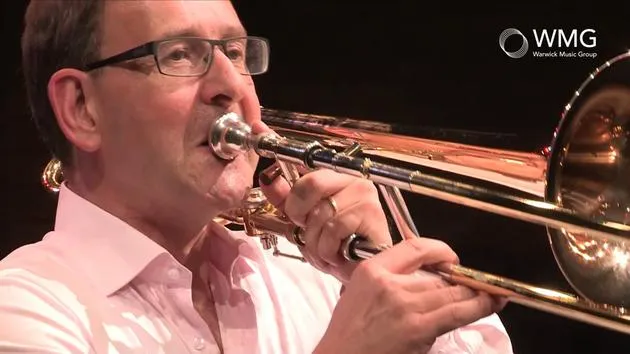
Now, if you watch what I'm doing there very closely, I'm not following textbook breathing because I'm not opening out.
- I'm not letting the diaphragm drop.
- I am breathing through the embouchure that I'm using.
- If I go from this position, I have a hundredth of a second to form my embouchure before coming in on a top B flat and going up to a top D flat.
Technique Reminder: We are breathing like this; it doesn't move. Keep the embouchure in position during this breath.
- It's the same thing with Schumann 3. The breath in the middle of that , don't move.
- Tried-and-tested system: it works.
Avoiding Miscounts
That's where many people miscount. Next, if we move on to the next section, accuracy is crucial.
- The slide must stay completely in tempo through that passage.
- That's why I was stamping my foot.
Different Approaches to Bolero
There are several different approaches to Bolero performance.
- The Bolero you play after you've been in the orchestra for 10 years is different from the audition version, which would be more conservative.
Now, let's look at some of the different ways of playing Bolero.
- Stylistically, there are many ways of playing Bolero, and I'm not going to tell you that the way I do it is right; it's just the way I do it.
- But the basic fundamentals are the same with whichever style we use:
- Rhythmic breathing.
- The formation of the embouchure at the beginning.
- The breath in the middle.
- Absolute adherence to tempo throughout the excerpt is critical.
Some people insist on playing the excerpt detached at the beginning and the end. That's okay! It's good for our basic technique to be able to play these things in different styles.
Personal Preference and Flexibility
As you may already have heard, I use slide vibrato; that's my preferred vibrato on Bolero.
- Some orchestras won't want any vibrato , that's okay.
- I prefer to use slide vibrato, but if you want to use lip vibrato, that's also okay.
Final Thoughts: We have to be open to anything. If we get the direction of the air running through the excerpt correctly, we should be able to play it in any style we like.
Conclusion
I think I've fairly comprehensively covered Bolero from practically every angle.
- Practice: First, find the tempo that you like, but then you've got to go a little bit faster and a little bit slower.
- Always be prepared for someone to say, "Could you play that a little bit slower or a little bit faster?"
I hope you enjoy it and gain from the benefit of 30 years of playing Bolero in orchestras.
10 leçons
2h 21m de leçons vidéo structurées
Fonctions vidéo avancées
Ralentissez, bouclez un passage, suivez la partition
Mobile, tablette et ordinateur
Pratiquez où vous voulez
Satisfaction garantie à 100 %
Garantie remboursement 30 jours
Rencontrez votre guru
Rencontrez votre guru
Ian Bousfield est au sommet de la profession depuis plus d'un quart de siècle, excellant peut-être dans davantage de facettes du métier de la musique que tout autre tromboniste à ce jour. Sa carrière l'a amené à jouer dans deux des orchestres reconnus parmi les quatre meilleurs au monde, dont l'un est considéré comme peut-être le plus grand orchestre d'opéra, à se produire en soliste au plus haut niveau avec des orchestres, des brass bands et sur instruments d'époque, à enregistrer en soliste chez les plus grands labels, à jouer les thèmes de superproductions hollywoodiennes et à enseigner à la Royal Academy de Londres.
En tant que soliste, Ian s'est produit, entre autres, avec la Vienna Philharmonic, le London Symphony, le London Philharmonic, le BBC Philharmonic, le Halle Orchestra, le Sapporo Symphony et l'Austin Symphony. Il a travaillé avec les chefs suivants : Riccardo Muti, Michael Tilson Thomas, Sir Neville Marriner, Kent Nagano, Ion Marin et Matthias Bamert, et EMI, Camerata, Chandos et Doyen comptent parmi les labels pour lesquels Ian a réalisé plusieurs enregistrements en solo au fil des ans. Les deux temps forts de la carrière solo d'Ian à ce jour sont probablement l'interprétation du Concerto de Nino Rota avec la Vienna Philharmonic et Riccardo Muti (2008) à trois reprises à Vienne, ainsi qu'au Lucerne Festival et à Tokyo, et la création mondiale de Stargazer de Jonathan Dove, écrite pour lui et qui lui est dédiée, avec le London Symphony Orchestra dirigé par Michael Tilson Thomas (2007). Il s'est produit avec tous les grands brass bands du monde, enregistrant avec bon nombre d'entre eux. Il s'est produit en soliste à peu près partout dans le monde et, en tant que clinicien, il est sans doute plus simple de mentionner les conservatoires et festivals où il ne s'est pas produit !







