



The Blues Scale and Top Harmony
With
Tim RichardsTim Richards combines the G blues scale with "top harmony" to add bite to your playing, built around the study "Funky2Five".
What's in the course
31 lessons (1h 44m) · 1 free
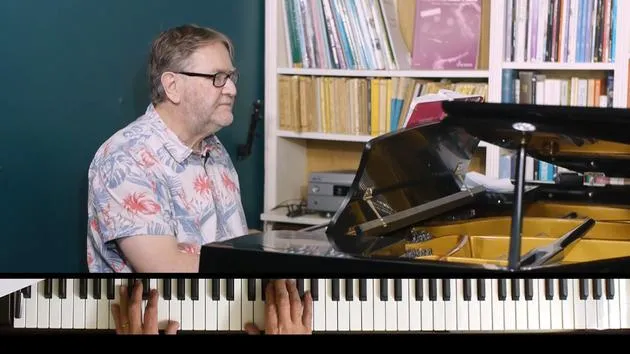
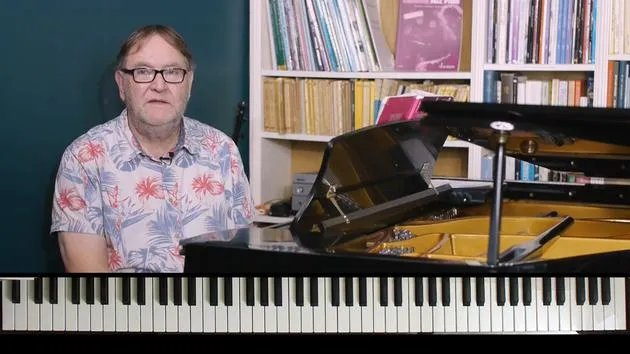
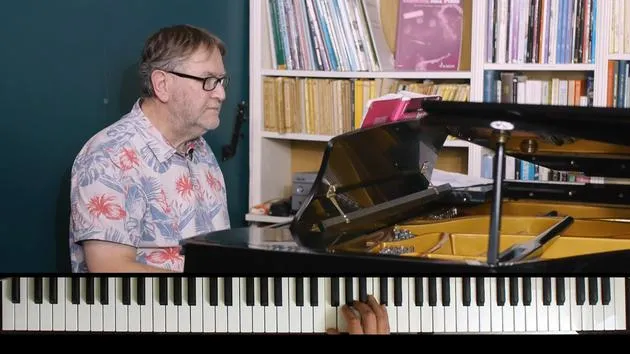
Lesson transcript
Blues Scale Study: Funky2Five
So, Funky2Five is a kind of study on the blues scale, specifically the G blues scale. The blues scale is based on the minor pentatonic, which you should know consists of the following notes:
- Root
- Flat 3
- 4
- 5
- B7
The Importance of C Sharp
The only thing that really makes it a blues scale is the C sharp, which is an optional extra, known as the flat five. This flat five is often used as a grace note. You can play it leading into the fifth.
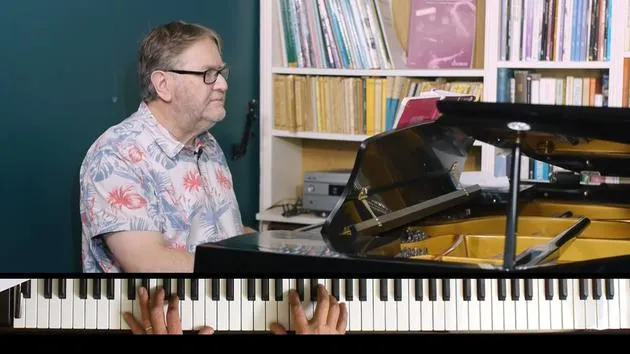
Although that's written as a note in front of the chord, you should really play it with the top note. So, you're playing C sharp and G together and just quickly swapping the C sharp for a G.
Note: It's important to know that it's not played with the C sharp by itself, even though it looks like that.
In jazz, grace notes are usually played on the beat. It is possible to slide off as well, and sometimes you slide down. For instance, the C sharp can go down to the F, down to the C. I'm still playing the C with the top G.
Top Harmony Technique
This top note is often added above more than one note, which I call top harmony. The melody might consist of single notes, but you add a G on top of everything, giving you a very bluesy sound.
This technique was used extensively in blues piano but has been borrowed in jazz piano as well. The idea is:
- Instead of adding a harmony note parallel with the melody (which is what harmony notes usually do, and they're usually below the melody),
- Top harmony is above the melody.
The note doesn't change, so it doesn't detract from the melody; it just thickens it.
Experimenting with Different Top Notes
Now let's do it. Instead of the root on top, let's put the fifth on top. In this case, the melody could be those notes there, and we could put a D on top to transform the sound.
Actually, any note of the pentatonic scale can be the top note. The root and fifth are just the most common ones.
Here's an example of using the seventh on top:
- The melody is
- I'm going to put an F on top.
And for the third on top. So the melody is...
- And I'm putting a B flat on top.
Combining Top Notes
You often find that, once you get these things under your fingers, it's really common to combine more than one top note in the same phrase. For example:
- I can put the third on top,
- The root on top,
- And the fifth on top.
You can run them into each other so that you don't notice the join.
31 lessons
1h 44m of structured video lessons
Advanced video features
Slow down, loop a passage, follow along
Mobile, tablet & desktop
Practise wherever you are
100% satisfaction guarantee
30-day money-back guarantee
Meet your guru
Meet your guru
Critically acclaimed jazz pianist and composer Tim Richards is one of Britain’s most experienced jazz educators, teaching piano privately for over 30 years, as well as at Morley College, Goldsmiths College, the University of Surrey, Premises Studios and other venues in the UK and abroad. He has produced numerous titles for Schott Music, including the best-selling two-volume Exploring Jazz Piano, Blues, Boogie & Gospel Collection and the acclaimed Improvising Blues Piano. He is also co-author, with John Crawford, of Exploring Latin Piano and Brazilian Piano Collection.
More recently Schott have published Jazz, Latin & Modern Collection (15 pieces for solo piano), comprising Tim Richards originals alongside pieces by Duke Ellington and Thelonious Monk, and the two volume set Beginning Jazz Piano (now a two-part MusicGurus course).
“The real joy of Tim’s music… is that it is both hugely educational but also such great fun to play. Anyone with the slightest interest in learning to play or teach jazz piano should really acquire a set of Tim’s books.” PianoDao
As a performer Tim has been a presence on the UK jazz scene since the 1980s, also playing the blues with UK and US legends such as Otis Grand, Earl Green, Dana Gillespie, Larry Garner, Joe Louis Walker and Mojo Buford. He has released over a dozen albums as a leader (featuring many of London’s best jazz musicians including Pete King, Gilad Atzmon, Tony Kofi, Jason Yarde, Seb Rochford, Ed Jones, Dick Pearce and many others), and toured all over Europe with line-ups ranging from duo to nine-piece. His latest recording, the album ‘Telegraph Hill’ by the six-piece Hextet, was described in The Observer as "A true joy from beginning to end".
More info can be found on his website www.timrichards.ndo.co.uk







