



Répartition de l'archet
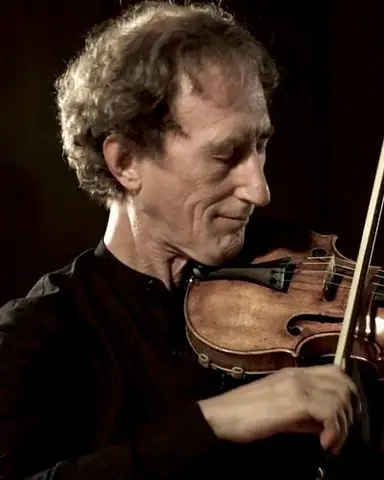
Lesson time: (5min 1sec)
Simon Fischer montre comment répartir l'archet de manière égale - en moitiés, tiers ou quarts - pour ne pas manquer d'archet avant la fin du coup.
Course preview
This lesson is part of the course The Secrets of Tone Production Partie 3 : Exercices fondamentaux de sonorité (suite)
Watch a preview of the full course below.
Lesson transcript:
Exercises for Improving Bow Division
These exercises are naturally good for improving bow division.
Key Concepts
- Two Heavy, Light Patterns: When playing two heavy, light patterns in one bow, begin the second pattern exactly in the middle of the bow.
- Dividing the Bow:
- For three patterns, divide the bow into three equal thirds.
- For four patterns, divide it into four equal quarters, and so on.
Common Mistakes
When players do this exercise for the first time, many make the mistake of using too much bow at the beginning and not having enough left at the end.
It isn't common to see someone use too little bow at the beginning and then have loads left over afterward.
Starting Technique
- Start at the Heel:
- That's right, you know, bow division.
- So you've got four in the lower half.
- Starting at the heel means here, it doesn't mean here.
- Start at the heel.
Step-by-Step Instructions
-
Begin at the Heel:
- 1, 2, 3, 4.
- Now I'm at the middle: 5, 6, 7, 8.
-
Repeat:
- 1, 2, 3, 4.
- Middle: 5, 6, 7, 8.
"Is that the heel?" Thank you, that's right.
- It's just even: 1, 2, 1, 2. Very simple.
- Start at the heel. Well done.
Maintaining Sound
"I don't hear what's happening there."
- Heavy Bowing:
- Heavy, heavy, heavy, heavy.
- Do just that much, Solomon.
Note: If you get a scratching sound, that's not ideal.
Building Pulse
- If you base your playing on this feeling, you can maintain the same feeling as you add the pulses.
- Stay in the bridge, and here we go. Now stay there.
- That's it. Good sound.
- Now pulse. That's better.
Caution: You don't want the sound stopping; there should be a continuation.
Focus on Technique
- "Try just the up."
- That's it.
May I borrow your instrument, please?
Listen to this:
- "Well, I can tell you, you need some rosin here because that's very shiny."
- I'm playing much more deeply into the string than you.
Engaging the Bow
- Observe: Heavy, heavy, heavy, heavy, heavy, heavy, heavy. Right deep into the string.
- You need to feel this, the springiness and the tension of the stability.
Remember:
- When you use a bow, it's not just the bow we're playing with.
- What we're really engaging is the force of springiness in the stick.
Analogy
It's a bit like when you receive a letter:
- You don't want the envelope; it came in an envelope, but it's not the envelope you want, it's what the envelope contains.
- Similarly, it's not the bow itself that we need to play with, but the force of springiness inside the bow.
Final Note
If you don't employ the springiness in the bow, you'll produce an inadequate sound. But if you play into the bow, the hair, and the springiness of the string, you can engage the string effectively.
Now, start lowering the bow!
About the instructor
Simon Fischer mène une carrière remarquable et variée de concertiste, de pédagogue et d'artiste de studio. Il s'est produit dans le monde entier en récital et a enregistré trois Sonates de Brahms, un enregistrement salué par la revue Gramophone. Simon est reconnu comme l'un des professeurs d'élite au monde. Il est professeur à la Guildhall School of Music et a occupé des postes à la Yehudi Menuhin School, la Wells Cathedral School et la Purcell School, et a été pendant 15 ans professeur invité à la Royal Scottish Academy of Music. Après avoir étudié à Londres avec Yfrah Neaman et à New York avec Dorothy DeLay, l'approche de Fischer réunit les meilleurs éléments des traditions violonistiques française, russe et américaine. Les publications de Fischer exercent une grande influence sur l'enseignement du violon. Rédacteur pour la revue The Strad depuis 1991, ses articles mensuels ont conquis un lectorat dans le monde entier. Publiés par Edition Peters, ses ouvrages techniques Basics and Practice (traduit en coréen, italien et allemand), Scales et The Violin Lesson, ainsi que le DVD The Secrets of Tone Production (désormais disponible en streaming via MusicGurus), sont devenus des références sur de nombreux continents. Son livre et DVD Warming Up a été décrit par la revue The Strad comme « 23 pages d'or technique à l'état pur ». En 2014, Simon Fischer a reçu le prix de la European String Teachers Association « pour saluer une contribution à l'enseignement des cordes à l'échelle d'une vie ». Dans son cours en quatre parties Secrets of Tone Production, Simon te guide pour apprendre à connaître ton instrument, puis pour travailler pas à pas ses exercices fondamentaux de sonorité, afin de produire un son plus riche, plus maîtrisé et plus beau au violon. read more