



Nosso Samba (Analyse)
Le batteur Harry Pope décortique la samba de Grade 8 Nosso Samba - comment improviser autour des stabs plutôt que par-dessus, et le feel latino qui relie le tout.
Le contenu du cours
29 leçons (3h 3min) · 1 gratuites
01. All Of You – Cole Porter
3:13
02. Last Time – Moderat
2:50
03. Red Baron – Billy Cobham
5:11
04. Some Skunk Funk – Brecker Brothers
2:49
05. Hit Me – Dirty Loops
2:55
06. Bonfire – Knife Party
2:47
07. Meet Darth Ear
3:02
08. Mind the Gaps
3:47
09. Lead Sheet
3:09
10. Freightshaker
Leçon gratuite3:14
11. Nosso Samba
3:15
12. Dark Matter
3:11
01. Last Time – Moderat (analyse)
10:31
02. All Of You – Cole Porter (Analyse)
14:36
03. Bonfire – Knife Party (Analyse)
14:02
04. Some Skunk Funk – Brecker Brothers (Analyse)
12:09
05. Hit Me – Dirty Loops (Analyse)
14:23
06. Red Baron – Billy Cobham (Analyse)
12:19
07. Meet Darth Ear (Analyse)
10:56
08. Mind the Gaps (Analyse)
5:22
09. Lead Sheet (Analyse)
9:09
10. Freightshaker (Analyse)
8:14
11. Nosso Samba (Analyse)
Tu es ici8:31
12. Dark Matter (Analyse)
5:55
Transcription de la leçon
Nossa Samba - Grade Eight Music Lesson
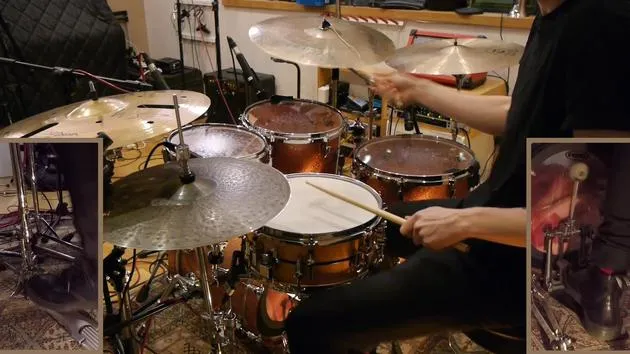
Okay, so Nossa Samba, grade eight. You made it. Cool.
Introduction
This one's tricky. It is tricky, but it's also really cool. And it's musically really satisfying to play. I mean, it starts with a drum solo, so immediately everything's good.
Soloing Tips
- Solo Around the Stabs: Not over the stabs. It does not say to solo over the stabs but around them.
- Fill the Gaps: Just catch them and then fill the gaps, and everything will sound cool.
Latin Music Inspiration
Before you even start playing this, you should be checking out some Latin music. So, you know, check out:
- Antonio Carlos Jobim
- Nosso Trio
Those solos should really emulate Latin percussion sounds:
- Lots of toms
- Lots of nice rolls
- Five-stroke rolls sound really, really great in there
You know, get around the toms and really emulate that classic Tim Barley sound. You can use rim shots on the toms if you want. It's not illegal, but it is frowned upon in non-Latin music.
Bass Tremosinata Technique
As we get to B, we've immediately started this bass tremosinata. I'm using heel up for that. You can use heel down as well; I sometimes use a heel down, heel toe sound when I get to the ride cymbal.
- Practice Slowly: Just be confident. Practice it slowly.
- Avoid Flamming: If you haven't practiced it slowly and then try to do it quickly, you're going to end up flamming between your hi-hat and your bass drum, and your bass drum and your snare drum.
Rhythm Practice
- Play some rhythms just with that ostinato.
- Puttido Alto is a great place to start.
- You could also use the classic bossa.
Feel free to play with your own ideas! Clap dotted crotchets across it; play with it, have fun, move it around the toms.
Coordination and Comfort
There's a lot of space to play with in this music. Coordination-wise, these samba rhythms can be tricky. If this may be your first samba, who knows?
- Start Slow and Simple: If you don't want to throw those 16th notes in straight away, you can start with just eighth notes.
- Use Your Left Hand: Once you're comfortable, you've got your left hand which is sitting here doing nothing. Start with quarter notes or eighth notes, then start playing the off-beats.
Creative Rhythm Building
- Write some rhythms out on a piece of manuscript paper and clap yourself two bars of 4/4 each.
- Pick another one. Before you know it, you'll be shedding all over the place and things will sound good.
Competitive Fill and Backbeat
At D, we do a nice competitive fill that goes straight into a backbeat, which is great. Some grounding, finally!
- Open Hi-hats: At the end of each four-bar section, we've got those two open hi-hats. Just make sure you don't rush those, it's very easy to do. Let beat one come to you; don't rush to it.
Bar 69: Offbeat Patterns
At bar 69, we have a really offbeat snare and bass drum pattern, reminiscent of the puttido alto. We're displacing it, playing across the kit, and it's really cool but will take some practice.
- Use a Metronome: Work through it slowly and use a metronome. Worth doing!
Bass Solo Considerations
Then we get to a bass solo at E. Great! Everybody loves a bass solo, so stay out of their way.
- No Free Reign: Just because a bass solo is happening, it doesn't mean you have free reign to do anything; you're still backing the bass.
Consider the Register
Whenever playing behind a bass solo, think about the register:
-
When we start, we're on hi-hats and kick drum, that's very low and very high. This means the bass has a lovely mid-range register to play in.
-
Avoid Clashing: If you start playing toms and snare, you might detract from the bass solo. Stay with the hi-hats and kick, it sounds really cool and lets the bass shine.
Guitar Solo Development
We've got a guitar solo, and it says to develop, fantastic! I mean, I've already told you some ideas to play there, but listen to what the guitar player is playing. Play something inspired by that; it sounds really cool.
- Improvisation as Conversation: Have a conversation! That's what improvising is all about.
Coda and Ghost Notes
Let's look at the coda. At the coda, we've got some pedaled hi-hat and also some ghost notes and accents thrown around.
-
Follow the Chart: It's best to play exactly what's on the chart. There are some buzzes as well; a ghost note followed by a buzz is tricky, so practice that slowly.
-
Buzz Technique: Think of a buzz as more of a push into the drum as opposed to a smack off it. Be subtle, be smooth, it will sound really nice.
Final Fill and Conclusion
Then we've got that lovely sextuplet fill leading into the hits to finish. Again, with all that fast bass drum stuff, heel up, heel toe, or heel down, whatever works for you!
- Catch the Open Hi-Hat: Finish with an open hi-hat and mute the cymbals as soon as we finish, so it sounds nice and clean.
Authenticity in Latin Music
To sum up, it's a great piece. If you fancy checking out some more Latin music, Horacio Hernandez is a fantastic artist to explore. He takes these Latin rhythms to a new level on the drum kit, his independence with hands and feet is a joy to watch.
- Listening is Key: You can't sound authentic in any style unless you really listen to it.
So, enjoy yourself, practice with a metronome, listen to your teacher, and have fun!
29 leçons
3h 3m de leçons vidéo structurées
Fonctions vidéo avancées
Ralentissez, bouclez un passage, suivez la partition
Mobile, tablette et ordinateur
Pratiquez où vous voulez
Satisfaction garantie à 100 %
Garantie remboursement 30 jours







