



Comment améliorer ton déchiffrage
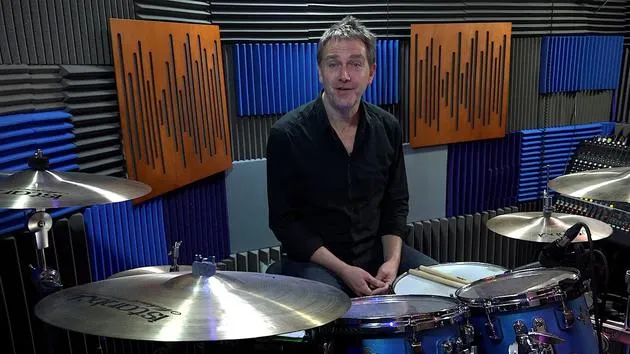
Paul Elliott partage une approche pratique du déchiffrage à la batterie, transformant les phrases à une seule ligne et à groove composite en une réponse automatique que tu peux lire à vitesse.

Le contenu du cours
29 leçons (2h 38min) · 1 gratuites
01. Hold The Line – Toto
2:49
02. Don’t Let Go (Love) – En Vogue
2:47
03. Window Seat – Erykah Badu
2:43
04. Chuck E’s In Love – Ricky Lee Jones
2:55
05. 444 – Jay Z
2:32
06. Hard to Handle – Otis Redding
2:39
07. Geek
2:27
08. Rollin'
2:39
09. Do Balanço
2:30
10. Tiberius
2:31
11. Smack Talk
2:25
12. Slam Dunk Funk
Leçon gratuite2:38
01. 444 – Jay Z (Analyse)
10:51
02. Chuck E’s In Love – Ricky Lee Jones (analyse)
12:28
03. Window Seat – Erykah Badu (analyse)
11:46
04. Hard to Handle – Otis Redding (Analyse)
7:23
05. Hold The Line – Toto (Analyse)
13:24
06. Don’t Let Go (Love) – En Vogue (Analyse)
6:55
07. Geek (Analyse)
14:24
08. Rollin' (Analyse)
6:10
09. Do Balanço (Analyse)
6:22
10. Tiberius (Analyse)
8:16
11. Smack Talk (Analyse)
7:17
12. Slam Dunk Funk (Analyse)
4:49
Transcription de la leçon
Music Lesson: Sight Reading, Interpretation, and Improvisation
In grades one to five, you'll be required to choose between sight reading and interpretation/improvisation.
The Importance of Sight Reading
You might ask the question, "Why do I need to read?" Well, sight reading is a really important professional skill with many benefits. If you find yourself in a professional context where you get a chart and have to read it, then you'll need to be able to read, this is very important.
At Rock School, we ensure this is a crucial criteria of the examination package.
Tips for Successful Sight Reading
Here are some tips to help you with:
- Single Line Reading
- Composite Groove Reading
These skills will aid your interpretation and improvisation. I will provide some practice systems on this and give you as much advice as I can.
The Process of Sight Reading
The process of sight reading typically involves:
- Looking at notes
- Putting those notes together into phrases
- Recognizing those phrases in a sight reading situation
Initially, when you're working on phrases, you're breaking them down very slowly.
Example: Listen to this 16th note phrase:
"1, 2, 3, 4."
When you first start looking at that phrase, you need to work out:
- What it looks like
- Why it's written like that
Then, you can hear that sound: "1 and a 2 and a 3 and a 4."
Eventually, you will have an automatic response to that rhythm when you see it written on the page. In practice, it is essential to work towards this natural automatic response, just like learning to string words together when reading.
Understanding Note Values and Phrasing
Every subdivisional note, pulse, and metric system will have a phrasing system attached to it. For example, with eighth notes:
- Tempo: 1, 2, 3, 4
- Possible phrases:
- Quarter Note Downbeat: 1, 2, 3, 4
- Half Beat: 1 and 2 and 3 and 4
- Two Eighth Notes: 1 and 2 and 3 and 4
These combinations of eighth notes come together to produce phrases.
Triplet Phrases
When playing triplet phrases, break them down into groups of notes:
"1, 2, 3, 4, 1, 2, 3."
You can subdivide those groups into different phrases. In the examination, you will be required to recognize and read those phrases.
- Example with triplets:
1 triplet, 2 triplet, 3 triplet, 4 triplet.
You can play:
- The last two triplets
- The first and third triplet
- The middle triplet
16th Note Phrases
For 16th note phrases, the more notes you have per beat, the more phrases you'll encounter in sight reading exercises.
Let's check this out:
-
Tempo: 1, 2, 3, 4
-
Playing four 16th notes:
"1 E and A, 2 E and A, 3 E and A, 4 E and A."
These can be broken into different phrases, such as:
- Common 16th Note Phrases:
- Example: Playing the first, third, and fourth notes
Start with:
"1, 2, 3, 4, 1 e and 2 e and 3 e and 4 e..."
Then try:
- The last three 16th notes
- The first two 16th notes
- The middle two notes
Practice Requirements
The practice requirements of this process include recognizing how those notes look and how those rhythms sound.
If you engage in sufficient practice, you will improve your sight reading ability in both musical and professional contexts.
Advanced Topics
We can also work through:
- 16th Note Triplets
- 32nd Notes
These will appear as you progress through higher grades.
Understanding the concept of recognition, note values, and subdivisions is key to advancing your skills in music.
29 leçons
2h 38m de leçons vidéo structurées
Fonctions vidéo avancées
Ralentissez, bouclez un passage, suivez la partition
Mobile, tablette et ordinateur
Pratiquez où vous voulez
Satisfaction garantie à 100 %
Garantie remboursement 30 jours







