



Analyse de Bourrée I, Bourrée II, Gigue avec Rachel Podger
Avec
Rachel Podger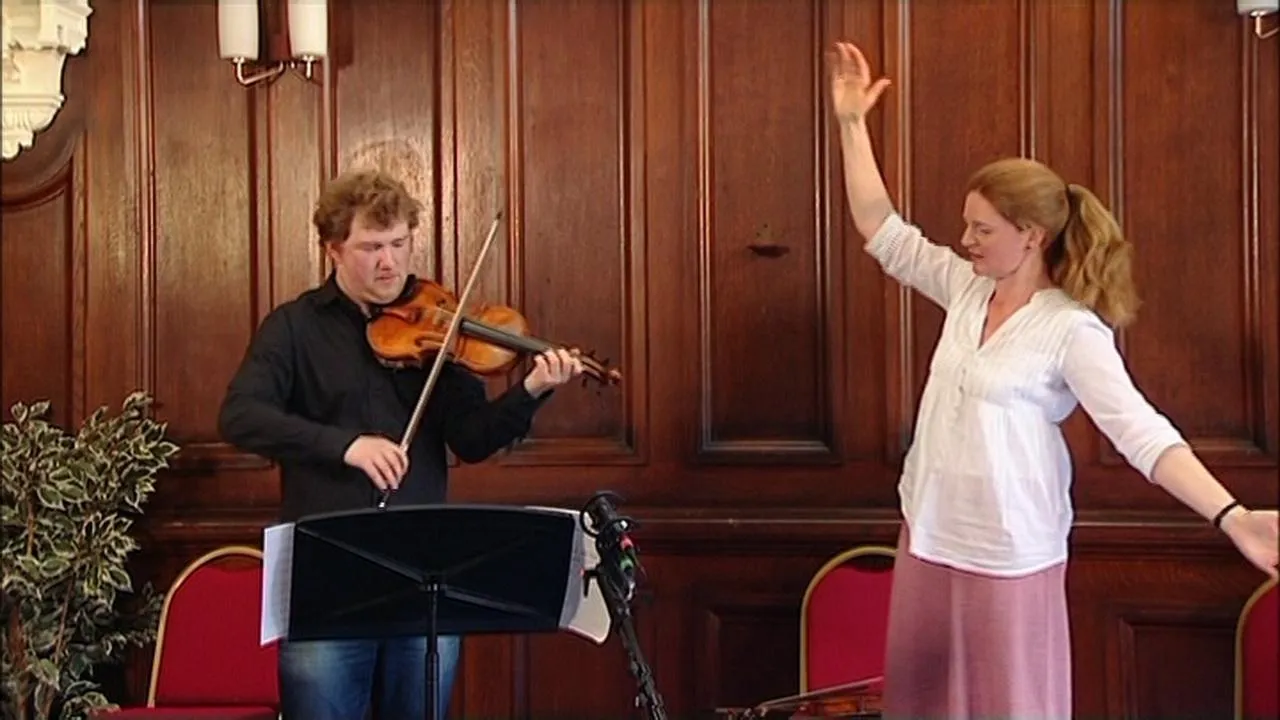
Le contenu du cours
11 leçons (2h 38min) · 1 gratuites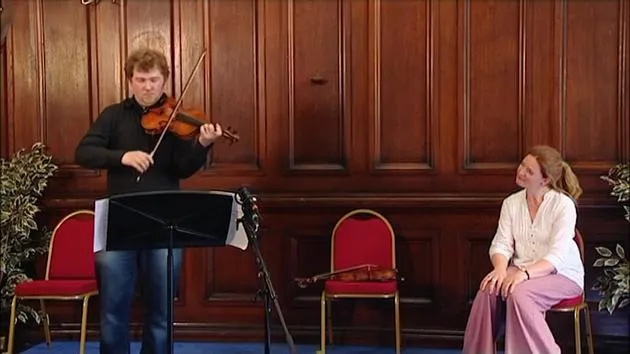
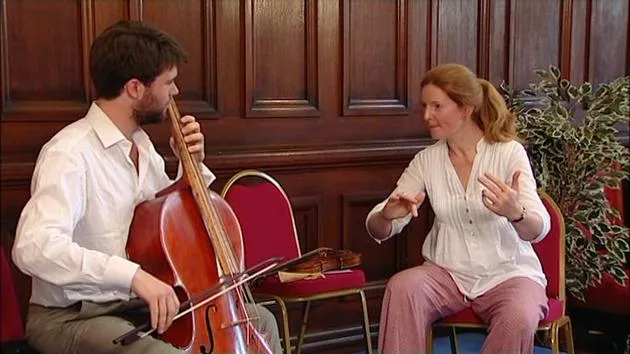
Transcription de la leçon
Music Lesson
Introductory Remarks
I thought that was lovely. Really spirited. And you looked like you were really enjoying it. You were, weren't you?
Yeah. And even though you say you've only just got this cello, I think you're making a really good sound.
About the Beret
The kind of essence of the beret. Of course, it used to be a kind of French folk dance, didn't it? It has that rustic nature, and I thought you brought that out really well.
Suggestions for Improvement
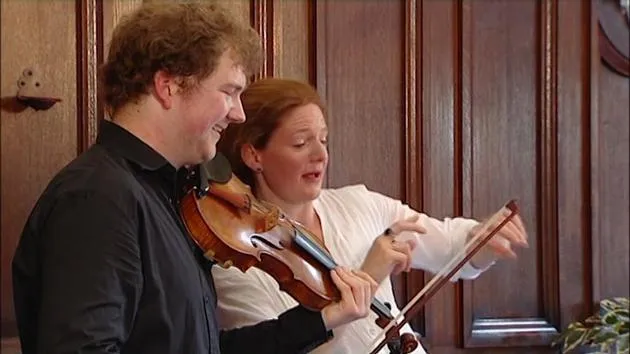
I was wondering whether you could sometimes have a little bit more space to bring out the different levels of the phrasing and also to highlight the bass notes within those phrases.
- For example: dee dee dee da da da di.
- Especially because this is obviously quite a large instrument, and because you're playing on gut strings.
- Gut strings take a while to speak, don't they? As you know, if you skim the string by accident or haven't got enough time to get into the string, it won't speak as well.
So, I think you could keep the spirit and rusticness that you have, which I think is great and really convincing, but occasionally you could allow for a bit more space and time in those places, even at the beginning, to really feel the different levels.
Speaking of Sound
What also helps with speaking of sound is going into the string immediately. Having a front to the note is really important.
And then, of course, when you are lyrical in the next one, or in the second half of the first beret, it becomes a bit more melodic, which was lovely. You have much more contrast when you're not doing the front of note business.
Then you have this great change when you go back to that.
Practice Exercise
Would you like to have a go? Can we do a little exercise where you just stop before you change the level? For instance:
da da da da. Just stop there to see how much time you need to actually catch the string.
Daddy. Da da da da da.
So we really hear the voicing.
Yes, and with lifting... dum t.
So.
Yes, yes.
And then would you say that those ones are...
Well, they seem to be connected to the beginning, don't they?
Explore Different Lines
- If you... What would happen if you just played the top line?
- Tum ta da.
Exactly.
And can you now play the bass of the bottom line?
Yes.
And that seems to want to grow, doesn't it? It grows when you play it all together.
It's great when you articulate it.
Dumb Bum.
So then we get the contrast with the top line and the bottom line:
- Melodic top line
- More articulated bottom line.
Should we try that together? But slower. Uh huh. Can you do it without the retake? Because when you're faster, you're not going to have time.
Focus on Technique
Yes, good.
You did have a bit of freedom before, which was lovely. I know it's a slower speed, but try to maintain freedom on the slur and then the punctuation.
Dump da good. Yes, that's the idea.
Instrument Characteristics
I mean, look at these strings; they're enormous. Really thick. Looks like they just came out of a cowshed.
It does take time, doesn't it? Just give us a little demonstration. If you play right on top of the string, what happens?
Yeah.
And can you play more into the string now?
Yeah. So it takes quite a lot of doing, doesn't it? You've really got a whole...
I think the contact here is so important, especially with those punctuated bits:
Dumb bum.
Feel like you're holding on for dear life on those. Then you can let go a little bit with your arm.
You never really let go here, of course, because this is basically our sound, especially with gut strings. But we let go, with more lyricism, only for a very short time and then you're back.
Dumb bar.
Try in Context
Should we try it in context once from the beginning?
Lovely. Very nice.
Phrasing and Musicality
Two other points:
- Could we have more sub-phrase at the beginning?
- So, di da dum. This is your introduction. It's rustic and French and folky, maybe a little more reflective.
Then when you go to the top...
Top.
So you can really let go a little bit. You don't have to hang on to the sound quite so much.
Yeah. Well done. Very nice.
Continue Progress
Let's go on a bit.
Very nice. The phrasing is really musical and logical. It's easy to understand, isn't it?
Absolutely. It's so important to do that. You really need to take the audience by the hand and lead them along the way of the story. Even if they might have heard this piece a hundred times.
Creating a Fresh Experience
Every time is a fresh experience, so it's important that you make friends with them and tell them the story. This includes a little bit more space and time.
- By the time what you're doing here arrives, it takes more time than it happening in your head and coming out here.
- You have to add a spatial dimension.
Imagine you are sitting there listening to it rather than just being involved in it.
Performer Awareness
As performers, we have to be a bit schizophrenic. We need to stay incredibly aware of how the audience perceives things while being self-possessed.
That's really great, but I think you can project it with more space.
This phrase here was lovely to come down a little bit, but then when you go towards the cadence...
Trying New Approaches
Could we have a bit more bounce and space between these bass notes and then the top?
Okay, yeah. Can we try that from the second half?
Good.
How about bouncing the ball a little bit more there at the end?
And now...
Yeah, to go on.
Good.
Again, let's add more punctuation so we can clarify the direction of the bass.
Could you give us the bass notes from this point?
Collaborative Singing Exercise
So actually, start there.
So I'll sing that bit. And then if you just play there...
La la la la la la la.
Something like that, yes.
So there are two voices happening at the same time.
Okay, you try that among yourselves.
Do you know what was good there? You did it naturally. You just took a little time to get into the bottom string, didn't you? You solved it yourself.
More Time to Express
That's exactly the thing to do. You've actually got a bit more time than you think.
Second Beret Exploration
Should we do a little bit of the second beret?
Can we have a little more gliding here, maybe? Because it's very linear, isn't it? You're doing a nice kind of...
You've got a bit of a feel for it, but I think you could do more. Also, it needs a bit more hierarchy in the bar because it's still the dance.
The hierarchy of the strengths of the beats in the bar underpins everything we do, of course, no matter how linear you go.
Rhythm and Direction
Let's try that.
Nice. Let's go on.
Uh-huh.
I think you wanted quite a lot of direction toward that; it was lovely. The thing about direction in a dance movement is that it's crucial to have the rhythm at all times.
In a way, I always feel that rhythm is at the middle of your being. It kind of comes from your stomach.
Do you know what I mean by that? Especially when standing as a fiddle player, it's great to feel that middle and, of course, in your feet too because of dancing.
How is it for you when you sit? Where do you feel it? Do you feel it in your feet?
Staying Grounded
Feet?
Yeah.
Yes.
And sitting down.
So if you feel the earthiness of that, the pulse will always be more apparent. Get in touch with that a little more, then you won't rush, and you can be as linear and have as much direction as you desire.
S.A. good.
Yes.
At the end, he's having quite a lot of fun, isn't he?
Ending Transition
So this is really something different. It's like he's lost the feeling of the earthy dance completely. We've gone into a different sphere.
That's lovely the way you were hanging on there. I think we need a bit more pulse there when we go back to the D.
Then, of course, the beginning of a sequence is always starting lower, maybe a bit more articulation.
D D D D and then you get the kind of feeling of the dance back.
And then towards the cadence, which is...
We always feel the punctuation there.
Final Details
I'd have a little bit more front to the note on the last note, especially as you have an octave.
Even though you're coming away, it's good to articulate it ever so slightly.
Should we go from that point?
Yeah, yeah.
Then we have approval.
That was really nice. What that made you do was take a bit of time. Did you notice that?
Yes.
It brings everything across much better also, creating a sense of hanging in the air and what it means to come back harmonically and then to drop at the sequence before moving to finish.
Conclusion and Reflection
So all those bits of information are so important, and there's so much in it, isn't there?
Should we do the jig?
Sa hold on. Enjoyed it?
Yeah, it's quite a complex piece, isn't it? Lots of information.
Overall Feedback
I think similar things apply, actually. I think you're getting around it beautifully, and it all makes a lot of sense. But you need to take more...
Yeah, let's try and take a bit more.
Yes, I know, of course, yes. Time becomes a different thing.
I'm sure you've all experienced this: when you're performing or under pressure in any way, somehow time kind of shrinks. You speak faster and everything.
The Role of Breathing
It comes from breathing. You breathe faster, and that's why we play faster.
I once, I think this is nothing to do with you, but I once made a recording in the middle of the night. It was the only way to get some silence. It was in the south of London and it was French music.
We did it in the middle of the night and thought the tempi were fine, but of course, we're used to having quite a low pulse during the night. Even though we prepared for being active during that time, the timings were skewed because everything was really slow, our heartbeats were just really, really slow.
So it was actually okay because we had beautiful, languid, French, complex harmony. It wasn't the end of the world.
But still, the timing is very important to understand. We can't actually change it; the only thing we can change is how to deal with it.
Dealing with Nerves
If you know that you're going to be nervous, there's no problem with that. If you accept it, then the nerves tend to diminish anyway by accepting it.
Then focus on your breathing. If you focus on your breathing while you practice, you'll know how you normally breathe, especially in that piece of music.
If you... then before you go on stage or while you're on stage or in between movements, you can home in on that experience of the breathing that you had while you were rehearsing.
So, you kind of home in on the association of feeling good. That really helps.
Technical Adjustments
Now, let's breathe a little bit more in this, especially between sections.
Just one technical thing with all the string crossings: especially with the slurred sections, I was wondering, where which part of the bow were you using those?
Yeah.
And also the dia, dia, dia before.
Yes, Mid.
Yeah, no, that should be fine.
I just want maybe a tiny bit more pressure and then a very quick release at the end.
So we don't get D.
So we don't do the ironing, but we're doing D D D.
Can you try that slower?
Yes.
Okay, now let's experiment. Let's do a little less release.
Good.
And now shape-wise, what shape are you after there? As in phrasing there.
Yes.
Singing Approach
If you sang it, how would it go?
That's lovely.
Okay. Yes.
You didn't need to sing it; you sang it on your cello team.
So there's a kind of circular thing going on. Three beats, three is always circular, isn't it?
Let's have a bit more of that feel. I think that will help. If you feel as if the string were...
If you see it as having this kind of depth...
Emphasizing Depth in Notes
You can play on the top, into the middle, and right down to the bottom.
And so maybe this bit, if you visualized it, you would be playing kind of middle to bottom rather than top to middle.
You start here and go in when you're phrasing.
At the beginning, Tim. Bom, bom, bom bom. But you never go above the middle.
I think that will help the sound.
Do you want to try that in context? A little faster?
Yeah.
Fantastic. It was so clear, wasn't it? Really good.
How about the arrival?
I'm not quite convinced about how you arrive at the end of that.
You're not convinced either. That might be why I was unsure.
Dean dum dum.
Does it need a little time?
Maybe.
Have you... you've tried an up though, haven't you?
I've tried down. I've tried up. I've tried...
Yeah.
Okay.
Final Approach to Expressions
How are you...? Because that one's a down.
So I was trying it down, down.
But then there's a bit of a hole in the middle which I wasn't so keen on.
Can I hear that? That'd be great.
Just play the top down.
Yeah, just play the top notes as if you were playing.
So they'd be a bit shorter.
They…
So a T.
Yeah.
And with the other notes.
Uh-huh.
And now with the feeling of a lift on the top note.
Uh-huh.
And now let's do the whole phrase and see if you can have a sense of arrival on the bottom.
It's very much in your system to do enough, isn't it?
I think, maybe at another point, try bigger.
Did you prefer the fact that it's connected? Is that where you lighten up?
Okay.
But I know, really, I should be doing down because of the...
It just feels a bit awkward, doesn't it, at the moment?
Yes.
Well, I just didn't like the sound of it.
But I can change it.
Open Exchange of Ideas
Yeah, maybe it's... well, it's not that. It's probably the pre.
Yes.
Deed.
If you feel free on that top note and free in the retake, it kind of becomes a more fluid motion.
Then I think it'll be much easier.
But we don't need to perfect things. This is not about getting perfect; it's about exchanging ideas.
Thank you very much. It was lovely.
11 leçons
2h 38m de leçons vidéo structurées
Fonctions vidéo avancées
Ralentissez, bouclez un passage, suivez la partition
Mobile, tablette et ordinateur
Pratiquez où vous voulez
Satisfaction garantie à 100 %
Garantie remboursement 30 jours
Rencontrez votre guru
Rencontrez votre guru
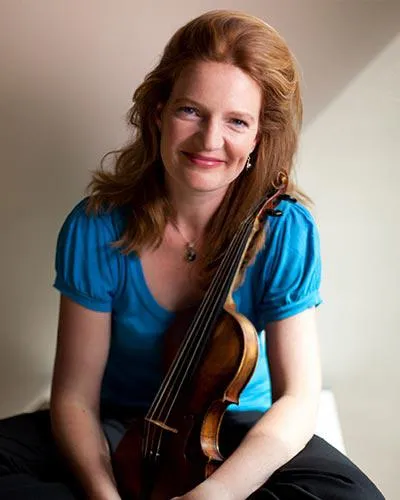
Rachel Podger est l'un des talents les plus créatifs à avoir émergé dans le domaine de l'interprétation sur instruments d'époque. Au cours des deux dernières décennies, elle s'est imposée comme une interprète de référence de la musique des périodes baroque et classique, avec de nombreux enregistrements à son actif allant de la musique du début du XVIIe siècle à Mozart. Elle a été formée en Allemagne et en Angleterre, à la Guildhall School of Music and Drama, où elle a étudié auprès de David Takeno et Micaela Comberti.
Après des débuts avec The Palladian Ensemble et Florilegium, elle a été premier violon de The English Concert de 1997 à 2002. En 2004, Rachel a entamé une direction invitée avec l'Orchestra of the Age of Enlightenment, en tournée en Europe et aux États-Unis. Un point culminant de cette collaboration a été un concert télévisé aux BBC Proms en 2007. 2009 a vu un enregistrement de la Sinfonia Concertante de Mozart avec l'altiste Pavlo Beznosiuk, ainsi que deux concertos pour violon de Haydn.
Au fil des ans, Rachel a mené de nombreuses collaborations avec des orchestres du monde entier ; parmi les projets qui lui sont chers figurent ceux menés avec Arte dei Suonatori (Pologne), Musica Angelica et Santa Fe Pro Musica (États-Unis), l'Academy of Ancient Music, l'European Union Baroque Orchestra et la Holland Baroque Society.
Dans son cours MusicGurus sur les œuvres de Bach pour violon et violoncelle seuls, Rachel ouvre ce répertoire fondamental et partage la manière dont elle l'aborde, t'aidant à apporter à ton propre jeu de Bach compréhension stylistique, phrasé et sensibilité baroque.
Crédit photo : Jonas Sacks







