



Comment commencer un morceau de boogie-woogie

Lesson time: (2min 58sec)
Tom explique pourquoi le boogie-woogie est son style de musique préféré et parle des pianistes qui l'ont inspiré en grandissant.
Course preview
This lesson is part of the course Deviens l'ultime « Piano Man »
Watch a preview of the full course below.
Lesson transcript:
Introduction to Boogie Woogie
One of my absolute favourite styles to play is boogie woogie.
The Components of Boogie Woogie
Now, I see boogie woogie as two things: the boogie and the woogie.
- To me, the left hand is the boogie,
- The right hand is the woogie.
There's certain things for both hands that you need to learn independently and then put them together.
What We'll Cover
Now, going forward, we're going to look at a few things:
- The left hand patterns
- The right hand patterns
- Different ideas on how to improvise
- Great endings
- Little breaks to give it that real authentic feel
Personal Journey
I've been so lucky that I've been able to sit and play the boogie woogie with my hero, Jules Holland. That's how I first got into this style of music.
- My grandad had the big band, but ultimately, I was introduced to Jules Holland and his Rhythm and Blues Orchestra.
- I went to see Jules and fell in love with that style of music.
- My piano teacher at the time bought me an album of Albert Ammons, Pine Top Smith, and all the greats of this style.
I knew instantly this is what I wanted to play. Actually, that was my second piano teacher that bought me that. The first teacher rang my mum after a few weeks and said, "I can't teach him. It's like he makes it up as he goes along." Luckily, I changed teachers, and he bought me that CD. I've never looked back.
Understanding Boogie Woogie
So we're going to start by looking at boogie woogie as what it is: blues. It comes from a very simple 12 bar blues pattern.
- Now, blues, of course, has many different meanings, often associated with emotion and sadness.
- But ultimately, boogie woogie is designed for dancing.
It's feel-good, uplifting, and it's great to play and listen to.
The 12 Bar Blues Format
Let's take the standard 12 bar blues format.
- We'll keep it in the simplest of keys: C.
The blues 12 bars are as follows:
- The first four bars are C
- The next two bars are F
- The following two bars are C
- One bar of G, one bar of F, and then two more bars of C.
This might sound a little bit complicated, but let's think about it in numbers:
- Let's use C as 1 (because we're in C)
- F is 4
- G is 5
So these are the bars written in relation to the notes within the scale:
1 - 1 - 1 - 1 - 4 - 4 - 1 - 1 - 5 - 4 - 1 - 3 (chords only).
Once you've learned that pattern, it can translate into any other key.
- For example, as long as you start on B flat as your 1, then E flat becomes your 4 and F becomes your 5.
You'll have a supplementing document that breaks that down.
It's really simple, but get your head around the 12 bar pattern. Once you've learned that, we're good to go!
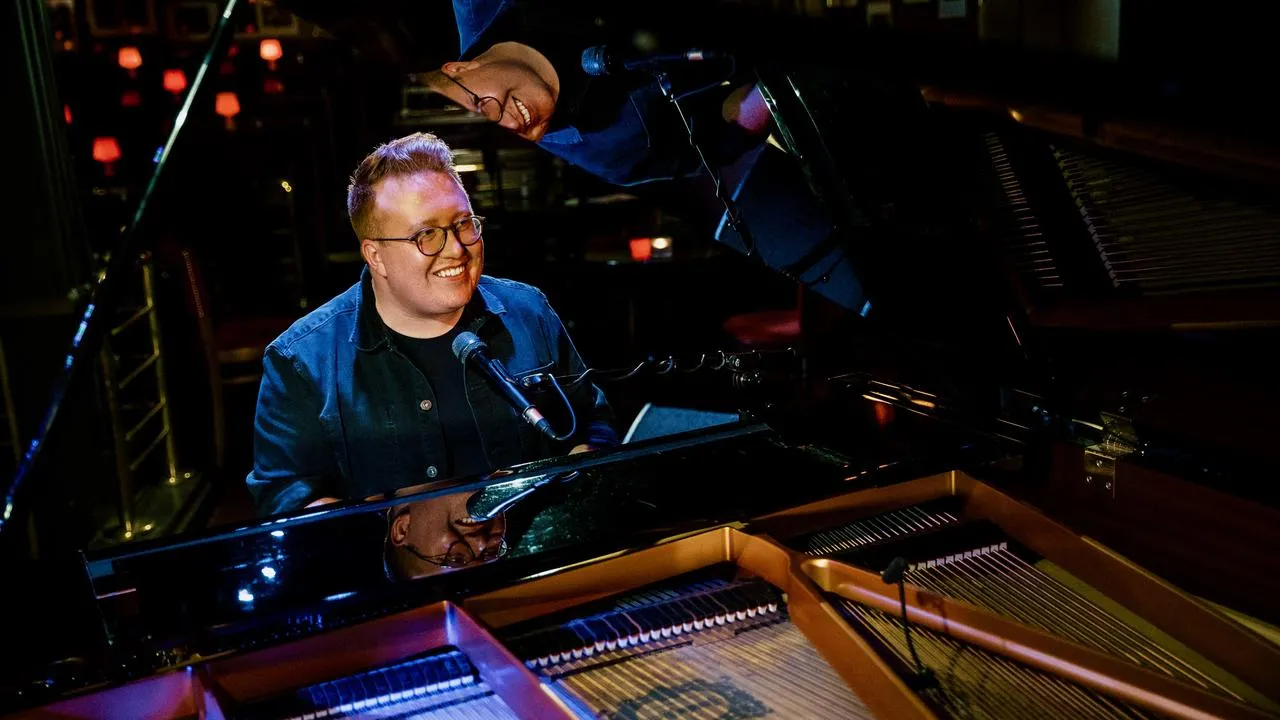
About the instructor
Le titre de Piano Man du Royaume-Uni a longtemps été détenu par Elton John, Jools Holland et Jamie Cullum. Au cours des cinq dernières décennies, personne d'autre ne s'en est même approché... jusqu'à aujourd'hui ! Tout juste sorti de sa tournée à guichets fermés "Let The Good Times Roll", Tom Seals - "tout simplement peut-être l'avenir du jazz et du blues" - tient le monde au bout des doigts. Son jeu de soliste virtuose, son excellent sens de l'improvisation et sa voix singulière ont conduit de grandes figures de l'industrie à le saluer comme le meilleur pianiste et chanteur de boogie woogie et de blues du Royaume-Uni. À peine âgé de vingt-cinq ans, Seals a déjà donné des concerts à guichets fermés aux quatre coins du globe, dont le légendaire Ronnie Scott's de Londres, une performance éblouissante au Birdland Jazz Club de Broadway à New York, et des collaborations avec Jools Holland. Apparitions notables : 'Gregory Porter & Friends' du Cheltenham Jazz Festival 'Boogie Woogie & Blues Spectacular' de Jools Holland Birdland Jazz Club, New York British Summer Time - Hyde Park Ronnie Scott's Jazz Club Gisburne Park Pop-Up Montreux Jazz Festival Cropredy Festival The Steinway Two Pianos Festival Glastonbury Newark Showground "Drive-In" Blenheim Palace Dans son cours, Tom dévoile les secrets de son jeu - en vous montrant comment faire swinguer les standards au piano, construire d'authentiques lignes de boogie woogie et de blues, et trouver la liberté d'improviser - pour que vous deveniez à votre tour l'ultime Piano Man. Vous pouvez lire la biographie complète de Tom sur www.tomseals.co.uk. read more