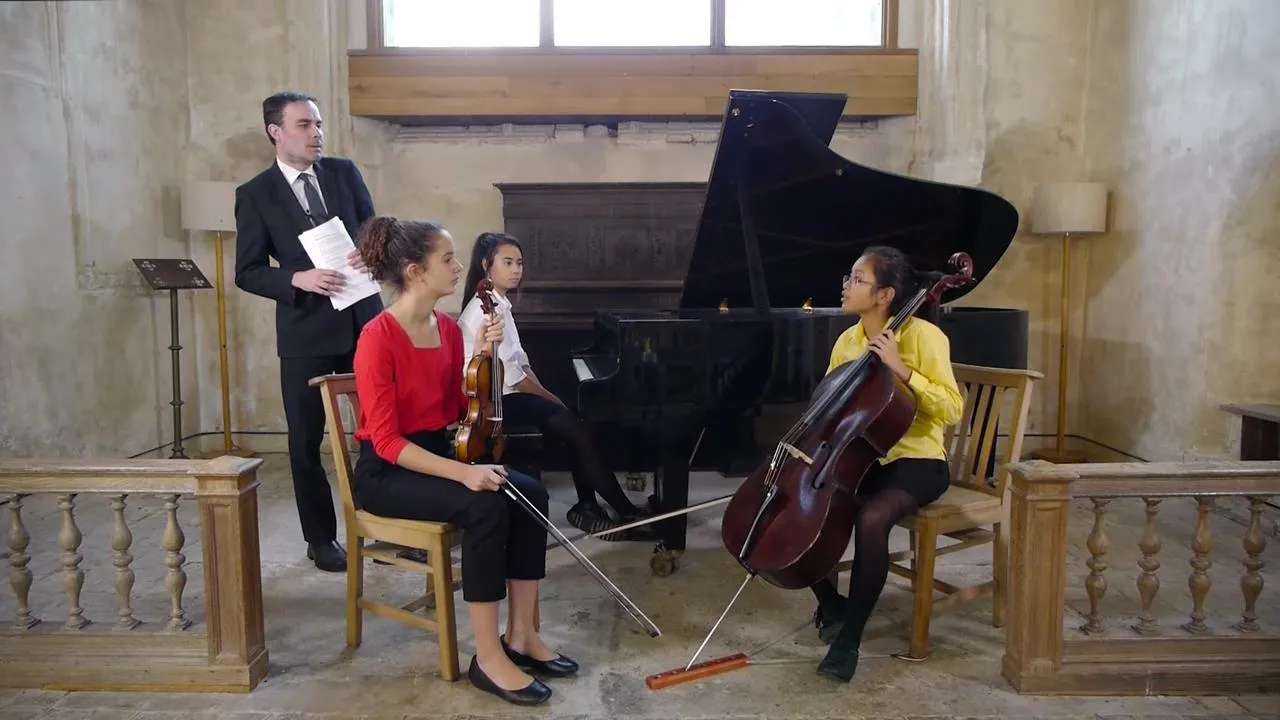
Exercice avec des élèves
Lesson time: (10min 25sec)
Andrew Quartermain travaille avec un groupe d'élèves pour mettre en pratique son troisième conseil pédagogique, en faisant ressortir les échanges qui font fonctionner un petit ensemble.
Course preview
This lesson is part of the course Créer de petits ensembles créatifs
Watch a preview of the full course below.
Lesson transcript:
Creative Ensemble Session: Exploring Chamber Music
In this first creative ensemble session, we can explore some quite advanced issues of chamber music, allowing our students to discover these concepts from within the group.
The Essence of Chamber Music
Chamber music, or small ensemble performance, is not just about teamwork, which is, of course, a fundamental aspect. It involves:
- Team Play: You have to respect each other equally.
- No Prima Donna Soloists: Each member must be a part of the group.
- Equal Creators: There is no conductor directing; everyone contributes equally to the performance.
This collaboration is what makes ensemble playing so special.
Key Skills: Leadership and Spontaneity
A small ensemble is also about leadership, which is one of the key transferable skills from this work. This skill can significantly:
- Influence Career Progression: It builds confidence to venture out into the world.
- Foster Natural Leaders: Helps students become comfortable in leadership roles.
During our next and final creative ensemble demonstration, we'll show how this layered textual improvisation can serve as a lesson in spontaneity. Spontaneity in music is vital, it teaches:
- When to Lead: Knowing when to take charge of an idea.
- When to Follow: Realizing when to support another's idea and help bring it to life.
Modal Harmony: A Wonderful Platform
We will utilize modal harmony, which allows for:
- Good Clashes: In cases where there are clashes, they are often beneficial.
- Layering Ostinati: Creating repeated phrases in different orders.
Activity Instructions
-
Starting the Improv:
- I'll start from the piano.
- Isabella, you will follow on the cello.
- Once you begin, keep playing, like diving into a pool, just keep swimming.
-
Calling Names Randomly:
- Emily and Nicky, I'll call your names in random order. When called, burst out of the texture and become a soloist.
- Do something distinctive with your improvisation!
Discussion: Ideas for Soloing
Before we start, let's discuss how to stand out:
-
Isabella: What can you do to burst out from the texture?
- "Change the pitch."
- Absolutely! Higher or lower is an excellent suggestion.
-
Emily:
- "Be more free with dynamics and create contrast."
- Great! Dynamics are a vital part of this palette.
-
Nicky:
- "Shape the way we play the notes."
- Exactly! Articulation is essential.
Demonstration of Articulation
Using a simple four-note ostinato, we can show how changing articulation makes a significant difference. Just shifting how we play these notes can create a distinctive sound that stands out.
Embrace Experimentation
As teachers, remind your students that this is an experiment. Just like in science, experiments can go wrong, and that's okay! Embrace the discovery process.
Engaging in Layers
Now, let's create our layers and I will call out names for solos:
- First Soloist: Emily, brilliant!
- Next Soloist: Nicky, fantastic!
- And then: Isabella, well done!
After each solo, return to your ostinato. Finish with two more phrases and find any note to conclude.
Reflecting on the Experience
How did that feel? Were you able to hear everyone? Great! We had some imaginative solos, and it worked well.
- While you played, I was adding some variation on the lower half of the piano, introducing dissonance and different articulations, which we will discuss in our tips.
Flow of Learning
The aim is to create a flow during the lesson where students learn as they go. This session isn't just about talking and then playing; it's about active engagement and learning through experience.
Knowing When to Step Back
It's vital to know when to step back. Some students might need guidance, and even advanced musicians may require support at times.
- When you pull back, it allows students to take full ownership and enjoy their learning journey.
Final Demonstration
For our last piece, let's create the texture and then I'll physically move away from the group. Body language plays a critical role in establishing dynamics within the ensemble.
Now, keep playing even when I stop, and simply enjoy the process. Let's go around: piano, violin, cello this time.
Conclusion
What a wonderful piano trio! That piece didn't exist a minute ago; now it does, and it was wonderful. Seeing the students take ownership at that moment signifies they are now fully-fledged chamber musicians, ready for the great works of Beethoven, Mendelssohn, and Ravel.
As you guide your students, feel free to intervene if the pulse dips, but remember the importance of pulling back to let them navigate their journey.
Well done, everyone!