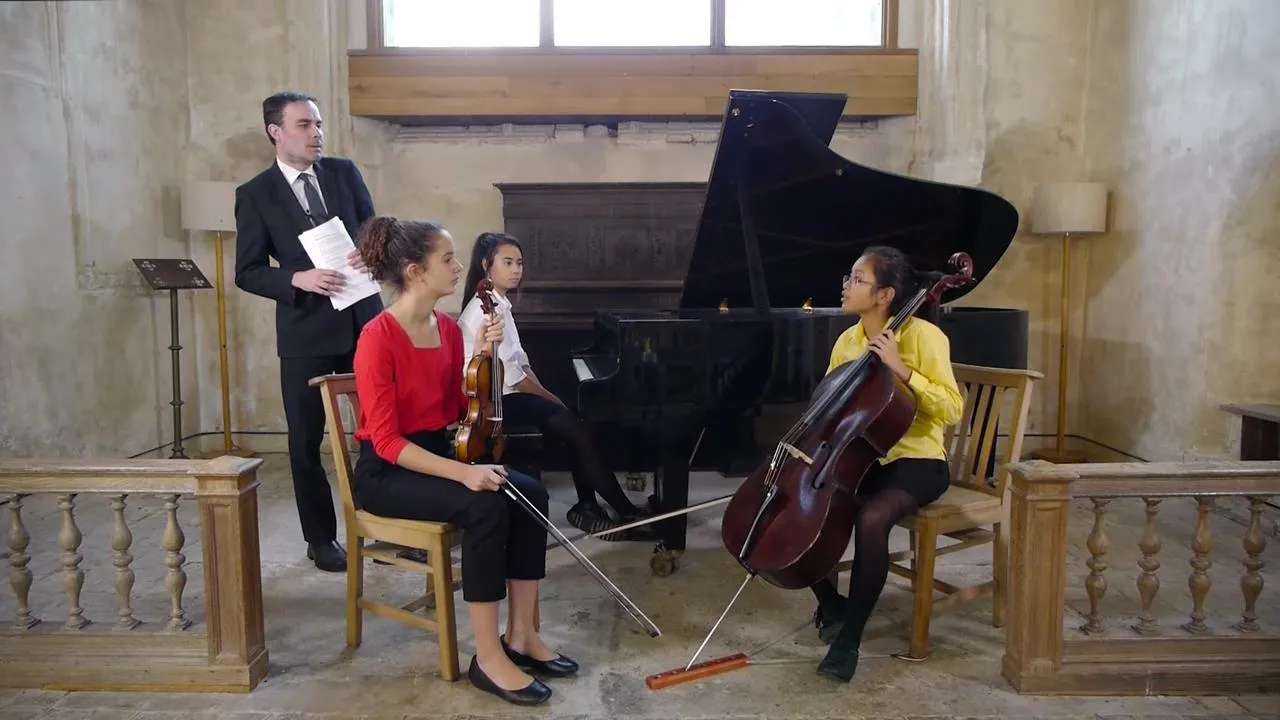
Conseils pour les professeurs n° 2 - Susciter l'intérêt
Lesson time: (3min 42sec)
Conseils pédagogiques pour enthousiasmer un petit ensemble dès la première séance, en utilisant l'improvisation libre plutôt que le répertoire pour éveiller l'intérêt des élèves.
Course preview
This lesson is part of the course Créer de petits ensembles créatifs
Watch a preview of the full course below.
Lesson transcript:
Creating Excitement in the First Music Session
One of the crucial things in this first session is to make sure that the students are completely excited about what they're doing.
Focus on Improvisation
- Okay, we've taken the printed page away.
- We're not, for very good reason, working with repertoire in this first session.
- But we don't want them to just feel that it's some kind of technical exercise.
Improvising together can explore the most amazing structural journey and the most amazing journey of musical color. We don't need repertoire for that.
Planting the Seeds of Interest
As the leader of the session, it's very important that you are, as it were, just planting those seeds, little, little sparks of interest that get the students, without necessarily even realizing it, excited and going in different directions.
Using Modal Harmony
When I lead these sessions, I tend to almost exclusively work with modal harmony. This adds so much interest and provides numerous possibilities. It means that students are not worrying about clashes, modulation, or feeling the need to get their Grade 5 theory book out. Modal harmony really gives that lovely kind of baseline of a sound world that can excite them.
Introducing the Dorian Mode
The most obvious one is the Dorian mode on D.
- Leading this from the keyboard, whether the teacher is a highly experienced pianist or not, is in a way the easiest one to do.
- You can root it onto D, explaining to your students that this is basically C major starting on D, or you can say that it's D major taking the sharps out.
Here, of course, is our Dorian modal scale on D.
Creating a Musical Kaleidoscope
A musical conveyor belt within that harmony works really well. However, you want to change the direction a little bit and give them some adjustments of color, so that this improvisation becomes a wonderful musical kaleidoscope.
- This is why it's good to add little nuggets or touches of color, possibly the odd discordant note into what you're doing.
The Importance of Pulse and Phrase
We've talked about the importance of pulse and phrase.
- Maybe with one hand, that's keeping going, and with the other hand, you're adding little sparks of color like this.
- All I'm doing is just taking one note at a time, perhaps playing that note as an offbeat, giving them that little interjection into the texture and flow that adds color.
Maintaining Continuity
The crucial thing is that you haven't stopped the session. You haven't explained, "Okay, now we're going to modulate. Let's just talk about what that is."
It's so important that this is about continuity, that they're always playing. The little things that you're adding in your backing for this improvisation session are very important.
- They should just happen naturally, thrown in without explanation, adding to the fun and the understanding that the students will be gaining from this session.