Conseils pour les enseignants n° 3 - Répondre à leurs besoins
Lesson time: (4min 25sec)
Comment diriger un petit ensemble aux instruments et aux niveaux variés : sentir l'ambiance, t'adapter sur le moment et renforcer la confiance de chaque musicien.
Course preview
This lesson is part of the course Créer de petits ensembles créatifs
Watch a preview of the full course below.
Lesson transcript:
Music Lesson: Leading Group Sessions
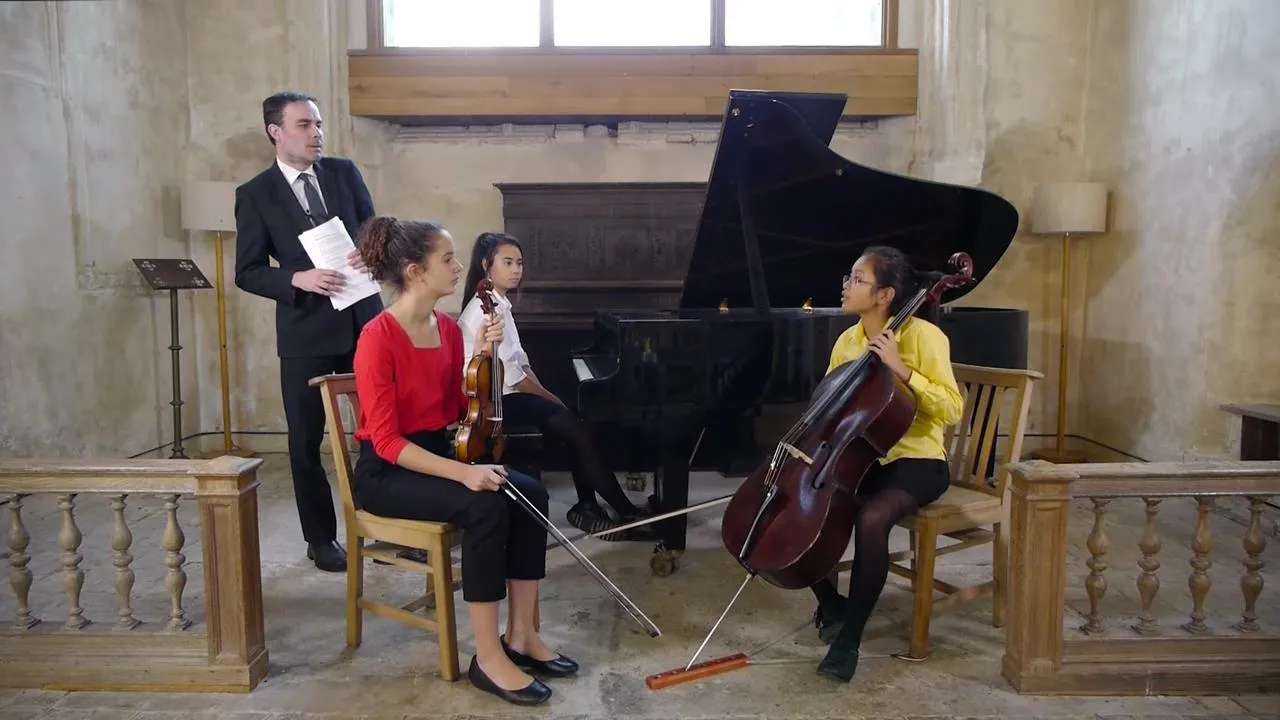
One of the crucial things here is that we might be working with a group that responds immediately to this work. They might all be at the same level as musicians and instrumentalists, but very often they're not.
I go to a lot of schools up and down the country where I don't know before I get there the level of the musicians I'll be working with, as well as the instrumental combination.
Varied Instrument Combinations
- I've led sessions with:
- Three trombones
- A tuba
- A cello
- I've also had:
- Four double basses
- A harpsichord
The combination can be totally bizarre. And that's a good thing! This really can be led with any instrument and any degree of level.
Instilling Confidence
Of course, it might be that mid-session, one player, let's say out of three or four, is not coping as well as the others. One of the crucial things here is that we're instilling confidence. We're really making them think about performance.
The last thing we want is for one person to think, "Oh no, I can't do this." So, it's very important that we never single one student out. We always make it about the group and taking shared responsibility.
Adapting to Challenges
As the leader of the session, it's essential that you're reacting on the spur of the moment to something that might be going on. Sometimes, things might go horribly wrong, so:
- Make a joke of it.
- Remind your students that there is no such thing as a wrong note in improvisation.
- It's only a wrong note if they say it's a wrong note, because it's their creation, so it's not a wrong note.
Another important aspect of your leadership in the session is to "right the boat," if the improvisation has gone slightly wrong. If the pulse has been lost or if one player has struggled, there are ways to adjust.
Key: Articulation
Let's imagine that you've set up that musical conveyor belt with your Dorian mode harmony.
- It flows nicely, but then suddenly your cellist stops.
- You notice there's a bit of upset, maybe the communication has broken down or there's not much pulse.
Don't stop the session.
- Don't analyze with them; keep going but adjust.
- That ostinato, the musical conveyor belt you've set up, can be adjusted with lighter articulation that emphasizes the upbeat and downbeat.
For example, you could stop the flow of the actual notes and switch to just a repeated chord.
Returning to the Pulse
You could:
- Change the articulation of what you're playing
- Make it lighter
- Make it more staccato
This bounce on the first beat, for example, instills the pulse that may have gone a little bit awry.
If it continues to drift off, that's when you might want to introduce that repeated chord to really emphasize the pulse again.
Remember:
- Your students will think it's just part of the accompaniment, part of the backing, that it was meant to be.
By doing that, you haven't stopped the session or shone the spotlight on one student. This approach ensures that no one feels they are a lesser musician or less skilled.
Collective Responsibility
You've helped them realize that as a group, collectively, they can get back on track, managing it themselves and taking responsibility. They've become leaders and team players in equal measure.
It's a very subtle aspect of leading a session, and articulation can really help with that direction.