



Bottleneck March (leçon)
Lesson time: (10min 31sec)
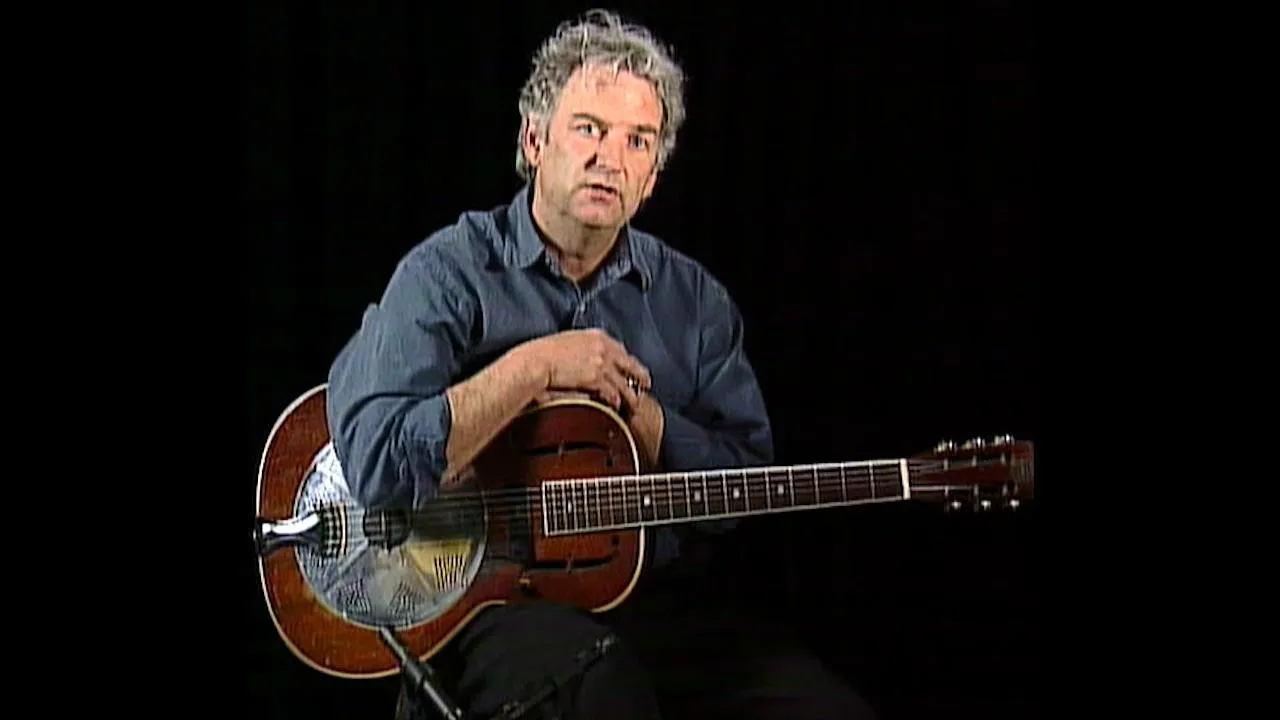
Mike Dowling enseigne « Bottleneck March » à la guitare acoustique en accordage de Ré ouvert, en abordant le travail de slide, les pull-offs et les syncopes de fingerpicking qui font avancer le morceau.
Course preview
This lesson is part of the course Uptown Blues (guitare American Roots)
Watch a preview of the full course below.
Lesson transcript:
Bottleneck March Music Lesson
All right, here's my tune: Bottleneck March. It's not truly a march, but please don't hold that against me. This is the only tune I'm playing today with my finger picks on.
As in Johnson City Rag, there are a couple of little fingerpicking syncopations that are good to get under your control. This will help you achieve as smooth an execution of this tune as possible.
Techniques and Tips
- If I'm up here implying E at the seventh fret, you can see the pull-off there.
- If I get the bottleneck out of the way for a moment, you can see what I'm doing.
- There's my pull-off, strike two, and then I pull off as I'm bringing my thumb up.
Pinching Notes
- Pinch, single note, pull-off to get that second bass note along with it. This is a pinch generated by a pull-off.
- I would describe that if I slid with my little finger from the 8th to the 9th fret on the B string.
- When I got to the ninth fret, I added my bass note: one and one.
Let me put them together. That's the opening phrase. And there's my A7 (or my A chord) up there.
Detuning Explanation
I'm in Detuning here. If you're not familiar with that, you've got:
- Low D
- A
- D
- F#
- A
- D again.
You might notice in my performance of this piece and as I'm teaching it that, for some reason, to get my fretted notes in tune up high at the ninth fret, especially on the B string, I've just put a little piece of plastic under the string there, creating a partial fret.
This allows me to play this song in tune, especially for my high fretted passages. When I come open, it's still in tune for me. Why it works, I don't know, but it's something that I'll continue to do.
Tuning Observations
- G tuning is fine.
- In standard tuning, it seems to be fine as well.
- There's just something about that detuning that helps.
Starting the Tune
Let's get back to this tune. To start, I'm going to have a series of forward rolls.
The cadence would be:
1 and 2 and 3 and 4 and 1 and 2 and 3 and 4 and 1 and 2 and 3 and 4.
I'm sorry.
Let's try again: 1 and 2 and 3 and 4 and 1 and 2 and 3 and 4, 1 and 2 and 3 and 4.
Okay, that's the intro. A lot of people ask why I play with the bottleneck on my third finger. Most people put it on their pinky.
If I had it on my pinky, I wouldn't be able to play this song. I probably wouldn't have written it the way I did. Having the bottleneck on my third finger allows me to make these reaches that span an extra fret that I wouldn't have available if using my pinky.
Balance and Technique
As far as playing these fretted tones, I like the bottleneck there because it feels balanced in my hand.
In the 7th position, I'm making a D chord, but putting it way down here. I have my ring finger free for the bottleneck while I'm moving it down. That's my turnaround.
This is a useful turnaround for the key of G and also works in standard tuning as well.
Second Part of Bottleneck March
Here's the second part of Bottleneck March:
- Surrounding tones for my D chord.
- A B flat chord with my same high D in the melody.
- Now, here I'm thinking I can be a little bit raucous this way: back to D, back to B flat, back to D.
That was my A passage, sort of. Then I play the theme again and use the introduction as a little interlude.
Pull-off Forward Roll
The bottleneck's probably in the way there, so let me get rid of that.
This sets up the next part of the tune: pull-off forward roll.
- A diminished D diminished, this little five-note thing is kind of interesting and fun to play.
- It starts with a thumb: thumb, thumb, index, middle, thumb.
Final Part
Now, onto the final part:
- A low octaves.
- A da da da da da da da da da da da da da.
- It's a common ragtime syncopation.
Diminish back to D, E, and back to D.
Now all that's left to finish out this tune is to play part one again.
I won't play the whole thing again; I'll just play the last part for you. You can see what I'm doing with my right hand there, just single noting those going out seventh harmonics.
See if you can capture those harmonics. Hit them at the 12th fret while they're ringing. Try to pick it up!
There it is on the first string, but you want to get more.
Alright, there's the Bottleneck March. Good luck with it!
About the instructor
Lorsque le grand Vassar Clements, aujourd'hui disparu, a entendu Mike Dowling jouer de la guitare en 1975, il a fait la chose la plus sensée. Il l'a engagé. Mike était le guitariste du premier groupe de tournée de Vassar et on peut l'entendre sur son “Nashville Jam”, nommé aux Grammy. Clements le décrivait simplement comme “l'un des meilleurs guitaristes qui soient, où que ce soit”. Ce sentiment est partagé par un chœur toujours plus nombreux de critiques musicaux, d'élèves guitaristes et d'amateurs de musique acoustique du monde entier. Mike puise en profondeur dans le riche bagage de la guitare des racines américaines, avec une prédilection pour le style Piedmont mélodique de maîtres du blues acoustique comme Mississippi John Hurt et le grand slidiste Tampa Red. Mais on ne peut pas cataloguer Mike comme un bluesman, ni même comme un fingerstylist. Il est bien trop polyvalent pour cela. Du blues au bottleneck au jazz d'autrefois et bien d'autres choses entre les deux, la musicalité, la profondeur et la maîtrise de l'instrument de Mike se transposent avec aisance aussi bien sur les guitares à table plate que sur les archtops et les résonateurs. Interprète, compositeur, professeur, musicien de studio, inventeur : tout ce que fait le guitariste Mike Dowling reflète son amour et sa maîtrise de l'instrument qui est au centre de sa vie depuis plus de quarante ans. Dans ses cours, Mike ouvre pour toi le sac à malices de l'uptown blues : un fingerpicking Piedmont détendu, une basse régulière au pouce alterné, des traits en notes simples pleins de swing et les figures de slide et de bottleneck qui donnent son âme à la guitare des racines américaines - le tout enseigné avec le même feeling qu'il insuffle à chaque note. “Un excellent instrumentiste à l'aise dans une large palette de styles musicaux. Il insuffle du feeling à chaque mot et à chaque note.” --Hit List, Acoustic Guitar “Dowling est un guitariste fluide et précis, et son chant éraillé possède un côté espiègle et bondissant très attachant.” --Dirty Linen read more