



Gammes de blues en première position

Lesson time: (5min 48sec)
Mat Walklate montre comment jouer le blues en première position sur un harmonica diatonique, y compris quelles notes aspirées éviter tout au long du douze mesures.
Course preview
This lesson is part of the course Gagner en fluidité à l'harmonica blues
Watch a preview of the full course below.
Lesson transcript:
First and Third Position Playing
Hello, my name is Matt. In this lesson, we're going to look at a little bit of first and third position playing.
Introduction to Positions
The vast majority of the time, given a choice, most people play blues in second position using the blues scale that's readily available on a diatonic harmonica. However, you can, in theory, play blues in 12 positions because there are 12 keys in music. Most people don't tend to stray above third position.
So far, we've done a fair bit in second position. Let's have a look at first position.
Understanding First Position
First position involves playing a C harmonica over a blues in C. It's trickier than second position because we're fighting against the major scale. We don't have a blues scale in C; we have a major scale, so there are certain notes we need to avoid at certain times.
Key Points to Remember
- For the vast majority of the 12 bar blues in first position:
- Avoid 1 draw and 4 draw.
- These notes sound weak except in bar number nine, where they sound fantastic.
To master first position, it's crucial to understand the structure of the 12 bar, or at least anticipate when these sections come up.
Recommended Notes for the First Eight Bars
- Best to stick to:
- 1 blow
- 3 draw
- 3 blow
- 2 draw (which is the same note)
- 2 blow
- 1 blow
Working with Riffs and Tongue Blocking
There are certain little riffs and licks that work quite well in first position. Tongue blocking can help a lot here because we rely on more blow notes than in second position.
If you can tongue block on full blow, you can give it a bit more oomph.
Example Riffs
- Riffs based around 4 blow.
- A tried and tested one starting on 2 draw:
- It sounds like this: 2 draw (bend in hole number two) ➔ 2 blow ➔ 1 blow.
If you have the time and inclination, you can explore using the two bends in hole number two and all three bends in hole number three. In second position, we don't tend to use the third bend in hole number three because it sounds a bit rough, but in first position, we sometimes do.
Limitations of First Position
First position is more limiting than second position but has a different flavor. It doesn't have to be played slowly; you can play it fairly rapidly as well. However, if you're not careful, you can soon run out of road. There's only so much you can do in first position, so it's best to keep it fairly sparse; otherwise, you run out of ideas fairly quickly.
High-End Play
At the top end of the harmonica, you tend to play mainly blow notes and use the blow bends.
Note: I won't demonstrate this on a C harmonica because it's quite shrill. It's usually better done on a lower-pitched harmonica, like one in A or one in the key of G, where it's a bit more mellow.
Conclusion
For this lesson, when I assemble the band in a moment, we'll record a little 12 bar in the key of C so you can hear how this sounds using just the first four holes on the harmonica.
So now, let's play a couple of 12 bars in the key of C, and I'll play a C harmonica that puts me in first position.
Take it away, gents!
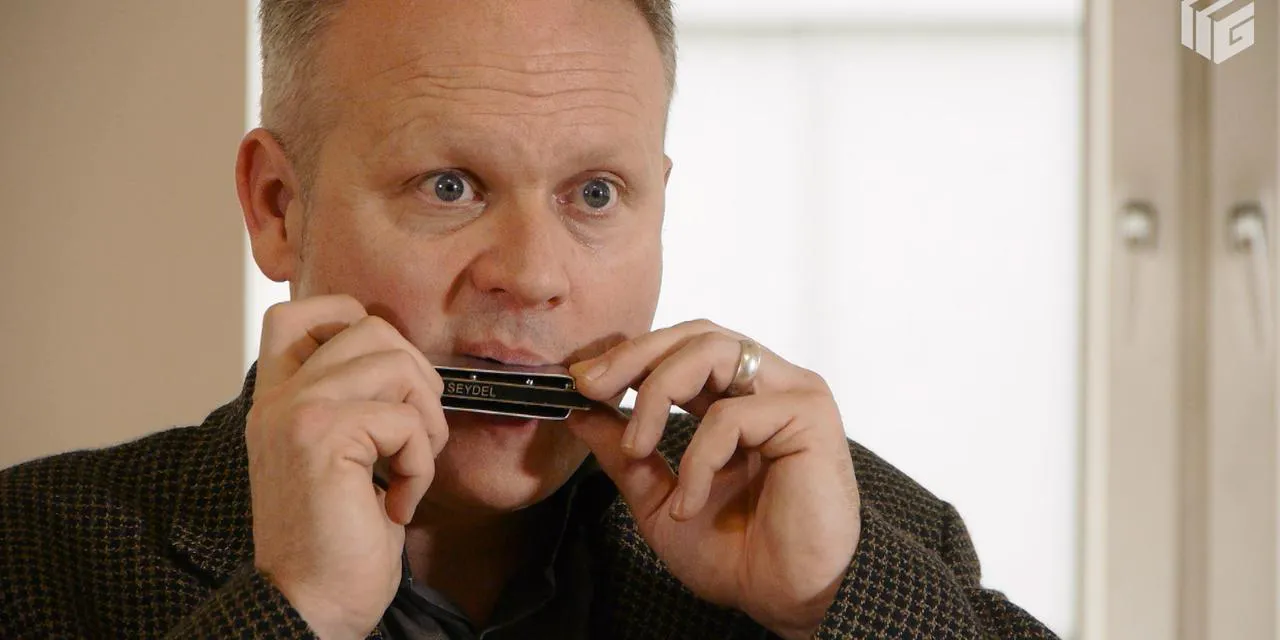
About the instructor
Mat Walklate est un harmoniciste et professeur installé à Manchester qui évolue dans le blues et le folk, et qui joue aussi de la flûte, du whistle et de l'uilleann pipe et chante. Il a remporté le British Blues Harmonica Championship en 1992 et le All-Britain Fleadh Cheoil à l'harmonica en 1993, et il est artiste endossé par Seydel.Au cours d'une carrière de trente ans, il a tourné en Europe avec des groupes tels que The Moochers et le groupe de musique irlandaise The House Devils, a enregistré et mixé quelque quatorze albums entre 2001 et 2021 — parmi lesquels Sea of Blues et Traditional Harmonica — et se produit désormais en duo avec le chanteur-guitariste Alex Haynes et aux côtés du spécialiste du blues Dr Tom Attah. Il enseigne l'harmonica au Leeds Conservatoire et en privé.Sur MusicGurus, ses cours te mènent de tes premières notes sur un harmonica en Do — embouchure, position cross-harp, bendings et ta première improvisation — jusqu'à un jeu de blues fluide, avec vibrato, positions alternatives et le phrasé qui fait chanter un solo. read more