



Le rythme et la main droite

Avec
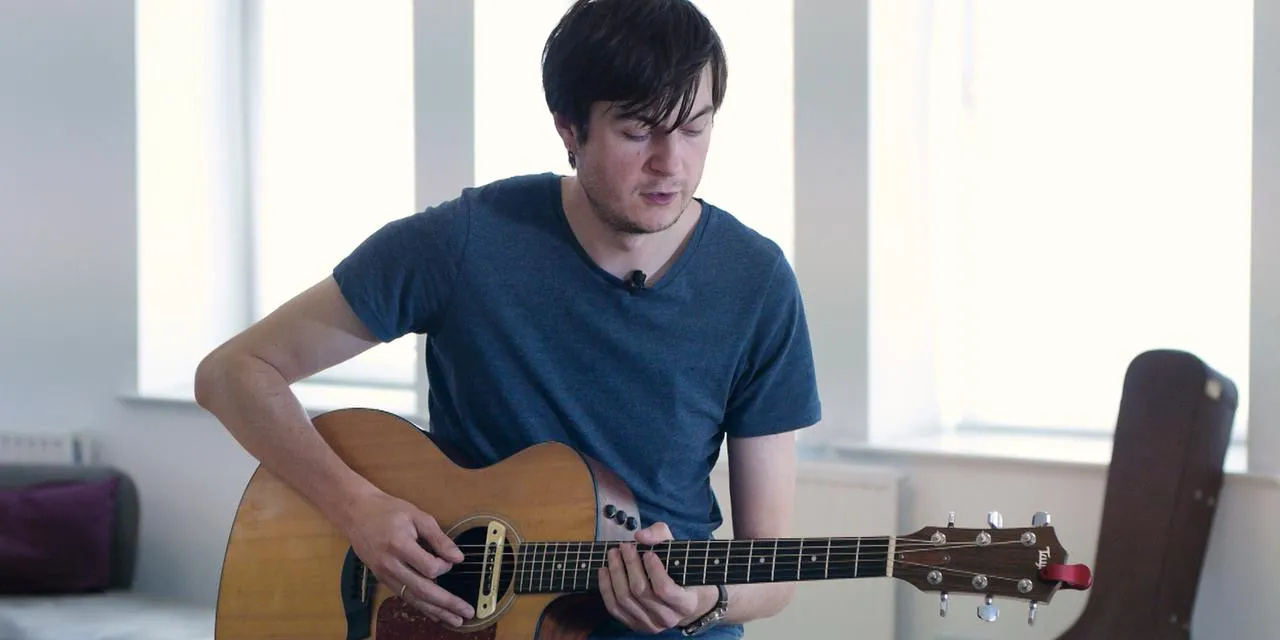
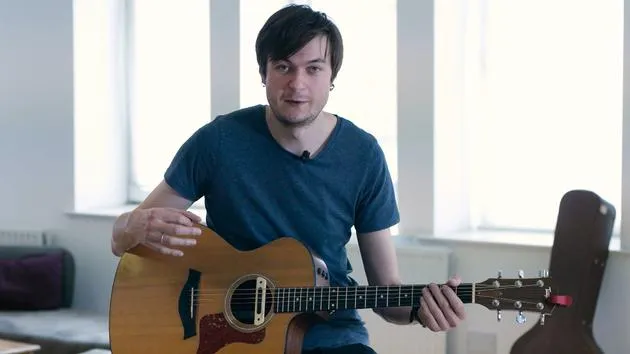
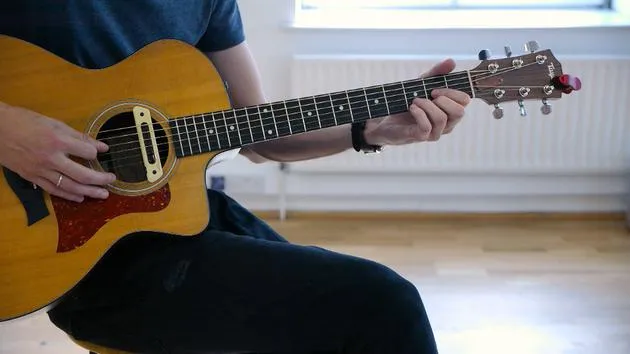
James BarrattJames se concentre sur la main de la rythmique, en partant des noires pour construire des motifs en croches, des ghost strums et des doubles-croches sur une position stable de mi mineur.
Le contenu du cours
14 leçons (2h 12min) · 1 gratuites
01. Accordage
13:34
02. Pour commencer
Leçon gratuite9:58
03. Technique de base
9:01
04. Accords ouverts
6:24
05. Progressions d'accords
7:57
06. Le rythme et la main droite
Tu es ici11:56
07. REM - Everybody Hurts
9:01
08. Bryan Adams - Run To You
3:23
09. Palm muting
3:16
10. Legato
8:47
11. Michael Jackson - Beat It
5:23
12. Bending
15:36

13. Accords barrés
11:35
14. Récapitulatif - AC/DC Back In Black
16:56
Transcription de la leçon
Music Lesson: Rhythm and the Right Hand
Introduction
Hey, guys! So today's lesson is going to be all about rhythm and the right hand. Okay?
We've previously looked at a bunch of open chords with the left hand and how to focus solely on the left hand while doing something straightforward with the right hand. Now, we're flipping that around.
Lesson Focus
We are going to look at our right hand while keeping the left hand in a straightforward static shape. For this whole lesson, we're going to be using E minor and nothing else with the left hand. It's all about the right hand.
Up until now, when we've been working on our chord progressions, we stuck to a simple quarter note rhythm with the right hand. This was great for practicing open chord changes. Now that you've got those together a little more, we are going to build up the right hand.
Eighth Notes Introduction
The first thing we need to introduce is eighth notes. This means we're going to cram double the amount of notes into the space where we only had four before. So, now we're going to have eight.
Here's how it looks:
- Quarter notes: 1, 2, 3, 4
- Eighth notes: 1 and 2 and 3 and 4 and
What I'm doing here is simply doubling the speed of my right hand and using upstrokes in between those downstrokes.
- Tip: There's no need to change your picking angle. Keep your right hand nice and relaxed. Make sure the movement comes from your wrist, not from your arm.
- Common Mistake: Avoid digging into the strings too much, especially on the upstrokes. Let your pick glide over the strings.
Practice Exercise
The first exercise worth practicing is going between quarter notes and eighth notes. Start with quarter notes, then switch to eighth notes back again.
- Pro Tip: Grab a metronome, set it nice and slow, and practice this.
Soon, you may find this exercise boring. What we want to do is combine those rhythms to create more interesting strum patterns.
Strum Patterns
Let's fret the E minor chord. For our first combined strum pattern:
- First half: beats one and two will be downstrokes.
- Second half: we'll do eighths.
Pattern Example:
- 1, 2, 3 and 4
Now we have more interesting diversity in rhythms.
Additional Patterns
Let's look at a second pattern that combines those rhythms.
Second Pattern:
- Counting: 1 and 2, 3 and 4
- Downstrokes are the counted beats (1, 2, 3, 4), while the upstrokes are off beats (the "and").
Both of these patterns are much more interesting than what we've been doing before.
Ghosting Technique
Now, let's take it a step further and introduce what's called ghosting.
We've actually been ghosting without realizing it. For instance, when we played two downstrokes in a row, we had to move our pick up over the strings without strumming them, technically ghosting an upstroke.
Now we will miss downstrokes in our patterns.
First Ghosting Pattern:
- We will play straight eighth notes but miss out beat three.
- Counting: 1 and 2 and 3 (miss) and 4
The idea is that if you mute the audio, my right hand would appear to be strumming eighth notes.
Why Ghosting?
- We maintain beat one as a downstroke. If we stop and start, it feels awkward and disrupts the natural flow.
Try With E Minor:
- 1 and 2 and 3 (miss) and 4
Really interesting sound, right? These types of patterns are prevalent in popular music.
More Ghosting Patterns
I've written out a couple more patterns:
- Second Ghosting Pattern: Miss out beat two and beat four (which is an upstroke).
Try not to overthink this technique. Relax your right hand, allowing it to feel like it's strumming consecutive eighth notes.
Practice:
- 2, 3, 4 (with the E minor chord)
Final Ghosting Pattern
Here is the third and final ghosting pattern. This time, we will miss out beat two and beat three, which results in consecutive upstrokes.
Counting:
- 1 (down), 2 (miss), 3 (miss), and 4
Transitioning to 16th Notes
Before moving on, let's relax the right hand. It should feel like it's doing consecutive eighth notes.
Now, we introduce 16th notes.
Counting: 1e and a, 2e and a, 3e and a, 4e and a
Exercise: Do quarter notes -> eighth notes -> sixteenths: 1e and a, 2e and a, 3e and a, 4e and a
In this pattern:
- The downstrokes occur on both counted beats and off beats.
- The off beats (the "ands") have upstrokes.
Ghosting with 16th Notes
The ghosting technique applies here as well. Keep your right hand relaxed, moving through the strum pattern, and introduce ghosting for 16th notes.
E Minor Example:
- Play a 16th note pattern now for demonstration.
Conclusion
You can see that although I'm only picking certain accents, my right hand is moving consistently.
If you can apply a strum pattern like that to any of the nine open chords, you can play hundreds of songs!
Spend some time really getting to know your right hand and those changes in subdivisions. Start applying the progressions we've looked at today to the earlier chord progressions.
Good luck, and I'll see you next time!
14 leçons
2h 12m de leçons vidéo structurées
Fonctions vidéo avancées
Ralentissez, bouclez un passage, suivez la partition
Mobile, tablette et ordinateur
Pratiquez où vous voulez
Satisfaction garantie à 100 %
Garantie remboursement 30 jours
Rencontrez votre guru
Rencontrez votre guru
James mène une carrière fructueuse de musicien à plein temps depuis l'obtention de son diplôme à l'Academy of Contemporary Music en 2007. Il a ensuite travaillé avec des artistes et producteurs de Stereophonics, Ronnie Dunn, Scissor Sisters et bien d'autres. Il compose également de la musique pour la télévision et le cinéma, comme la publicité télévisée 'Music Pieces' de Sony Walkman et la bande-annonce du film Albatross.
Il se décrit comme une sorte de puriste, un musicien pour musiciens, et cette approche de son art a attiré l'attention de grandes entreprises et de producteurs télé. On peut entendre James dans des émissions comme 'Geordie Shore' et même dans des publicités pour la British Heart Foundation, grâce à sa polyvalence naturelle d'artiste. Comme il le dit : « Le meilleur compliment, et le plus fréquent, que l'on me fait lors des sessions pour des clients, c'est que je joue ce qui est "juste" pour la musique. Souvent, tout tient à la simplicité. »
« James, c'est du sérieux. Excellent musicien, son remarquable, et je n'hésiterais pas une seconde à le recommander pour n'importe quel projet. Continue comme ça, James ! » - Joey Sykes (Meredith Brooks / Will Champlin / The Babys)
Dans Foundations of Rock Guitar Technique, James te transmet exactement cette philosophie et te montre comment bâtir une technique de guitare rock solide et musicale et jouer ce qui est "juste" pour la chanson.







