



Analyse par András Schiff du n° 1 Moderato
Lesson time: (21min 47sec)
Course preview
This lesson is part of the course Schubert - Moments Musicaux nos 1, 3 et 4
Watch a preview of the full course below.
Lesson transcript:
Musical Moments with Franz Schubert
Now we have here Maumam Musico, a musical moment of Franz Schubert. Wonderful music!
Intimacy in Schubert's Music
What does this title suggest? It could be called anything, but to me, it suggests intimacy. And we are in a wonderful room here.
- You don't have to play as you would in the Royal Festival Hall.
- You must scale your playing to the room, the acoustics, and the surroundings.
Of course, if you play Maumam Musico in the Royal Festival Hall, it's not a very good idea, mind you. But then you will play it differently.
To me, Schubert's music is the most touching and intimate. It's capable of great dramatic outbursts. But what makes Schubert's music unique is the soft music, how many colors you have from piano downwards:
- Pianissimo
- Triple pianissimo
- Quadruple pianissimo
- Thousands of colors
And you are not using that. It's much too loud for the room and for the music.
The Nature of the Music
Let me show you: while we are playing in a room, the music is about nature.
- We have a horn call.
- I always see pictures of nature in front of me: forests and a horn call in the forest.
These days in Britain, we talk a lot about fox hunting. I am not a fan of fox hunting myself, but in Schubert's days, there was a lot of hunting.
This Jagdorn, we know Schubert's wonderful song cycle Die schTripletne M?llerin, and it's full of these images. To me, this cycle Maumam Musico is very close to the SchTripletne M?llerin.
Schubert is the greatest song composer of all time, and these are songs without words.
Technique and Expression
So please hear accents, but small accents. You must voice your chords. The piano is a polyphonic instrument, so when you play six notes together, you shouldn't play all of them with equal strength.
Here's a cooking analogy:
- If you put a little more salt, a little more pepper, a little more nutmeg, you just taste it.
Alright, let's try from the beginning.
"Please play for me this horn call: Yum Ba Ba. Once more. That's right. Now, from the beginning."
Be careful! We have the triplets. Don't play rubato here, because Schubert composed triplets and duplets.
- 1, 2, 3, 14 , You always change.
I would be much stricter with the tempo. Romantic music is full of emotions, but it doesn't mean it's without tempo.
Balance and Tone
Let's go on. The tone quality is not beautiful. Even if you play forte, not hard, please.
In the forest, you have different birds:
- What's that ugly black bird? A crow.
- And then there are very nice birds.
Play the grace notes gracefully. There is great domestic warmth in this to me.
The SchTripletne M?llerin is in springtime and in summer; then you have Winterreise, the winter journey.
- That one has ice and snow, but this is in springtime. It's all green and flowers.
Adjusting Dynamics
Now the second half, please. Why is this hard?
You see, it's because the balance is not right. The left hand is too strong. The modern piano has much thicker bass strings than a piano from Schubert's time. So, you have to watch the left hand.
Really?
- Uh huh.
- Look good, but don't stop all the time.
Come on! 1, 2, 3. I don't hear the bird call. Where is the rest?
If you pedal through the rest, it's not good. We lost the tempo.
You have to lead the listener who doesn't have the score in front of them. They must understand rhythmically, metrically, what you are playing, doing all the details.
Major and Minor
Schubert always plays between minor and major. We often think of major as happy and minor as sad, but it's nonsense.
- I feel that with Schubert, the major is the tragic one, so the minor is more...
You have to play rhythmically. And here, this can only...
You have this move, this wonderful flowing triplet. It always means water, you know, a brook flowing.
So do the middle section, please.
- No G major.
Alright. Can this be a gentle brook? It's a very loud one.
Please play. You don't have to whisper, but I think that the palette of colors of a pianist is very important.
Technique and Imagination
Technique is not just about playing fast and loud and accurately, but the colors and the imagination.
You also have to trust your listeners. Of course, we live in a world dominated by disco music and rock music, and many people are hard of hearing.
But we have to trust that there are still people out there who can listen to fine nuances.
- Alright? Yes, beautiful! Now all the way through.
This is very typical of Schubert. The fifth of the chord, it's like a bell calling.
- Here. The simpler, the better.
Now again, all the pieces that you play, every piece by Schubert has a basic rhythm.
Just play me the left hand here. You have to have this.
- Don't move from that. Okay?
Very good. Together.
The Reality of Major and Minor
These are again, two horns, the horn quintet. Minor.
To me, the minor is reality. The major is a wish, a dream. We would all like to be somewhere else, but this is where we are.
Life is not so easy to put up with, not for Schubert. But he had his dreams.
So do this, G Minor please.
But there's breath.
Again, the opening of...
You have to think. If I was the director of Austrian Radio, I would make this the signal. A beautiful signal.
Why have they never thought of this?
Please.
But you see, what's most important is the rest. If you take away your hand, there is no tension.
This frozen time is very important, so the listener remembers this outburst.
Final Touches
Not... and the transfiguration. It's a different world. Very good.
Now, the accented notes are not with pedals.
Alright? Just a little more cozy. Gem?tlich.
You don't have to write a four-hour long opera like Mr. Wagner to achieve something great. You can do it in two minutes. That's Schubert's unique greatness.
About the instructor
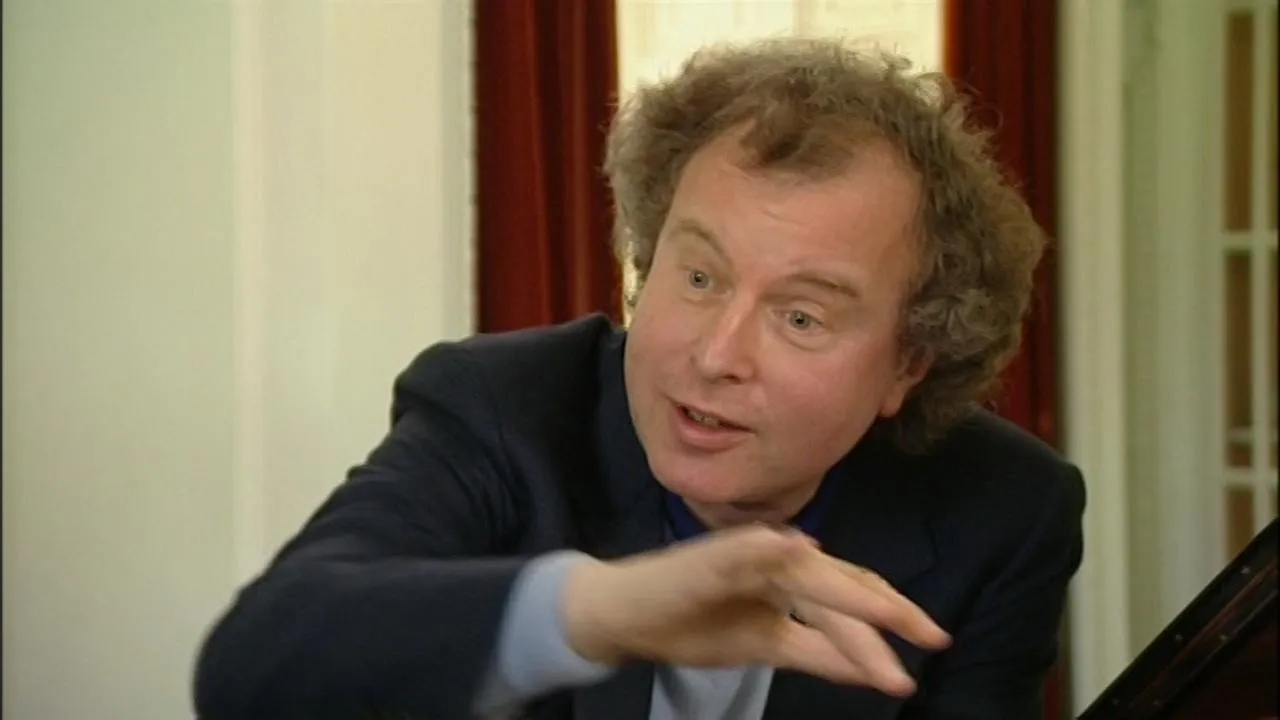
András Schiff est l'un des membres les plus éminents d'une génération de pianistes hongrois nés dans les années qui ont suivi la Seconde Guerre mondiale, aux côtés d'artistes tels que Zoltán Kocsis, Dezso Ránki et Jenő Jandó. De ce groupe remarquable, Schiff est celui qui a acquis la plus grande réputation internationale, non seulement en raison de sa décision de mener sa carrière hors de Hongrie, mais aussi grâce à son sens du toucher finement nuancé et à une mémoire impressionnante qui lui permet de présenter, en concert et sur disque, de larges pans de l'œuvre d'un compositeur. Schiff est né à Budapest le 21 décembre 1953 et a étudié avec le compositeur hongrois Pal Kadosa et Ferenc Rados (qui ont également enseigné à Kocsis et Ránki), ainsi qu'avec le claveciniste anglais George Malcolm. Il fait ses débuts à Budapest à l'âge de 19 ans, suivis d'apparitions en concert dans toute l'Europe et aux États-Unis. Sa réputation s'est accrue avec des prestations primées au concours de Moscou en 1974 et au Leeds Festival en 1975. András Schiff travaille avec la plupart des grands orchestres et chefs internationaux, mais il dirige lui-même la plupart de ses interprétations des concertos pour piano de Bach, Beethoven et Mozart. En 1999, il a créé son propre orchestre de chambre, la Cappella Andrea Barca, avec lequel il travaille chaque année comme chef et soliste, tout comme avec la Philharmonia Orchestra et le Chamber Orchestra of Europe. Le style de Schiff, où un toucher d'une sensibilité peu commune s'allie à une attention à la clarté contrapuntique, a fait de lui l'un des plus grands interprètes de Bach de notre époque. Il a enregistré l'intégrale de la musique pour clavier de Bach, ainsi que l'intégrale des sonates et des fragments de sonate de Franz Schubert, dont la musique pour clavier introspective convient bien au tempérament de Schiff. Il a achevé un cycle des sonates de Beethoven chez ECM en 2009, et il a reçu en 2011 le Prix Schumann de la ville de Zwickau pour son interprétation et sa promotion de la musique de Schumann. En 2001, Schiff a entrepris de revisiter et de réenregistrer les œuvres de Bach. Outre les œuvres romantiques d'Europe centrale attendues, la musique de Béla Bartók et de Leos Janácek occupe une place de choix dans le répertoire de Schiff. Dans ses cours MusicGurus sur les Moments Musicaux nos 1, 3 et 4 de Schubert, la Partita no 2 de Bach et les dernières sonates pour piano de Beethoven, Schiff te fait entrer dans cet univers interprétatif — en partageant sa façon de penser la conduite des voix, le toucher, la clarté contrapuntique et la structure, pour que tu puisses apporter une réelle profondeur et une véritable compréhension à ces œuvres au clavier. read more