



Explicación y demostración del ejercicio cinco
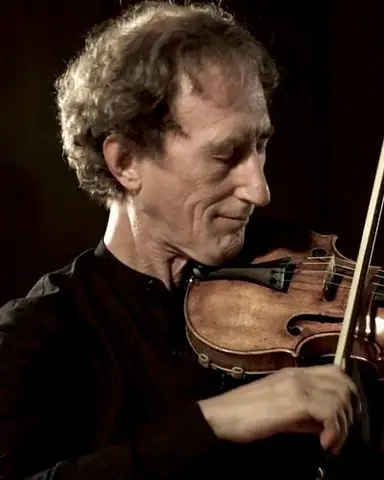
Lesson time: (12min 39sec)
Course preview
This lesson is part of the course The Secrets of Tone Production, Parte 4: ejercicios fundamentales finales de sonido
Watch a preview of the full course below.
Lesson transcript:
String Tension Exercise
In this exercise, feel the qualities and tensions of the string while moving the bow towards and away from the bridge. This is one of the most sensuous of all the exercises, perhaps because all three factors of speed, pressure, and distance from the bridge all change so much at the same time.
There's a lovely feeling of breathing in this exercise, a feeling of build-up and release:
- Build-up: As you slow into the tension of the string near the bridge, your in-breath slows at the top of your lungs.
- Release: As you move away from the bridge or breathe out.
Stage One
- Movement: Move once to the bridge, beginning near the fingerboard.
- Bow Speed: The bow needs to be faster and lighter near the fingerboard, and slower and heavier near the bridge.
- Speed Pattern: Fast, slow, fast.
- Pressure Pattern: Light, heavy, light.
- Bow Division: Very important!
- Ensure you reach the bridge around the middle of the bow.
Tip: Avoid moving in and out of the bridge twice.
Stage Two
- Starting Point: Begin a little nearer the bridge, around sound point 4.
- Bow Division: Be even more careful.
- Use a quarter of the bow to reach the bridge.
- Drift back to sound point 4 by the middle of the bow.
- Repeat the same in the second half.
- Progression: Continue beginning each stage nearer the bridge until you end up using only sound points 1.5 to 1.
Important Observations
- The bow wants to be faster.
- Hold on to the bow here - it should be much slower, light at times, and heavy at others.
Questions for Self-Assessment:
- What's the speed pattern of the bow?
- Answer: Fast, slow, fast.
- What's the pressure pattern?
- Answer: Light, heavy, light.
Corrections
- If the movements look very even, slow down in the bridge.
- Ensure to vary between light and fast, slow and heavy.
Helpful Instructions:
- Stay aware of the bow's angle. If it's tilting, adjust to a straighter position.
- Keep practicing slow movements and ensure to steer correctly.
Advanced Practice
-
Two in One Bow:
- Start a little near the bridge.
- Keep concentrating on bow division and maintaining the correct speed and pressure patterns.
-
Three in One Bow:
- Continue revising angles and positions.
-
Four Saves:
- Start near the bridge each time, maintaining the angle.
- Steer back to the fingerboard, focusing on heavy steering.
Key Takeaway
Whenever something feels very good, aim to elevate your practice level.
-
Technique Refinement:
- Aim for total purity and heavy steer returning back to the fingerboard.
- Ensure to be sensitive to the sound and pressure applied to the strings.
-
Twice in One Bow:
- Start nearer the bridge and ensure you're not too angled.
Final Thoughts:
- You're practicing the necessary control to move efficiently.
- Remember to save your energy as you would your money; maintain a reserve for when you really need it.
Keep practicing and adjusting as needed, great job on the progress, everyone!

About the instructor
Simon Fischer disfruta de una distinguida y polifacética carrera como intérprete, pedagogo y artista de grabación. Ha actuado por todo el mundo como recitalista y ha grabado tres Sonatas de Brahms, una grabación que recibió grandes elogios en la revista Gramophone. Simon está reconocido como uno de los profesores de élite del mundo. Es profesor en la Guildhall School of Music y ha ocupado cargos en la Yehudi Menuhin School, la Wells Cathedral School y la Purcell School, y durante 15 años fue profesor visitante en la Royal Scottish Academy of Music. Tras estudiar en Londres con Yfrah Neaman y en Nueva York con Dorothy DeLay, el enfoque de Fischer une los mejores elementos de las tradiciones violinísticas francesa, rusa y estadounidense. La obra publicada de Fischer ejerce una gran influencia en la enseñanza del violín. Autor de artículos para la revista The Strad desde 1991, sus columnas mensuales han atraído seguidores en todo el mundo. Publicados por Edition Peters, sus libros de técnica Basics and Practice (traducido al coreano, italiano y alemán), Scales y The Violin Lesson, así como el DVD The Secrets of Tone Production (ahora disponible en streaming a través de MusicGurus), se han convertido en referencias en muchos continentes. Su libro y DVD Warming Up fue descrito por la revista The Strad como "23 páginas de oro técnico puro". En 2014, Simon Fischer recibió el premio de la European String Teachers Association "en reconocimiento a toda una vida de contribución a la enseñanza de instrumentos de cuerda". En su curso de cuatro partes Secrets of Tone Production, Simon te guía para que conozcas tu instrumento y luego trabajes sus ejercicios fundamentales de sonido paso a paso, de modo que puedas producir un sonido más rico, más controlado y más hermoso con el violín. read more