



Dutch Flowerz – Skream (Análisis)
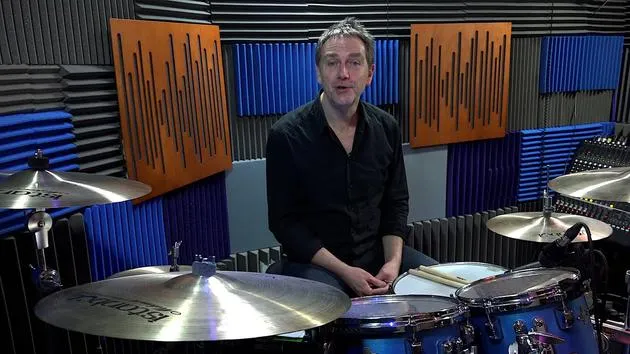
Pete Riley desglosa 'Dutch Flowerz' de Skream, una pieza con sabor a dubstep que se mueve entre un feel steppers, grooves en half-time y algunos redobles complicados de semicorcheas.

Qué incluye el curso
29 lecciones (2h 46m) · 1 gratis
01. Chameleon - Herbie Hancock
2:55
02. Superstition – Stevie Wonder
3:00
03. Dutch Flowerz – Skream
2:42
04. Ziggy Stardust – David Bowie
2:46
05. Rock The Bells – LL Cool J
3:04
06. I Got You (I Feel Good) – James Brown
2:51
07. Mohair Mountain
3:01
08. Pop It In The Top
Lección gratis2:59
09. Mind Sweeper
2:35
10. Favela
2:41
11. Space Future
2:47
12. You Can Call Miguel
2:30
01. Ziggy Stardust – David Bowie (Análisis)
9:38
02. Dutch Flowerz – Skream (Análisis)
Estás aquí10:44
03. Superstition – Stevie Wonder (Análisis)
11:12
04. Chameleon - Herbie Hancock (análisis)
11:20
05. I Got You (I Feel Good) – James Brown (Análisis)
9:37
06. Rock The Bells – LL Cool J (Análisis)
12:16
07. Mohair Mountain (Análisis)
12:25
08. Pop It In The Top (Análisis)
7:14
09. Mindsweeper
10:40
10. Favela (análisis)
6:42
11. Space Future (análisis)
4:50
12. You Can Call Miguel (Análisis)
8:24
Transcripción de la lección
Music Lesson: Dutch Flowers
Overview
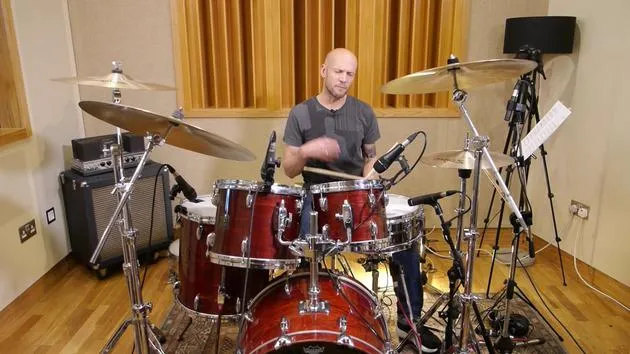
Here we're looking at the scream track Dutch Flowers, which features a dub scar feel and moves between several different patterns on the kit. Occasionally, we've got what you might call a Steppers type feel, where we're playing quarter notes on the bass drum. However, at other points, the actual part is a little more syncopated, and there are also a few 16th note fills around the kit that are quite challenging at the tempo that we're playing at.
Structure of the Piece
I'll work through the various parts that we've got. Most of them will be two-bar patterns. The piece starts with a very skeletal version of the pattern and also with a full-time feel where the backbeat is landing on 2 and 4. Once the intro is out of the way, it takes on a more half-time dub quality.
First Two Bars
- In the first two bars, there's no time on the hi-hats.
- We keep time between the bass drum and the snare drum.
- This forms a two-bar pattern.
Once we've played that pattern for four bars (basically repeating it once), we reach bar five, and we start to add quarter notes over the top. The same underlying kick and snare pattern continues.
Transition to Half-Time Feel
After another four bars of that feel, the piece takes on its half-time feel in bar nine.
- Now, the backbeat lands on beat three.
- In bar nine, we've got this two-bar pattern.
Letter A
When we reach letter A, the bass drum pattern changes slightly, and we essentially encounter the feel that runs through the majority of the track.
- Again, it's a two-bar pattern, and the last couple of beats are the same as I introduced with that syncopated sound.
16th Note Fills
Bar 32
At bar 32, we encounter the first of our 16th note-based fills.
- It's loosely based around a sticking that consists of:
Right, Left, Left, Right, Left, Left, Right, Left.
This sticking has many uses on the kit and is worth being familiar with. With some different orchestration, it can sound very different and prove to be a very useful one-bar fill if you play it twice, or a two-beat fill if you play it just once.
- Here, we're basically playing it twice and changing the orchestration.
- The final challenge is that we're playing quarter notes on the bass drum underneath that.
Let's hear that in context.
I'll alternate that with a bar of time, cycling between bars 31 and 32.
Bar 56
In bar 56, we've got another 16th note fill, but this time it's based around broken 16th notes.
- We're playing this using single strokes.
- This also moves down the kit over a quarter note on the bass drum.
Once again, our cycle consists of bars 55 and 56.
Bar 64
In bar 64, as we head into the breakdown, there's a variation on the previous fill.
- Here, we don't crash the downbeat of the next bar.
- We're playing a crash cymbal on the last eighth note and then the downbeat of the bar, but without a bass drum.
This is an effective way to transition into a section where the feel drops out. Instead of playing a heavy crash on the downbeat, playing a cymbal without a bass drum creates a light, airy feel.
I'll demonstrate this transition from bar 63 into 64, hitting the downbeat of bar 65.
Bar 69
At bar 69, we reach the final Steppers style groove.
- Steppers is a variation of a reggae feel where you play quarter notes on the bass drum.
- Traditionally, it's played with cross stick landing on beat three, perhaps even with a swing feel.
In this case, we're playing it with the open snare and maintaining that syncopation on the last two beats (this figure has occurred throughout the piece).
- This two-bar pattern at bar 69 sounds like this:
Bar 76
In bar 76, we encounter our final 16th fill, which again is based around the same sticking from earlier:
Right, Left, Left, Right, Left, Left, Right, Left.
It's all about the orchestration on the kit and how we accent that.
- This is slightly different from the previous example.
I'll alternate it with the bar that precedes it, cycling from bar 75 into 76.
Transition to Final Section
We're almost at the end of the piece now and will take a look at bar 84, which doesn't have a specific fill notated within it.
- There's just an open hi-hat note written at the end of the bar.
The idea here is to play a fill around the kit that ends on the last upbeat eighth note of the bar. This prepares us for the final four bars of the piece, where we transition over to playing the cross stick on beat three.
I'll demonstrate a couple of different ideas that achieve this, filling through bar 84 and landing on the last upbeat eighth note, with the snare and hi-hat falling simultaneously.
I close the hi-hat on the downbeat of bar 85.
Conclusion
You can see the transition from that fill, where you've ended on the last upbeat eighth note, into the final cross stick groove which concludes the piece.
Going from bar 80...
So, there you go! That's all the parts you need to play Dutch Flowers.
- There are some nice 16th note fills in there that will work in a reggae or dub style.
- Plus, there are some nice two-bar patterns to play as well.
I'm sure you'll have fun incorporating these along with the track!
29 lecciones
2h 46m de lecciones en vídeo estructuradas
Funciones de vídeo avanzadas
Ralentiza, repite un pasaje, sigue la partitura
Móvil, tablet y ordenador
Practica donde quieras
Garantía de satisfacción 100%
30 días de garantía de devolución







