



Noisy Neighbour (Análisis)
Paul Elliott analiza 'Noisy Neighbour', una pieza indie al estilo de Arctic Monkeys y Franz Ferdinand, abarcando su anacrusa de batería inicial, su feel de semicorcheas y sus numerosos stops y arranques.

Qué incluye el curso
29 lecciones (2h 24m) · 1 gratis
01. Ready or Not – Fugees
2:34
02. Sweet Home Alabama – Lynard Skynard
2:10
03. Let’s Dance – David Bowie
1:58
04. Respect – Aretha Franklin
2:14
05. In My Place – Coldplay
2:21
06. Scary – Stormzy
1:54
07. Cold Pants
2:00
08. Attitude
1:59
09. The Nod
2:00
10. Hammerblow
Lección gratis2:04
11. Jahmake Ska
1:58
12. Crop Duster
1:57
01. Let’s Dance – David Bowie (Análisis)
8:26
02. In My Place – Coldplay (Análisis)
10:16
03. Scary – Stormzy (análisis)
10:27
04. Respect – Aretha Franklin (Análisis)
9:50
05. Ready or Not – Fugees (análisis)
7:51
06. Sweet Home Alabama – Lynard Skynard (Análisis)
8:33
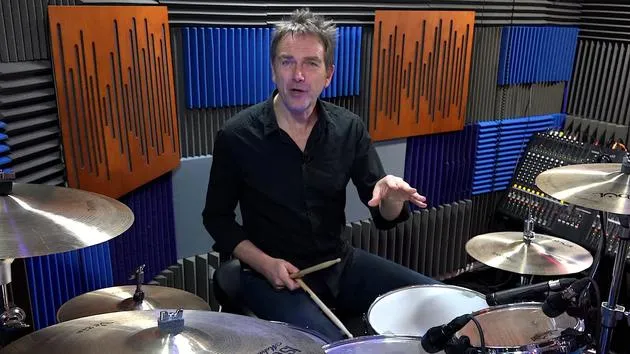
07. Noisy Neighbour (Análisis)
Estás aquí17:14
08. Cold Pants (Análisis)
4:24
09. Attitude (Análisis)
6:22
10. The Nod (Análisis)
4:18
11. Hammerblow (Análisis)
11:04
12. Jahmake Ska (Análisis)
4:00
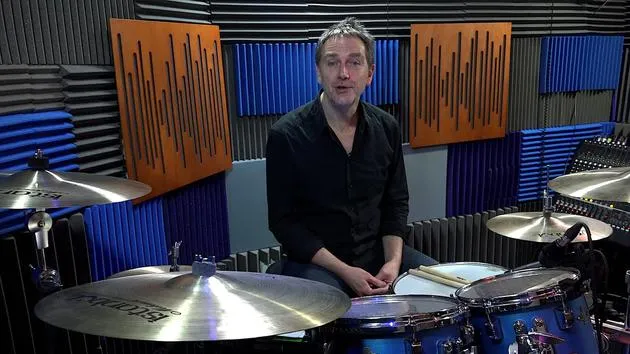

Transcripción de la lección
Music Lesson: Noisy Neighbour
Introduction
Okay, let's take a look at Noisy Neighbour. This is an indie piece along the lines of artists such as the Arctic Monkeys, the Strokes, and Franz Ferdinand. That kind of feel. We've got lots going on here.
- Dynamic Tune: It's a very dynamic tune, which I'll talk about in a moment.
- Anticipation: Lots of stops and starts, lots of anticipation in this tune. When I was working through it, I found it really interesting in terms of where it moves to and from.
I was kind of thinking about all the time where I'm going to go geographically on the drum kit. I think it's very important, so we'll talk about that in a little while.
Starting Point
So let's get into it. Right from the start, we've got this drum pickup.
- You'll hear on the track that there's a count-in, and then there's literally the drum pickup.
- This means that it's just the drummer playing.
So, you're the drummer, and it's just you. It's very important to come in with that really good time feel at the start.
Key Points:
- One Bar Fill: It's a 16th note feel.
- Tempo: Here's the tempo:
- "1, 2, 1, 2, 3, 4. Ticket, ticket, ticket, ticket..."
Think about that rhythm on that opening bar. Coming in with these crash cymbals, 16th notes.
- "Bang, bang, bang, bang. Sing the tune."
Get a good feel, even though you haven't got much time to feel this when it comes in.
Preparing for the Intro
As soon as it starts counting off on the track:
- 16th Note Feel: "Taka tika taka ticket Ba da da ba da da ba boom, boom, boom..."
So, you get that time, and you get that sound. Prepare that melody in your head, so you've got that time feel and you're listening to the tune in your head before you come in.
Dynamics
The other key thing right at the start is to make sure that you get this loud introduction.
- It's signposted 'F' on the charts, indicated which means loud.
- Then we go down to 'mp', which is softer.
So, it's important to think about coming in to the floor tom with a much softer feel. This isn't easy technically, so you need to be really aware of that.
- Dynamic Introduction: We come in with a suitably loud introduction and then get down to that floor tom for the right line feel, which is quieter, and then it builds back up into 'F' after four bars.
This happens again at the end as well. We'll talk about that in a little while.
Floor Tom Feel
When it comes to the floor tom feel, you can choose various stick ins on that.
- What I think is perhaps most accessible is to play 8th notes all the way through with your lead hand and then fill the notes in between with the other hand.
I decided in my performance to do a little bit of both. I played the majority of 8th notes, but I also filled some notes in or changed the stick in there, so I came off on the left hand. It just felt right to do that.
Key Advice:
- Anticipate Snare Drum: Be careful that you need to anticipate coming off onto the snare drum during the louder bars (bars 5, 6, 7, and 8).
- Give yourself plenty of time to set up a nice big snare drum beat there.
Demonstration
I'm just going to demonstrate the eighth note feel and then roughly what I did:
- Remember that I'm coming in softly after the introduction and then building that up.
I found it interesting to mess around with those stick ins for a short while.
- You can see that I changed that slightly just to add a different dynamic, and it felt good coming from the floor tom to the snare in that louder section.
Stops and Starts
Now, we've got lots of stops and starts here, lots of cymbal chokes, and it's very metronomic.
- Feel 16th Notes: I would suggest feeling 16th notes throughout the whole piece.
Think "cha, kicky chaka, chicky, chaka chicky chaka, check."
Technical Points:
- There's quite a big room for error here because of the chokes and quarter note hits with quite big gaps.
- From a technical point of view on the choke, I would play on the same cymbal to avoid getting a ring over.
Choke Technique:
- When choking, I stay close to the cymbal, making it as simple as possible.
Let me show you that for a few seconds to illustrate my playing style during those choke sections.
Offbeat Feel
The next section I want to talk about is this offbeat feel. It's common to play these offbeats on the hi-hat.
- Spacious Bass Drum Part: It's very tight, as written out in the first part of section C.
I'll play a little bit of what's written. You could go to 16th notes if you wanted, but I decided to just fill some notes in, keeping the back beats with the left hand.
Quick Demonstration:
Let me just run you through very quickly how I approached that section.
- This includes filling in some notes with the left hand and coming back to the snare.
Transitioning with Fills
As we move on, the D section features big fills and crashes.
Advice:
- On the D section, I would crash on separate cymbals to create space (right, left, right, left) before entering my fill.
In terms of the fills, keep it simple.
Fill Guidelines:
- Think about subdivisions ranging from a nice big eighth note feel up to a 16th triplet feel.
- However, generally, play less. Just use eighth notes, eighth note triplets, or 16th notes to maintain clarity.
Anticipation:
It's also very important to anticipate the crashes coming out of each fill.
Example:
- "1, 2, 3, 4, bam, bam, bam..."
E Section Transition
Going into the E section, coming out of the last fill can be challenging.
- Prepare for Heavy Eighth Note Feel: Anticipate that heavy eighth note and big snare hits.
When you come out of the last fill into the E section, keep it simple.
Final Recommendations:
- Play an eighth note fill to establish a steady feel before the big sound.
Once again, we go back to the intro, so prepare for another big dynamic shift with the eighth notes and snare bass drum in between.
Conclusion
Overall, Noisy Neighbour is an interesting tune with lots of dynamics and spaciousness, but it requires anticipation.
- As always, work methodically, break it down, and spend time on each section.
- Work with your teacher and check out guides to help piece it together in your own time.
Have fun with this! Good luck with Noisy Neighbour. See you very soon!
29 lecciones
2h 24m de lecciones en vídeo estructuradas
Funciones de vídeo avanzadas
Ralentiza, repite un pasaje, sigue la partitura
Móvil, tablet y ordenador
Practica donde quieras
Garantía de satisfacción 100%
30 días de garantía de devolución







