



Mosaic (lección)
Qué incluye el curso
13 lecciones (1h 28m) · 1 gratis
01. PCH (interpretación)
3:09
02. PCH (lección)
Lección gratis11:01
03. Liquid Amber (interpretación)
3:50
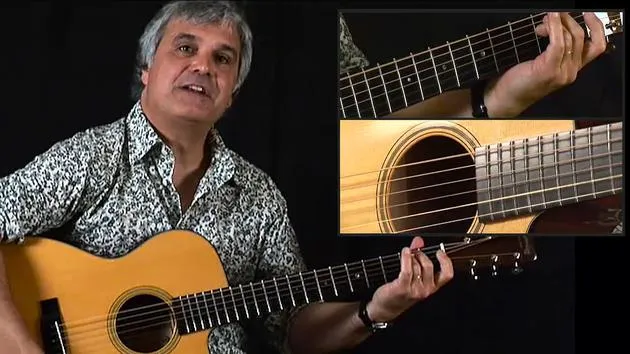
04. Liquid Amber (lección)
9:19
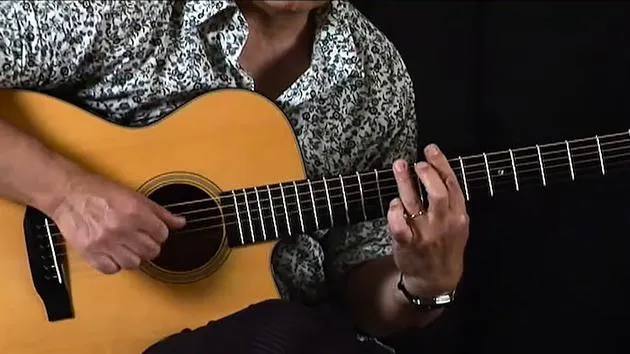
05. Gardenia (interpretación)
3:41
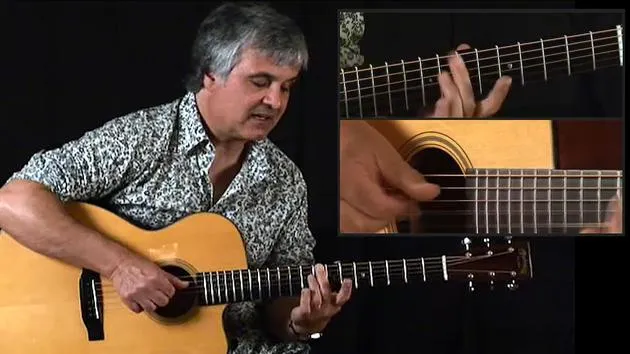
06. Gardenia (lección)
13:37
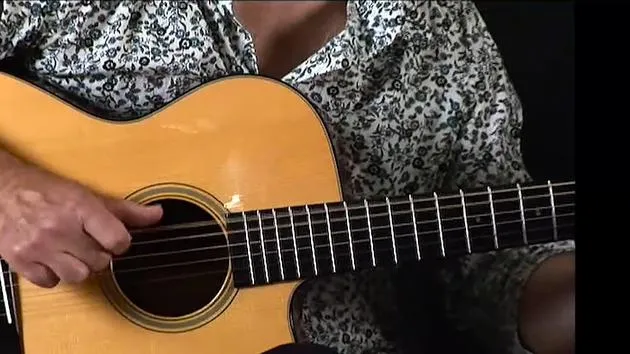
07. Mosaic (interpretación)
3:49
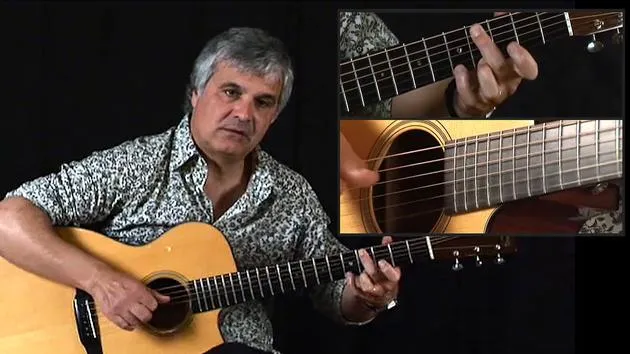
08. Mosaic (lección)
Estás aquí10:21
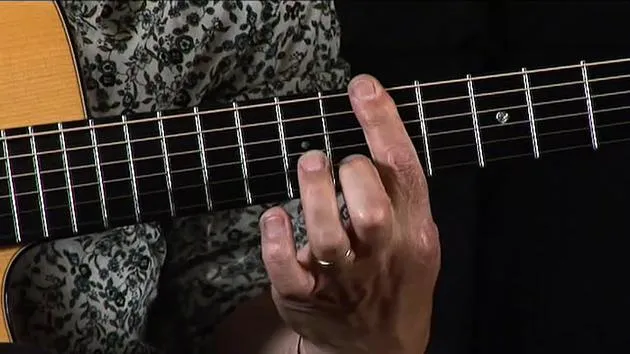
09. Stolen Glances (interpretación)
3:51
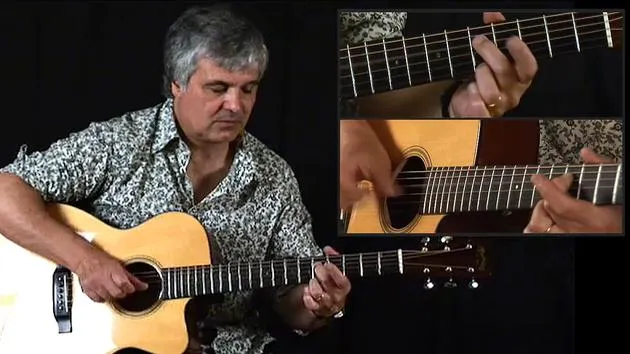
10. Stolen Glances (clase)
11:20
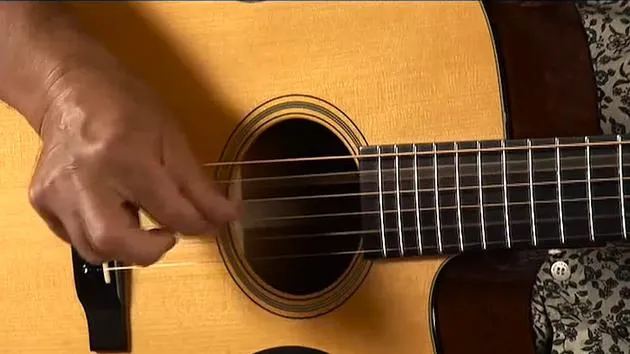
11. Bullet Train Boogie (interpretación)
3:52
12. Bullet Train Boogie (lección)
8:42
13. Lección de cierre
1:30
Transcripción de la lección
Mosaic: A Guitar Lesson
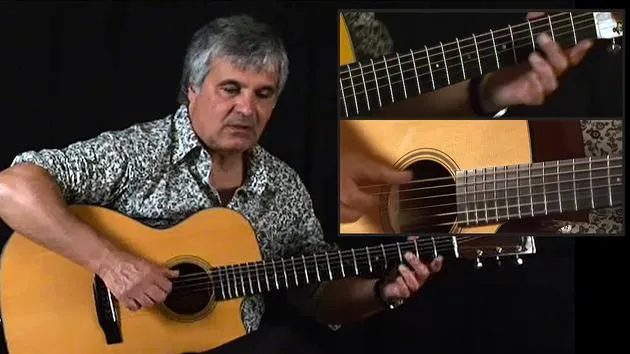
That's called Mosaic from the album of the same name.
Tuning
It's in CG dgad tuning, a little different from DADGAD. The top three strings remain the same, but the bottom two strings go down a whole step:
- C
- G
- D
- G
- A
So, now I have:
- C, G, D, G, A
- D, C, G, D, G, A, D
The bottom three strings are the same as cello tuned in fifths. This tune is in the key of G.
G Chord Position
My resting position for a G chord is like this:
- My fifth through third strings give me a G, D, and a G.
This is my kind of G power chord, as it were. When I go to the four chord (C), it gives me a C bass note, which gives me a C chord.
Introduction and Technique
This tune starts off with a little flourish. Now, let's look at this from a technical point of view.
- I have a hammer, a pull, and another pull, followed by a pick note and a pull, then holding the bass note and a variation on that hammer pull.
This showcases a very cool voicing of an E minor.
It's an E minor E with an F sharp (which is a 9th) and the 7th D on top, so it's an E minor 9th.
Then, moving to the next chord, I go to an E flat major 9, where both the G and the D are common tones.
- With the E flat chord, that G becomes the major third and the D becomes the major seventh.
I actually do a pull off here, so that E flat major 7 also has a slight Lydian tonality to it.
Lydian Tonality
Lydian being the sharp four, plus I have three adjacent scale tones in:
- F
- G
- A
Then, resolving to the D. Now I do a slide in fourths, combined with a pull off, and then 2/3 with the G bass note moving into the next section.
Chords and Voicings
I walk up to the first string to this chord:
- D
- A
- D
- E
- A
It's like a D sus 2, these are very rich chords.
What do we have here?
- A flat
- D flat
- A
- D flat
- E flat
- A flat
I wonder what that really is. You know what? Let's not give it a name; it'll be in the tab. But right now, let's just call it a very cool chord.
Walking Up
Now, moving up:
- G, B, G, A B (with a B in the bass and an F sharp on top) creates a first inversion G major 7 chord, progressing to an E minor chord.
One thing that's really important, something I've touched on in my other videos, is that when you're in an altered tuning, you want to pay attention to familiar intervals, even though the fingerings may not be.
Example of Intervals
For example, this relationship is a tenth:
- I have a C in the bass with an E above it, filling it in with a bar over the first three frets.
Then back to the G, repeating all that.
Next is the tenths, walking up using the two top strings open as a pedal, and then hitting a slap harmonic on that, which gives me a C69 chord (C, G, E, G, A, D).
The whole thing will repeat.
Bridge Section and Improvisation
Moving into the bridge section, I'm pedaling on the bottom two strings open with the melody moving up on the fourth string, then back to the G, and walking up again.
Again, I have tenths, but this time, they're between the fifth string and the second string.
At the end, I do a little breakdown section, walking down the bass line but with this little rolling thing.
Then I go into some improvisation, something like this:
- E minor, but now doing a full bar to play melodic material on top, then moving down from there.
So here we go:
- E minor, then whatever I would do over that E flat.
Then here's that E minor again, but now in a higher voicing:
- E flat → D, then walking down in thirds to the G.
Finally, I repeat the melody from the very introduction and end on the G with a pair of harmonics at the 7th fret and 12th fret.
Conclusion
Now, in concert, I would most likely do some improvising over that chord sequence, because the basic sequence is:
- G
- E minor
- E flat
- D
- G
But each time, I may be playing a different voicing of it.
And that's Mosaic!
13 lecciones
1h 28m de lecciones en vídeo estructuradas
Funciones de vídeo avanzadas
Ralentiza, repite un pasaje, sigue la partitura
Móvil, tablet y ordenador
Practica donde quieras
Garantía de satisfacción 100%
30 días de garantía de devolución
Conoce a tu gurú
Conoce a tu gurú
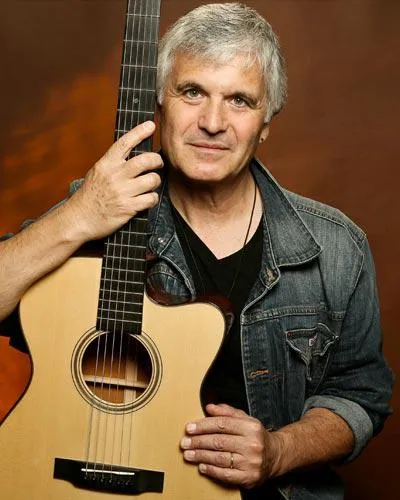
Laurence Juber se dio a conocer primero como guitarrista principal de Wings, la banda de Paul McCartney. Desde entonces ha construido una carrera como guitarrista fingerstyle, compositor y arreglista, trabajando en gran medida con la afinación DADGAD, que le valió el apodo de 'the Duke of DADGAD'.
Los lectores de Fingerstyle Guitar Magazine lo han votado Guitarrista del año, y la revista Acoustic Guitar lo ha incluido entre los mejores guitarristas, junto a una larga lista de álbumes en solitario y giras por todo el mundo.
En sus cursos enseña su técnica fingerstyle y la afinación DADGAD por la que es conocido, cómo combinar melodía, armonía y bajo en un arreglo para guitarra sola, y las piezas -como su emblemática 'Wooden Horses'- que lo reúnen todo.







