



Bullet Train Boogie (lección)
Qué incluye el curso
13 lecciones (1h 28m) · 1 gratis
01. PCH (interpretación)
3:09
02. PCH (lección)
Lección gratis11:01
03. Liquid Amber (interpretación)
3:50
04. Liquid Amber (lección)
9:19
05. Gardenia (interpretación)
3:41
06. Gardenia (lección)
13:37
07. Mosaic (interpretación)
3:49
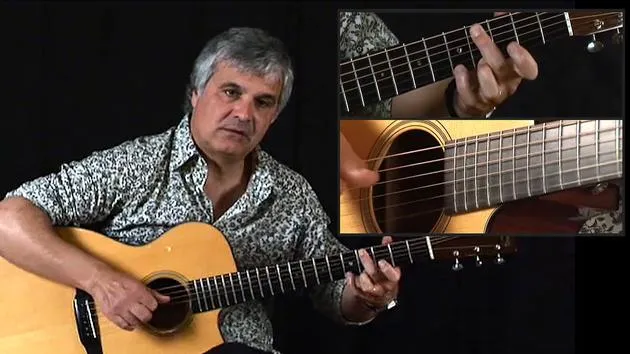
08. Mosaic (lección)
10:21
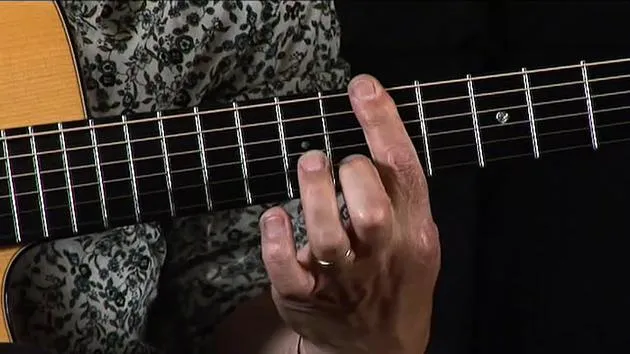
09. Stolen Glances (interpretación)
3:51
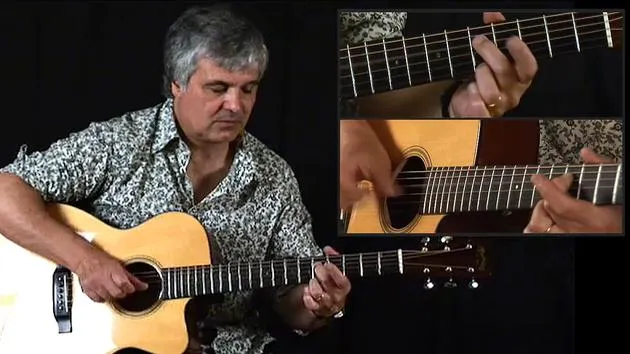
10. Stolen Glances (clase)
11:20
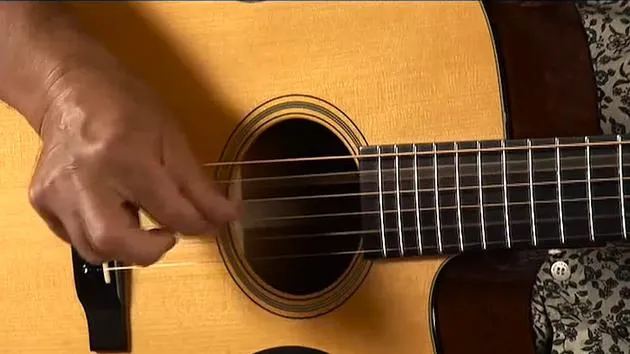
11. Bullet Train Boogie (interpretación)
3:52
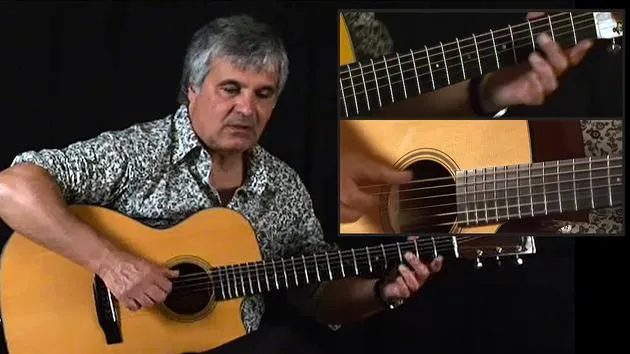
12. Bullet Train Boogie (lección)
Estás aquí8:42
13. Lección de cierre
1:30
Transcripción de la lección
Bullet Train Boogie
Introduction
I'm in DADGAD Tuning in the key of D, so DADGAD again:
D A D, G A D.
You'll notice that I'm making use of the octaves because you have:
- 3 D strings
- 2 A strings
Basic Groove
I can get this octave jump and basically alternate between the low octave and the high octave.
So, the basic kind of groove involves alternating:
- Sometimes I'm pulling off
- Sometimes I'm not
- Sometimes it's just straight picking.
The Trickiest Lick
When I get to the next section, this is the trickiest lick of all. I'll play it slowly, do it again, and then up to speed.
It's really a flourish; I mean, it's just like you're on the train and things are just flying by. The image is such that you almost don't have to make out the individual notes. And, you know, I'm lucky if I get it right maybe 25% of the time, so don't be discouraged.
The Hammer-on and Pull-off
Then it follows up with just a straight hammer-on, pull-off. And you'll notice I'm using the power chords here: just the bottom three notes, Root, Fifth, Octave.
Chord Movement
Then moving up here and then here over an A bass:
- Landing here, what it really is, is just a D chord, C natural, E, F sharp.
- It's like a C9 cluster underneath it.
I'm moving that down a half step at a time, and then landing on a B chord, B7, A7, an A sharp B, which is a sixth chord.
Bass Movement
A little bass movement there, and then I've got a bass line which I'm thickening up the melody on top with these kind of clusters.
And here, I'm doing basically what would amount to a dbea, but I'm moving down and then moving up.
Chorus
The same thing, repeat, walk up on the bass and hold there.
Then back to the top, so that becomes like the chorus.
Solo Section
Moving into the solo section, I walk up holding a D7 chord there.
You'll notice I'm using my third and fourth fingers to do that because I need some freedom to make the bass notes. If you know your harmonic theory, you'll know that this tritone moves from:
- D chord
- G chord
- A chord
- D chord
I've established 14151 as the chord sequence, adding some melody to those same chords with a little lick.
Exercises
And I'll do that good Dagat exercise and then a flourish, kind of a percussive hit.
Improvisation
In this section, I'm improvising. Notice I'm using:
- Slides
- Hammers
- Pulls
Each time I play it, it's going to be different.
Specific Techniques
I won't even try to analyze the specifics other than to say that when I get into the second half of that, I tend to do this. If you go back and review Stolen Glances, I'm using the same technique there too, playing the octave and then doing the pull-offs and then into the next.
Again, I'm playing a D7 chord. Keep your pinky occupied there with a pull-off from the octave to the open D on the first string.
Then again, I'm going to do a different lick each time there, kind of an improvised lick, but then moving up into the last part of this, getting a reason to have a cutaway.
Final Section
And again, it's a D7 chord, really.
Now here I'm alternating the bass, doing a slide with my first finger and the thumb down one fret at a time up to the open strings before I come back to this section.
Then back to the build-up to the verse and then I'm back to the verse.
Turnaround
At the end, I've just got a little turnaround that I'm adding to the main riff.
Here we go. Here's the turnaround, slowing down like the train and then putting the whistle at the end.
Conclusion
And that's Bullet Train Boogie.
13 lecciones
1h 28m de lecciones en vídeo estructuradas
Funciones de vídeo avanzadas
Ralentiza, repite un pasaje, sigue la partitura
Móvil, tablet y ordenador
Practica donde quieras
Garantía de satisfacción 100%
30 días de garantía de devolución
Conoce a tu gurú
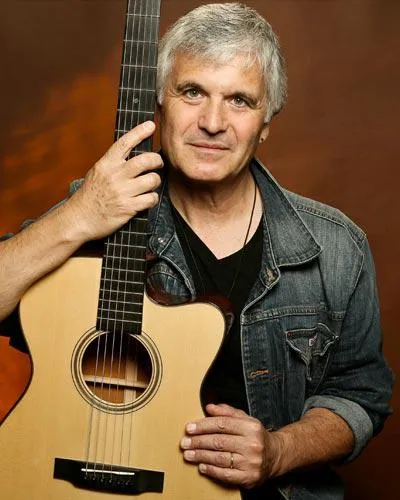
Conoce a tu gurú
Laurence Juber se dio a conocer primero como guitarrista principal de Wings, la banda de Paul McCartney. Desde entonces ha construido una carrera como guitarrista fingerstyle, compositor y arreglista, trabajando en gran medida con la afinación DADGAD, que le valió el apodo de 'the Duke of DADGAD'.
Los lectores de Fingerstyle Guitar Magazine lo han votado Guitarrista del año, y la revista Acoustic Guitar lo ha incluido entre los mejores guitarristas, junto a una larga lista de álbumes en solitario y giras por todo el mundo.
En sus cursos enseña su técnica fingerstyle y la afinación DADGAD por la que es conocido, cómo combinar melodía, armonía y bajo en un arreglo para guitarra sola, y las piezas -como su emblemática 'Wooden Horses'- que lo reúnen todo.







