



Movimiento de la fundamental y ritmo armónico (tiempos por acorde), aproximación por escala y cromática
Lesson time: (7min 49sec)
Bruce Gertz desglosa la segunda progresión de bajo: caminar hacia abajo por la escala sobre cambios en ciclo de quintas como do7 a fa7, cuatro tiempos por acorde.
Course preview
This lesson is part of the course Grooves contemporáneos para bajo eléctrico
Watch a preview of the full course below.
Lesson transcript:
Music Lesson: Scale Down and Scale Up Techniques
So now we did the roots and fifths and octaves.
Scale Down
Now we're going to talk about number two: the scale down.
- When we have cycle five motion, in other words, we're going from C to F down a fifth, like this (or any position), in four beats, we can walk right down the scale.
"See where that works? 1, 2, 3, 4."
So in the C7 to F7, it comes right down.
Close-Up of the Neck
Again, that scale down thing takes four beats.
- When you're looking at Example One on the sheet, from point A to point B, you have:
- C
- F
- D minor 7
- G7
So I can come down the scale to the F.
"I'm sorry, it's C major 7."
Now I have to go back to D, then down to G.
- If I was going to repeat the idea, I'd come down the scale from the G. Say here's low G.
"I can't keep going down because I run out of bass."
So I go with seventh up and come down the scale that way, like that.
Scale Down from the Octave
Now, moving on to Example 1:
- C major 7
- F major 7
- D minor 7
- G7
I'll start walking down the scale now to repeat.
"What I did was I just did scale down on every chord change."
However, that's not the way you really want to play.
-
Combine that with the fifths and roots and octaves, and then you can get a real interesting sound just with those two things.
- Here, I'll go down the scale now, octave, I mean fifth and octave down the scale, fifth root.
"See all the different ways I can combine just root, fifth, and octave and down the scale."
Example Two
Now, in Example Two, where you have two beats per chord change, you can't walk down the scale for four beats, obviously, because you only have two beats.
- In a situation like that, the best thing is to use that root and fifth:
- C
- F
- root
- fifth
- D
- E
- A
- D
- G.
Again, fifth root, fifth root.
"If I wanted to do that faster, it'd be like, see that? And that's just roots and fifths and octaves."
Example Three
In Example 3, I can come down the scale:
- G minor 7 for 2 bars,
- C7 for 1 bar,
- D7 for 1 bar.
"Best thing is probably, since you have two bars of A, G minor, is to walk to the fifth, then C, D to the fifth, C to G."
Scale Up
Now let's talk about the scale up.
- When you walk up the scale from C to F in four beats, you land on F on beat four.
"And you don't want that; you want to land on F on beat one."
So in order to do that, you need to add a note.
-
You could play two Cs so that this comes on 1, 1, 2, 3, 4, 1.
-
Or you can add a chromatic in here like that.
-
You can also add another chromatic this way.
"See, that way I get four beats on that."
Also, I can walk up the scale to the third and then skip above the F and then go to that.
- That's 1, 2, 3, 5 of the scale.
Scale Up Ideas
These scale up ideas would be:
- Repeat the note
- Chromatic
- The other chromatic
Another thing is to have the triad:
- A triad is 1, 3, 5.
Then you can either go:
- Back to the octave or to the octave above,
- Back to the root below,
- Back to the third.
That's the first example, a combination of using root, fifth, and octave, scale down, scale up, and now the next thing to talk about is approach notes.
About the instructor
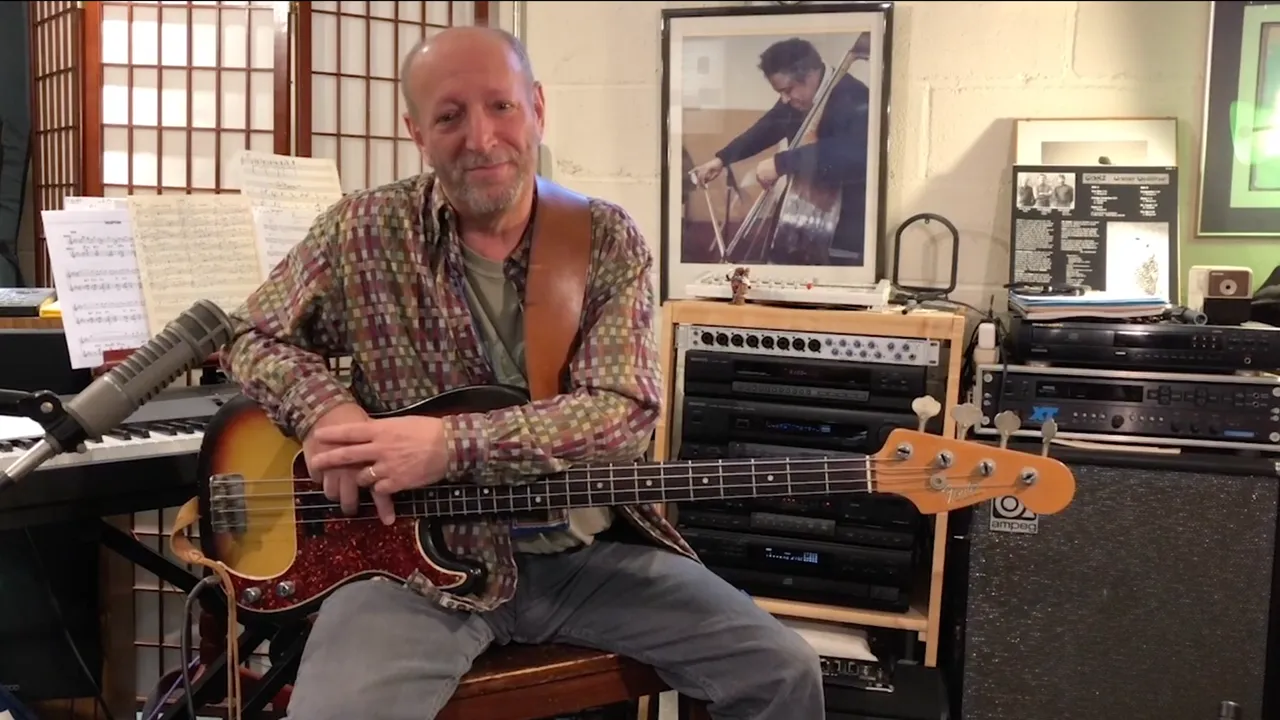
Bruce Gertz es un bajista (acústico y eléctrico), compositor, educador y autor galardonado. Es profesor de bajo en el Berklee College of Music, donde enseña desde 1976. Bruce es beneficiario de la beca del National Endowment for the Arts Jazz Performance Award, del Massachusetts Cultural Council Musical Composition Award y de numerosos premios al mejor bajista de los Boston Music Awards, los A.S.C.A.P. Plus Popular Awards, así como de múltiples reconocimientos de la International Association of Jazz Educators y la Jazz Education Network. Bruce también forma parte de la junta directiva de la International Society of Bassists. Ha actuado y grabado con artistas como Gary Burton, Jerry Bergonzi, John Abercrombie, Joey Calderazzo, Kenny Werner, Mick Goodrick, Kurt Rosenwinkel, Billy Hart, George Garzone, Mike Stern, Larry Coryell, Joe Lovano, Cab Calloway y Count Basie, entre muchos otros. En Contemporary Bass Guitar Grooves, Bruce pone toda esa experiencia a tu servicio. Aprenderás a construir líneas de bajo sólidas y con swing y a encajar en grooves auténticos a través del funk, el jazz y la fusión, para que puedas sostener la base rítmica y desenvolverte con confianza en cualquier situación de banda. Su extensa discografía e información adicional pueden encontrarse en www.brucegertz.com. read more