



Breaks de boogie-woogie

Con
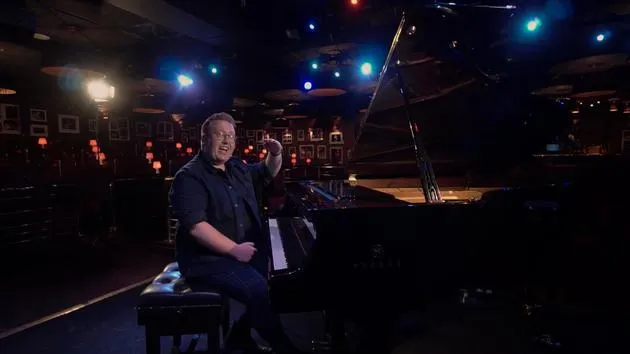
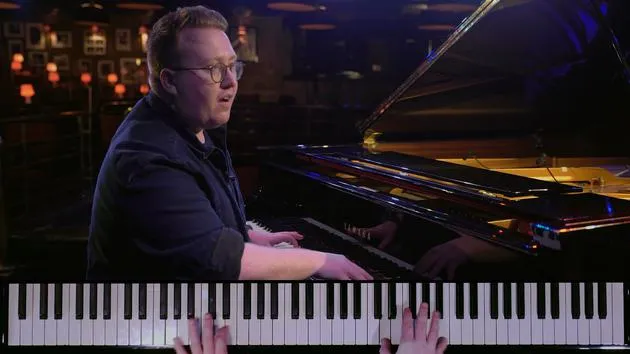
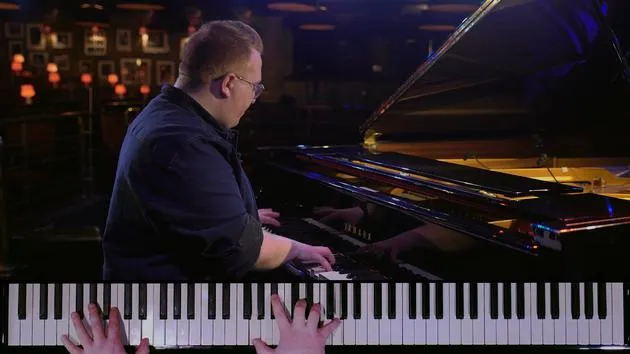
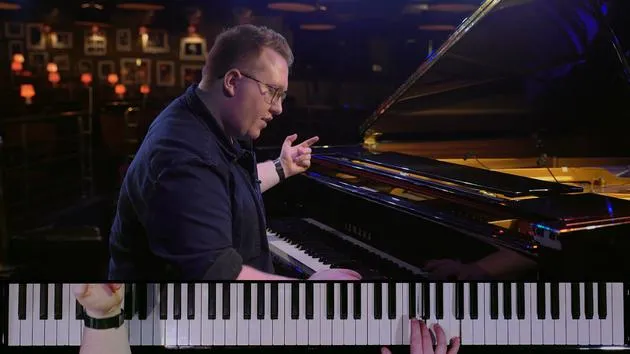
Tom SealsTom Seals desglosa el "break" del boogie-woogie: detener la mano izquierda durante un par de compases sobre una posición de C6 y luego rellenar el hueco con la mano derecha.

Qué incluye el curso
21 lecciones (1h 47m) · 1 gratis
01. Introducción a 'New York State of Mind'
3:05
02. Usar terceras
Lección gratis1:41
03. Darle un toque 'bluesero'
10:58
04. Darle un toque ‘jazzy’
1:20
05. Ganar confianza al improvisar solos
3:05
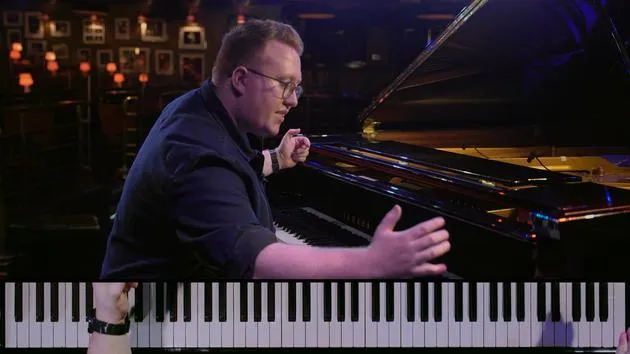
06. Ideas avanzadas para solos
7:30
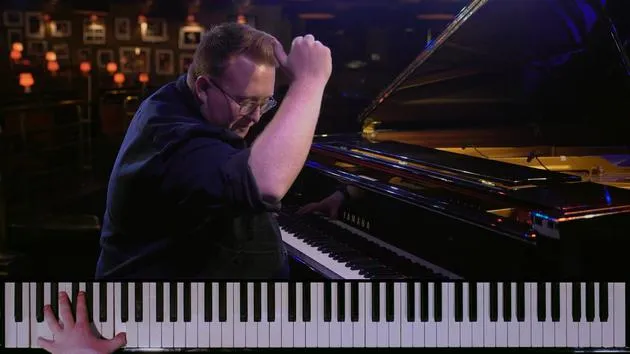
07. Un final clásico al estilo de ‘Billy’
3:47

08. Tom Seals interpreta 'New York State of Mind' de Billy Joel
6:26
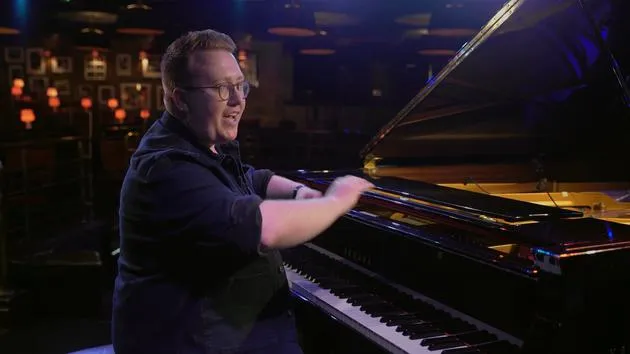



Transcripción de la lección
Boogie Woogie: Understanding the Brakes
One thing that is standard in boogie woogie is what we call brakes.
Now, I'll play it in context. I'll give you a nod when it happens so you can hear.
Here we go:
I'll start, of course, without the brake. I'll give you a nod when it happens. Okay, it's coming up now. And then we're back in.
The Concept of Brakes
So, the brakes are, to me, they represent a real change, not in tempo or anything else, but it gives a bit of dynamic. It stops the left hand for a couple of bars, and then we get straight back into it.
Chord Breakdown
I'll show you what I played there:
- I started with a C6 chord.
- We're going to take a C and add the sixth, which is the A.
- It sounds like this: da da da da da da da.
So I did it in both hands:
- C, E, G, A
- C, E, G, A
- And I put a C at the top there.
We're nearly using every single finger there and playing all the notes at the same time.
Adjusting the Chord
Next, we're going to move the E and the G down by semitones:
- E becomes E flat
- G becomes F sharp
So in context, while playing every other note as well, you get this:
Adding a Glissando
I like to do a little glissando, a little run up the piano to this. Now, because that's so full on and a bit frantic, I like to take the left hand off and just do a two bar fill with the right hand.
Here's an example:
It could be any blues line, any riff, anything you like. What I played in that example was this:
- C and G at the same time
- C and F sharp at the same time
- C and F at the same time
So you get this melody:
- G, F sharp, F natural, E flat, E, C (always add the C in).
Practicing the Melody
Now, that's quite fast and you can do that all the way down the piano. Get that into your fingers.
Putting it Together
So let's add those things together:
- C6
In my mind, that replaces the first four bars of C in the 12-bar pattern. The 12-bar pattern is just on repeat:
- Repeat the 12 bars, repeat the 12 bars, repeat the 12 bars, but maybe once.
Only use this trick once throughout the whole piece, as you want it to be effective and have impact.
Transitioning Back into Boogie Woogie
This little passage here replaces the four bars of C. So when you come back into the boogie woogie, don't go back to C; you have to go straight back into F.
Here's how it would break down:
- Bar 1: C
- Bar 2: C
- Bar 3: C
- Bar 4: C
- Bar 5: F
Now I will play 12 bars: I'll play the little break for you and then come back in.
Here's the playthrough:
- Bar 1,
- Bar 2,
- Bar 5,
- And in on F.
Ending a Boogie Woogie
Now, of course, we need to end it.
The Standard Ending
How do we end a boogie woogie?
As soon as I play this ending, you'll say, "I have heard that ending on thousands of records."
Here it is at speed:
- C, E, F, F sharp, G, G, A, B natural, C.
- (Again, that's C down to the E, F, F sharp, G, A, B, C.)
You know the rhythm because everybody knows this.
Adding a Dramatic Finish
You can hold on that E and then end with a nice C7 chord:
- C in the bottom, E, G, B flat.
For the seventh, we love the seventh! Add the ninth and then run that up the piano. Give it your best dramatic ending.
Alternative Endings
That's one ending.
Let's look at an alternative ending.
Here's another option:
- C to E again,
- F, F sharp G.
All of that is the same as the first one. Instead of running up like we did before, we'll go:
- G, B flat up to E flat, which gives it a nice jump.
Crafting Your Unique Ending
You're working all the way back up to C. This gives it a nice jump, making it sound different to the ear.
Then you might end with a nice C7 at the end.
Another thing you could do, as you're playing solo piano, you've got freedom. If there's a little gap, make up your own ending.
For example:
It could sound like this, allowing you that space.
Using Blues Scale Variations
So give your right hand that freedom, take your left hand off, and just use the simple blues thing that we learned before to come up with your own.
As long as you end on a C with a big C7 chord to finish, the world is your oyster!
Conclusion
Use the blues scale to finish that. Incorporate little blues ideas, use the E flat as your grace note, use some repetition.
You could even mix it up:
- First half using the blues scale
- Second half making your own.
This could sound like this, or this, and everybody will know that you finished.
Final Thoughts
Hopefully, you will have just played a great boogie woogie. The audience will be standing on their feet!
I hope you enjoyed that little boogie trick. Remember, this doesn't just work for boogie woogie. These little right-hand tricks here will work over anything.
Pick any classic tune, for instance, Billy Joel's New State of Mind, these right-hand tricks will make your playing bluesy.
So enjoy them, get them into your fingers. And don't forget: sit on Facebook with your right hand, drill a boogie with your left hand. Once you've got the boogie, add the woogie, and there'll be no stopping you.
I can't wait to hear you play it!
21 lecciones
1h 47m de lecciones en vídeo estructuradas
Funciones de vídeo avanzadas
Ralentiza, repite un pasaje, sigue la partitura
Móvil, tablet y ordenador
Practica donde quieras
Garantía de satisfacción 100%
30 días de garantía de devolución
Conoce a tu gurú
Conoce a tu gurú
El título de Piano Man del Reino Unido lo han ostentado durante mucho tiempo Elton John, Jools Holland y Jamie Cullum. En las últimas cinco décadas nadie más se ha acercado ni remotamente... ¡hasta ahora!
Recién salido de su gira con las entradas agotadas "Let The Good Times Roll", Tom Seals -"posiblemente el futuro del jazz y el blues"- tiene el mundo en la punta de los dedos. Su virtuosismo como solista, sus excelentes dotes para la improvisación y su voz personal han llevado a destacadas figuras del sector a aclamarlo como el mejor pianista y vocalista de boogie woogie y blues del Reino Unido.
Con apenas veinticinco años, Seals ya ha ofrecido conciertos con las entradas agotadas por todo el mundo, incluido el legendario Ronnie Scott's de Londres, una actuación deslumbrante en el Birdland Jazz Club de Broadway, en Nueva York, y trabajos junto a Jools Holland.
Apariciones destacadas:
- 'Gregory Porter & Friends' del Cheltenham Jazz Festival
- 'Boogie Woogie & Blues Spectacular' de Jools Holland
- Birdland Jazz Club, Nueva York
- British Summer Time - Hyde Park
- Ronnie Scott's Jazz Club
- Gisburne Park Pop-Up
- Montreux Jazz Festival
- Cropredy Festival
- The Steinway Two Pianos Festival
- Glastonbury
- Newark Showground "Drive-In"
- Blenheim Palace
En su curso, Tom desvela los secretos que hay detrás de su forma de tocar -mostrándote cómo dar swing a los estándares al piano, construir líneas auténticas de boogie woogie y blues, y encontrar la libertad para improvisar- para que tú también puedas convertirte en el Piano Man definitivo.
Puedes leer la biografía completa de Tom en www.tomseals.co.uk.







