



Ideas avanzadas para solos

Lesson time: (7min 30sec)
Tom Seals comparte su enfoque para improvisar al piano, construyendo patrones a partir del acorde y usando recursos como la tercera de menor a mayor, octavas, quintas y terceras.
Course preview
This lesson is part of the course Conviértete en el 'Piano Man' definitivo
Watch a preview of the full course below.
Lesson transcript:
Music Lesson: Soloing Techniques
One thing I think that's key when we're looking at soloing is to pick a few patterns.
- Learn the patterns and then experiment with them to make them completely your own.
Starting with C Chord
Let's start with the first chord, C.
The Pattern
I'll play it to you at speed, and then we'll slow it down.
- This pattern is using the chord of C.
- We're going to use most of the notes in this middle section of the chord.
Notes and Movement
- Start with the minor third, which is the E flat.
- Moving from the minor third to the major third creates tension and resolution:
- "Oh, what's that?"
- "Oh, there he is, we're home."
This major to minor transition sounds bluesy, jazzy, and great.
- Start with the E flat.
- Move to the major third (E natural), then to F and F sharp.
- Finally, to G.
Add a bit of a pivot with your hand for movement.
You'll always be using the notes in the middle and the two C octaves with your thumb and little finger.
Speed Practice
At speed, you get this:
- Just C on its own, and then the note that we change plus your little finger every time.
And all of that is based around this:
- C, E flat, E natural, F, F sharp, G, and the occasional A.
Have a little play with these notes to come up with your own blues ideas.
Transitioning from C to E7
One thing that I really like is moving from C to E7.
- The fifth of C is G (the fifth note in the scale of C).
- The fifth note in E7 is G sharp, which is a semitone above G.
Although the chords seem distant, the fifth notes are only a semitone apart.
Improvisation Tip
You could resolve your improvisation in C on A G and start on E7 with G sharp.
This creates a nice familiarity in your playing. For example:
- You might go something like this:
- "It's that semitone of like, oh, we've moved chord."
Adding Thirds to Improvisation
Don't forget to use thirds in the improvisation as well.
- Thirds are where we take the note of the melody.
- For example, if the note is C, we add the third note of that chord, which is E.
Practicing Thirds
You can constantly move these thirds up and down the piano. This might take some practice.
- Exercise: Pick some thirds and move them up and down the piano.
- This is also the Rugrats theme, incidentally.
Use the melody to influence your soloing skills.
Example
Take the melody:
"Some folks like to get away, take a holiday."
- That's only three notes!
You can do nice things around that.
- Start on an E.
- Remember, the minor thirds of any chord always sound nice.
Using Incidentals
The melody starts on the major third. Use little incidentals, you might catch the minor third.
Here we go:
- I'll swing the left hand and play some right-hand ideas.
This was based only on the C pentatonic scale:
- C, D, E, G, A.
You can experiment with these five notes anywhere on the piano.
Advanced Techniques
When you're feeling more confident, you can learn this advanced rundown:
- This works from the top to the bottom of the piano.
Example Rundown
Let's take: C, G, G, C, G, F sharp, F natural, E flat, C.
This is similar to the C blues scale.
Adding Over Chords
At tempo, this works all the way down the piano.
Add this over a nice G7 chord with your pentatonic ideas.
Chromatics
And of course, here comes the big rundown.
Feel free to experiment and make these ideas your own!
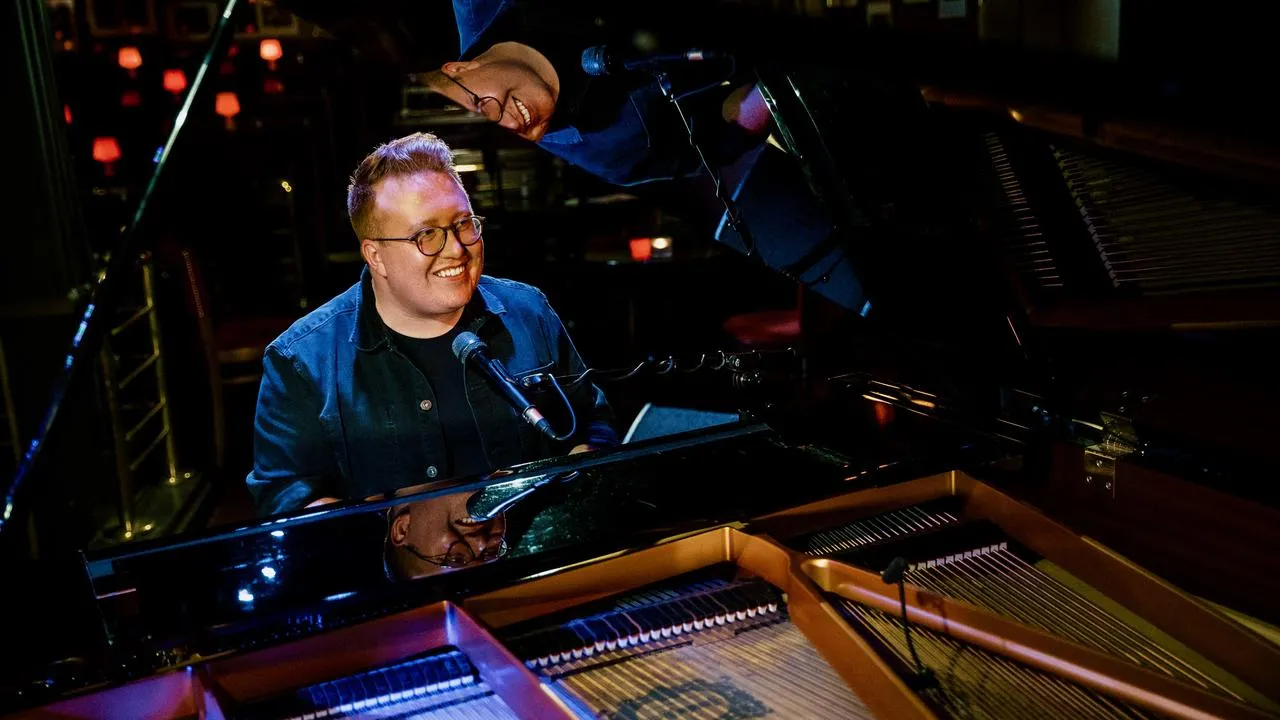
About the instructor
El título de Piano Man del Reino Unido lo han ostentado durante mucho tiempo Elton John, Jools Holland y Jamie Cullum. En las últimas cinco décadas nadie más se ha acercado ni remotamente... ¡hasta ahora! Recién salido de su gira con las entradas agotadas "Let The Good Times Roll", Tom Seals -"posiblemente el futuro del jazz y el blues"- tiene el mundo en la punta de los dedos. Su virtuosismo como solista, sus excelentes dotes para la improvisación y su voz personal han llevado a destacadas figuras del sector a aclamarlo como el mejor pianista y vocalista de boogie woogie y blues del Reino Unido. Con apenas veinticinco años, Seals ya ha ofrecido conciertos con las entradas agotadas por todo el mundo, incluido el legendario Ronnie Scott's de Londres, una actuación deslumbrante en el Birdland Jazz Club de Broadway, en Nueva York, y trabajos junto a Jools Holland. Apariciones destacadas: 'Gregory Porter & Friends' del Cheltenham Jazz Festival 'Boogie Woogie & Blues Spectacular' de Jools Holland Birdland Jazz Club, Nueva York British Summer Time - Hyde Park Ronnie Scott's Jazz Club Gisburne Park Pop-Up Montreux Jazz Festival Cropredy Festival The Steinway Two Pianos Festival Glastonbury Newark Showground "Drive-In" Blenheim Palace En su curso, Tom desvela los secretos que hay detrás de su forma de tocar -mostrándote cómo dar swing a los estándares al piano, construir líneas auténticas de boogie woogie y blues, y encontrar la libertad para improvisar- para que tú también puedas convertirte en el Piano Man definitivo. Puedes leer la biografía completa de Tom en www.tomseals.co.uk. read more