



Las 3 ventajas que ofrece el half valving
Con
PT Gazell
Qué incluye el curso
8 lecciones (1h 11m) · 1 gratis
01. Repasar lo básico
20:08
02. El método Gazell y el medio pistón
Lección gratis11:51
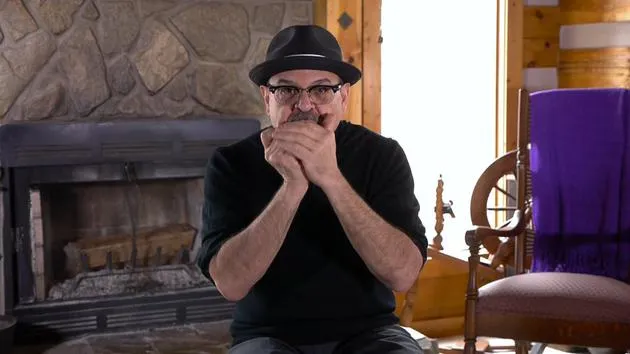
03. Las 3 ventajas que ofrece el half valving
Estás aquí10:58
04. La importancia de doblar con precisión en los agujeros 2 y 3 aspirados
11:58
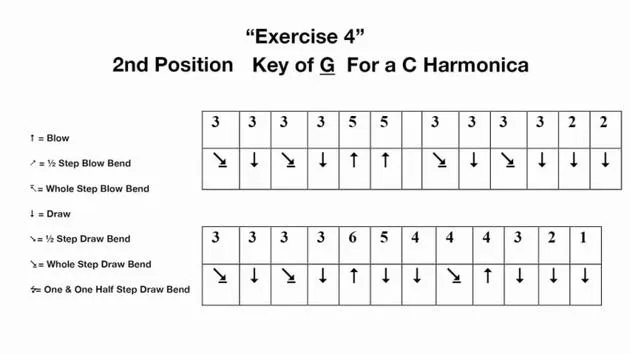
05. Ejercicios de bend aspirado en los orificios 2 y 3
2:22
06. Aprender una melodía de jazz blues
3:53
07. Improvisar sobre una progresión de acordes de jazz blues
3:28
08. Añadir una buena línea de vientos a esta progresión
6:48
Transcripción de la lección
Lesson Three: The Advantages of Half Valving
Introduction
Hi everybody. Welcome back. This is lesson three, and we're going to be talking about the advantages that I think half valving provides.
First of all, I should preface this by saying that I don't think any one of the three reasons I'm going to give you outweighs the other. For me, they're all equal in importance, and hopefully, you'll see what I'm talking about.
1. Filling the Chromatic Scale
The first advantage is obvious: we can now fill in the chromatic scale with the notes that weren't available on a Richter-tuned harmonica.
To illustrate, let's play the chromatic scale in second position. Most of us play in second position; I play in second position most of the time. A lot of times, I will also play in 12th or fifth position minor. However, my first inclination is to try and work out a song in second position, especially now that I have all the notes at my disposal.
Let's play the chromatic scale starting on the two draw:
- You'll hear that I'm able to play all 12 notes without any missing. This wouldn't be possible without valves in the harmonica.
- Interestingly, if you're a good bender of notes, you're really only missing two notes in second position anyway.
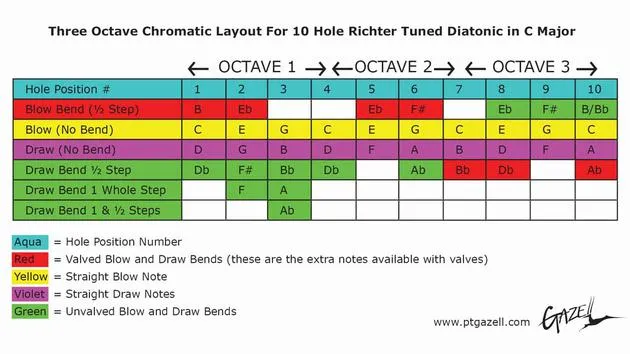
The valves that occur on hole five and hole six allow for blow bends that fill in the chromatic scale in second position:
- Hole five gives your flatted sixth.
- Hole six provides your major seventh.
If you look at the chart of the Gazelle method and the notes available, you'll see what I'm talking about.
Now, I have all the notes, which opens up a world of possibilities in terms of playing melodies, something I very much enjoy doing.
2. The Logic of Half Valving
The second reason I like half valving is what I call the logic of it.
Let's back up just for a moment and discuss bending notes, as we did in the last lesson. Many of us who have been playing diatonic for a while figured out how to bend notes. One of the first notes we bent was hole four draw.
- We are flatting the note; remember, on holes one through six, certain holes allow us to flat the note.
- Even when we reach the top of the harmonica and do blow bends, like on holes 8 and 9, we're still flatting the note.
With half valving, all the additional bends, both blow and draw, are also flatted. I appreciate the logic of that because it's something I've done my whole life on the instrument.
There is a mental hurdle we must overcome since we've all grown up knowing that we couldn't blow bend holes one through six or draw bend holes seven through ten. But with the valves, we now can do that. Once we move past the mental block, it follows the great logic of always flatting the note when bending, whether it's blow, draw, valved, or unvalved.
Note Repetition
You might be looking at the chart and saying, "Well, the four blow note, if you bend that down, that's a repeat. It's the same note as hole three draw." Correct!
However, the reason we put a valve on there is that I'm able to expressively shade the note. It often feels much nicer than just going to the straight note. Let me show you what I mean:
- Hole four blow: if I blow bend it, that bent note is the same as three draw.
- But listen to what happens when I use that four blow bend as an expressive shading in a song.
Here's a snippet of a tune called "Secret Love."
Watch.
That's me expressively shading the four blow note. Instead of playing it like this:
- (plays straight)
Which sounds very linear and square, devoid of expressiveness, I can capture that emotion:
- (plays expressive shading)
All those notes are expressive shading. That's what we can achieve on certain notes without valves, which is something people truly appreciate about the diatonic harmonica. It sounds very voice-like and emotional.
Conclusion
Our typical four draw bend, the one most of us start out learning, is what people love about the harmonica. Now, I have that capability for all 20 notes on the harmonica, whether I'm playing blows or draws. This allows me to deliver a lot of expressive shading and emotional content because of the valves.
To recap, the three reasons I enjoy playing half valving are:
- I have access to all the notes.
- The logic of flatting all additional bends.
- The extra emotional content and shading made possible through the valves.
I'm going to play a selection from one of my CDs entitled "What Is There to Say?" You'll notice all the extra emotional shading that happens because of the valves. I think you'll see all the extra emotion I'm able to convey, especially during the B part, those are all blow notes that I'm able to expressively shade.
We're going to talk a little bit more about how to utilize these techniques in future lessons. Thanks!
8 lecciones
1h 11m de lecciones en vídeo estructuradas
Funciones de vídeo avanzadas
Ralentiza, repite un pasaje, sigue la partitura
Móvil, tablet y ordenador
Practica donde quieras
Garantía de satisfacción 100%
30 días de garantía de devolución
Conoce a tu gurú
Conoce a tu gurú
PT Gazell se ha ganado su posición como maestro de la armónica diatónica. Tras años como codiciado músico de acompañamiento y de sesión para algunos de los más grandes de Nashville, PT descubrió el half-valving y su música literalmente alcanzó nuevas cotas.
Ningún otro intérprete combina su fraseo, su estilo melódico, su elección de temas y sus habilidades de improvisación como él lo hace: en definitiva, es un estilo completamente suyo. Usando su propio instrumento signature, la diatónica Gazell Method fabricada por Seydel, PT demuestra que la armónica es capaz de mucho más de lo que la mayoría creemos.
¡Disfrútalo!
En sus cursos, PT enseña el half-valving directamente desde la fuente, para que puedas empezar con el Gazell Method, dominar los bends valvulados e incorporarlos a tus propias canciones.







