



High Range Building
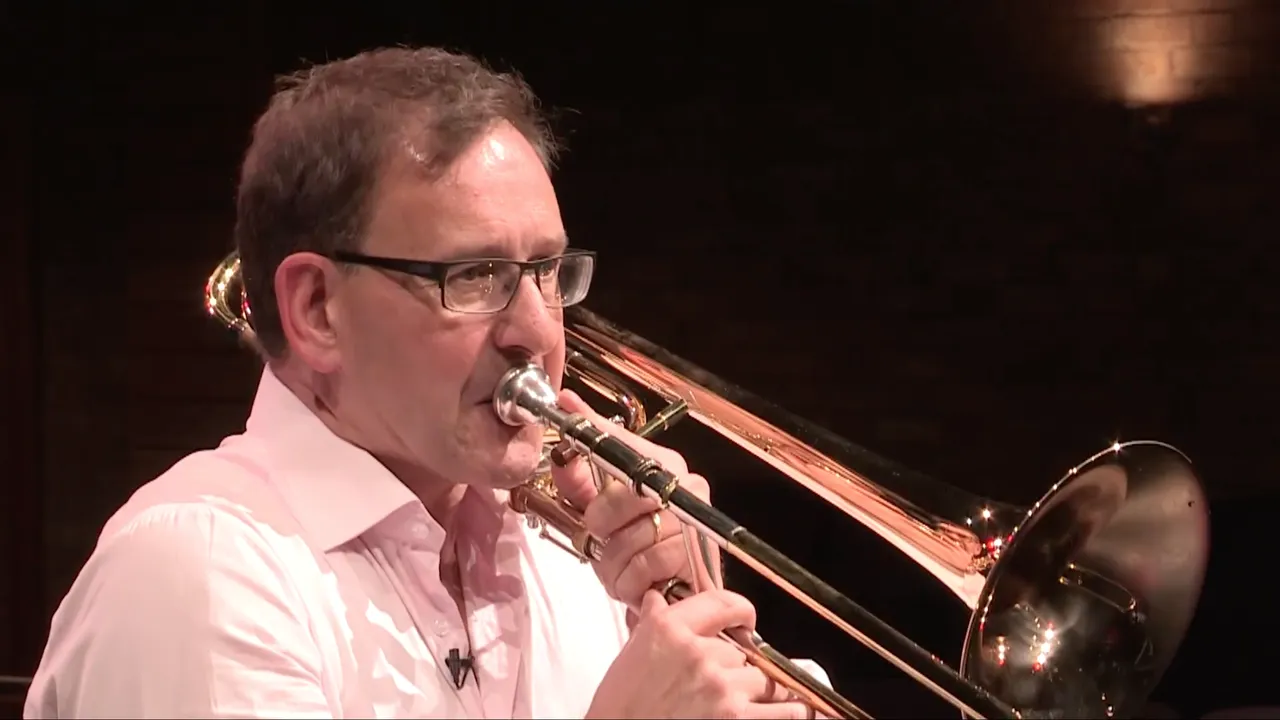
Qué incluye el curso
10 lecciones (2h 21m) · 1 gratis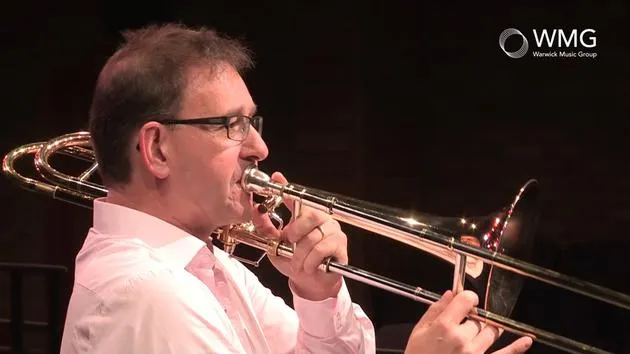
01. Breathing, part 1
Lección gratis6:59
02. Rossini, William Tell and The Thievish Magpie
14:54
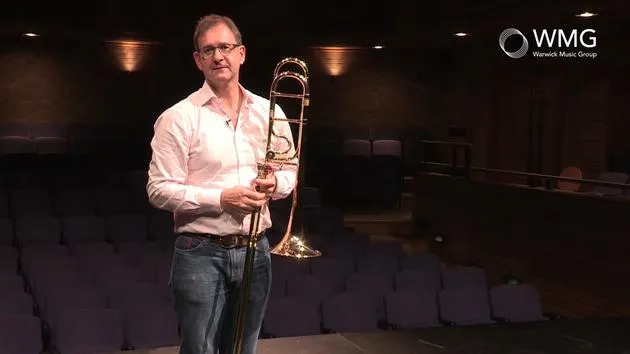
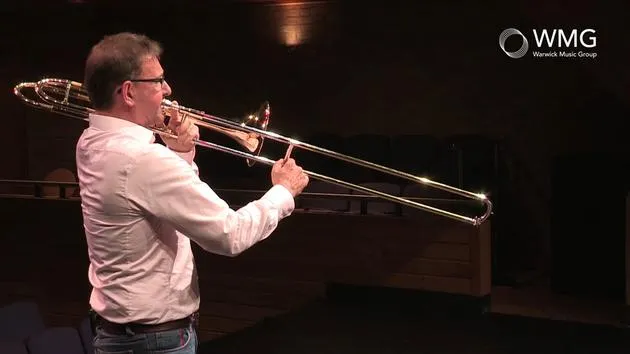
03. High Range Building
Estás aquí8:50
04. Detached Articulation
18:50
05. Mahler's Third Symphony
22:21
06. Mozart Requiem
13:41
07. Ravel's Bolero
11:35
08. Legato
17:55
09. The Philosophy of Warm Up
14:04
10. Wagner, Ride of the Valkyries and Prelude to Act 3 of Lohengrin
12:20
Transcripción de la lección
Range Building in Music: A Comprehensive Lesson
In this video, I'd like to look at range building, something that's important to all of us.
What is Range Building?
Range building is something else that I title:
"The lips respond to the speed of the air and also high note entrances."
Range building is one of the things that I think is a concern to most students. Everyone wants to get higher, higher, higher, higher. We all love it. I'm as guilty as anybody.
The Bread and Butter Register
I'd really like to emphasize the point that I live in what I call the bread and butter register. That's where we earn our money.
- Look at the orchestral repertoire:
- That's where we work most of the time.
- To go higher than the B flat, I practice. I have to work to go lower than the bottom B flat. The same thing applies.
Stretching Our Borders
So, how do we stretch those borders?
- Mouthpiece Use: We have to be able to swoop around the register, going low and high on the same embouchure, just using the air differently.
- Open out, soften the airflow, and widen the airflow as we go low.
- Make it go faster as we swoop higher.
Importance of Scales
The other thing that is essential to range building is the ability to play scales.
"If you can't, well, then go away and learn a few scales."
- The German word for scales is "e ton".
- Later, it means "a tone ladder".
- Of course, we all know that we use ladders to climb up and down.
- So we really must know our scales. It's essential for range building.
The Practice Technique
The next thing that I do might sound quite strange. It's very superficial.
- Yes, I just did go from a low D flat to a top D flat.
- But if you listen very carefully, I'm not digging into the notes. It's very superficial, very, very light, very, very loose.
- Now, you don't have to go as low, or as high, with terrible slide technique, but with a wonderful use of air.
It's all incredibly relaxed. We just let the embouchure swoop low and swoop high.
Never Hurt Yourself
The important thing with growing our register is that:
- We never hurt ourselves.
- We never push.
- We never force.
Use the air:
"No, I wouldn't be proud to make a performance of that in public. But that's not what this is about. This is about improving."
Working with Air Speed
You may remember at the beginning of the video, I was going to talk about something called the lips respond to the speed of the air.
- That's what I'm practicing, where the lips respond to what I'm doing with the air.
- The faster the air comes through, the more the lips and the embouchure have to work to hold in position.
But that's the way it is.
- Too many people will try to play a top B flat and wonder why they can't go any higher.
- It's because we're overworking our embouchure.
Embouchure Functionality
The embouchure should never work harder than is necessary:
- Yes, we have to have it in position, but only loosely.
- The embouchure will react to the speed of the air.
- The faster the airstream goes through, the more the lips have to work.
Utilizing Flexibility Exercises
Of course, when we're working on building the register, we can play flexibilities. You'll find them in any book.
- Again, it's the airstream that's the important thing.
Very loose chromatics are also crucial:
- I said "very loose," didn't I? There's a reason for that.
- Because we don't want to break the airflow as soon as students start to get disciplined.
In order to build range, we must have this glissando air that I keep talking about.
Chromatic Practice
Chromatic of your choice is fine, but don't be frightened when you practice. You can say,
"When I do it this time, I'm concentrating on the airflow."
- It doesn't always have to come together with all of the individual parts of our technique working.
- Sometimes you can focus solely on the airflow right here.
What I do with these chromatics is:
- Go a semitone higher each time.
- Make a crescendo, then come down.
- But don't forget:
"If it hurts, it's wrong."
Avoiding Strain
Don't work your face too hard. Don't hurt yourself in range building. The non-specific high note is really, really important.
Learning from Masters
When I was young, one of my heroes was an English trombone player called Don Lusher.
- He played on a recording of Gordon Langford's Rhapsody for Trombone.
- There was a bit in the cadenza that went like this...
And that's actually how I learned to play high without realizing it, not the bit at the end, but the glissandos.
So many times, if I ask a student to play me a top C, they'll strain and panic.
- Then I say, "Just go from an F and say you just went up to a top F, or an E, or a D."
- And we go up there without realizing it.
The Method to Stretch Range
That's our way into gently stretching our range as we go higher. And always remember,
"Never practice your high register in isolation."
We must always start from the middle register, move up, and come down.
Conclusion
Otherwise, we're in danger of separating the high register off into a different embouchure, and then we can't fit it into the rest of our range.
So, there are a few insights into how I play high and develop my high register. If it's any reassurance to you, I have to constantly work on my high register too.
That's how I do it. That's my philosophy of how I approach range building in the high register. I hope there are some ideas here that help you and that you too can achieve the high register that you're looking for.
10 lecciones
2h 21m de lecciones en vídeo estructuradas
Funciones de vídeo avanzadas
Ralentiza, repite un pasaje, sigue la partitura
Móvil, tablet y ordenador
Practica donde quieras
Garantía de satisfacción 100%
30 días de garantía de devolución
Conoce a tu gurú
Conoce a tu gurú
Ian Bousfield ha estado en la cima de la profesión durante más de un cuarto de siglo, destacando quizá en más facetas del mundo de la música que cualquier otro trombonista hasta la fecha. Su carrera ha incluido tocar en dos de las orquestas reconocidas entre las cuatro mejores del mundo, una de las cuales está considerada quizá la mayor orquesta de ópera; actuar como solista al más alto nivel posible con orquestas, bandas de metales y con instrumentos de época; grabar como solista en sellos de primer nivel; tocar temas principales de superproducciones de Hollywood y enseñar en la Royal Academy de Londres.
Como solista, Ian ha actuado, entre otras, con la Vienna Philharmonic, la London Symphony, la London Philharmonic, la BBC Philharmonic, la Halle Orchestra, la Sapporo Symphony y la Austin Symphony. Ha trabajado con los siguientes directores: Riccardo Muti, Michael Tilson Thomas, Sir Neville Marriner, Kent Nagano, Ion Marin y Matthias Bamert, y EMI, Camerata, Chandos y Doyen se cuentan entre los sellos para los que Ian ha realizado varias grabaciones en solitario a lo largo de los años. Probablemente los dos momentos culminantes de la carrera solista de Ian hasta la fecha hayan sido la interpretación del Concierto de Nino Rota con la Vienna Philharmonic y Riccardo Muti (2008) tres veces en Viena, además de en el Lucerne Festival y en Tokio, y el estreno mundial de Stargazer de Jonathan Dove, escrita para él y dedicada a él, con la London Symphony Orchestra bajo la dirección de Michael Tilson Thomas (2007). Ha actuado con todas las grandes bandas de metales del mundo, grabando con muchas de ellas. Ha actuado como solista prácticamente en todas partes del mundo y, como clínico, ¡probablemente sea más fácil mencionar los conservatorios y festivales en los que no ha aparecido!







