



Breathing, part 1
Qué incluye el curso
10 lecciones (2h 21m) · 1 gratis
01. Breathing, part 1
Estás aquí6:59
02. Rossini, William Tell and The Thievish Magpie
14:54
03. High Range Building
8:50
04. Detached Articulation
18:50
05. Mahler's Third Symphony
22:21
06. Mozart Requiem
13:41
07. Ravel's Bolero
11:35
08. Legato
17:55
09. The Philosophy of Warm Up
14:04
10. Wagner, Ride of the Valkyries and Prelude to Act 3 of Lohengrin
12:20
Transcripción de la lección
Breathing in Brass Playing
In this video, I'd like to talk to you about one of the hottest topics in brass playing: breathing.
The Importance of Breathing vs. Blowing
- Everybody talks about it.
- Everybody places it as their number one importance.
- In fact, we hear many people saying the most important thing in brass playing is breathing.
Actually, I disagree. The most important thing in brass playing is blowing. But in order to do that, we have to get the air coming in correctly.
Breathing Technique
I'm not one of those people who discusses the diaphragm, positioning, or pushing out here and there. I don't like to keep it as physical as that.
- If we take the air in the way we want a note to sound, we'll breathe properly.
- For example, if we want a note to go like this, you can hear from the way the air comes in how the note is going to sound, as opposed to another style of breath.
You'll notice that both of those breaths are completely different.
Different Breaths for Different Pieces
- Mala 3 breath
- Bolero breath
- Berg three pieces breath
We have three completely different breaths. Basically, the focus of the breathing is in different places. You can think of it being at:
- This point,
- That point,
- Or this point.
This will bring the air in the way we want it to go out.
The Mechanics of Air
The most important thing is that the note begins with the air coming in. It starts here.
There is no single breathing method that fits every entrance we're going to play.
- Sometimes, the air will come in really fast, and then, bang!
- Other times, it's going to go exactly the way you'd speak, just think of it like that.
The most important thing is that the air must come in with no resistance.
- If you hear sounds like "uh" or anything similar, take it out.
- That's no good. We need it to come in completely without resistance.
A Helpful Breathing Example
Now, someone once showed me a fantastic example of how to breathe.
- If I keep talking until there's no more air left in my lungs and I hold that position, when I release it, my lungs automatically fill.
- This will work naturally and is a good way to understand how we actually breathe.
How Do We Release the Air?
This is very interesting. I'd like you to try this:
- Take a full breath of air in, hold it, and then release it.
- Now, did you have to blow the air out? No, you didn't.
The lungs want to exhale.
In many ways, having said that, blowing is more important than breathing, sometimes we don't even need to blow. This brings us to the subject of support.
The Concept of Support
There are two words that I don't like discussing in brass playing:
- One is diaphragm.
- The other is support.
Because what is support? To define it is very, very difficult.
Support is air pressure. It's a quantity of pressurized air within our body.
- Now, bear in mind that these are my words, my ways of explaining.
- I'm sure you can go and ask a doctor, and he'll tell you I'm talking nonsense. But these are my words and my thinking regarding breathing, and it works.
A Demonstration
If we take the air in and just let it release, there's no blowing involved. This is my default setting for how I actually play.
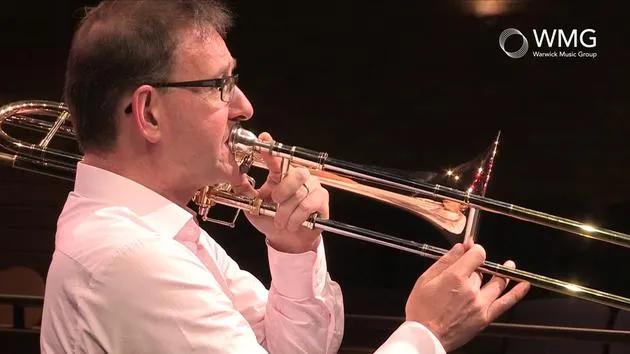
Here's the end of the second movement of the Davide concerto to show how air can just naturally exhale. There are no camera tricks here, so you can see how much air I apparently have if I just let my lungs exhale.
Mustn't do that too often, though. Not good for the blood pressure.
Overcoming Breathing Paralysis
There's one other thing that I'd like to discuss here:
I see so many students I work with who seem to be paralyzed by their breathing technique. Everything happens between here and here.
Let's not forget:
The objective of breathing is for the air to come out this way.
I see so many people, and it stops. The bottom line is we need to take air in, so it can come out through our lips and into the instrument.
Don't forget that. It sounds self-explanatory and simple, but it's often forgotten.
Don't be frightened when you're practicing breathing. Remember that breathing and blowing are linked.
10 lecciones
2h 21m de lecciones en vídeo estructuradas
Funciones de vídeo avanzadas
Ralentiza, repite un pasaje, sigue la partitura
Móvil, tablet y ordenador
Practica donde quieras
Garantía de satisfacción 100%
30 días de garantía de devolución
Conoce a tu gurú
Conoce a tu gurú
Ian Bousfield ha estado en la cima de la profesión durante más de un cuarto de siglo, destacando quizá en más facetas del mundo de la música que cualquier otro trombonista hasta la fecha. Su carrera ha incluido tocar en dos de las orquestas reconocidas entre las cuatro mejores del mundo, una de las cuales está considerada quizá la mayor orquesta de ópera; actuar como solista al más alto nivel posible con orquestas, bandas de metales y con instrumentos de época; grabar como solista en sellos de primer nivel; tocar temas principales de superproducciones de Hollywood y enseñar en la Royal Academy de Londres.
Como solista, Ian ha actuado, entre otras, con la Vienna Philharmonic, la London Symphony, la London Philharmonic, la BBC Philharmonic, la Halle Orchestra, la Sapporo Symphony y la Austin Symphony. Ha trabajado con los siguientes directores: Riccardo Muti, Michael Tilson Thomas, Sir Neville Marriner, Kent Nagano, Ion Marin y Matthias Bamert, y EMI, Camerata, Chandos y Doyen se cuentan entre los sellos para los que Ian ha realizado varias grabaciones en solitario a lo largo de los años. Probablemente los dos momentos culminantes de la carrera solista de Ian hasta la fecha hayan sido la interpretación del Concierto de Nino Rota con la Vienna Philharmonic y Riccardo Muti (2008) tres veces en Viena, además de en el Lucerne Festival y en Tokio, y el estreno mundial de Stargazer de Jonathan Dove, escrita para él y dedicada a él, con la London Symphony Orchestra bajo la dirección de Michael Tilson Thomas (2007). Ha actuado con todas las grandes bandas de metales del mundo, grabando con muchas de ellas. Ha actuado como solista prácticamente en todas partes del mundo y, como clínico, ¡probablemente sea más fácil mencionar los conservatorios y festivales en los que no ha aparecido!







