



Ejercicio con alumnos
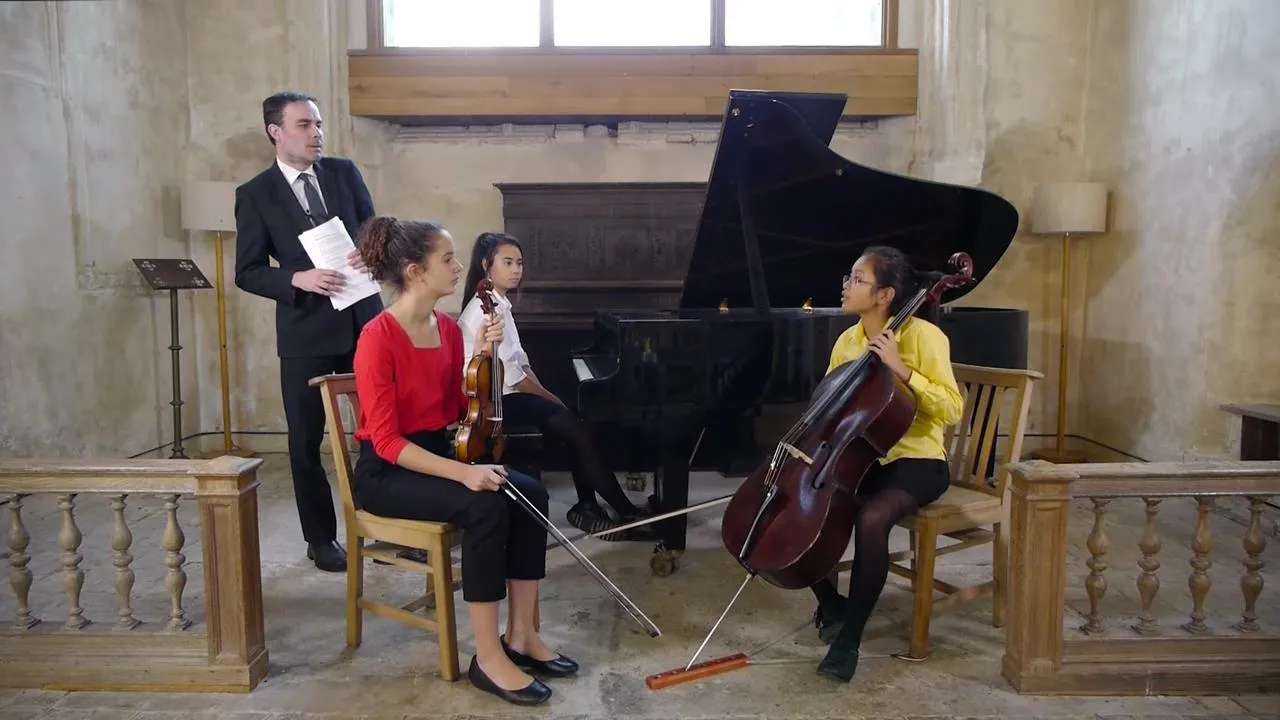
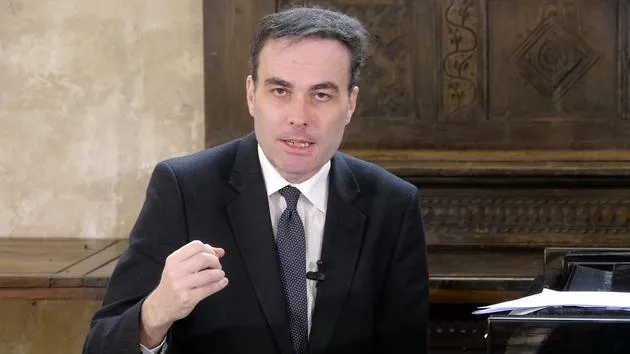
Andrew Quartermain demuestra su primer consejo de enseñanza con un trío de alumnos en directo: un ejercicio de 'cinta transportadora musical' para desarrollar el pulso y el fraseo en el modo dórico.
Qué incluye el curso
8 lecciones (0h 46m) · 1 gratis
01. Introducción a los conjuntos creativos con Andrew Quartermain
4:44
02. Consejos para profesores n.º 1: cómo empezar usando la improvisación
Lección gratis3:16
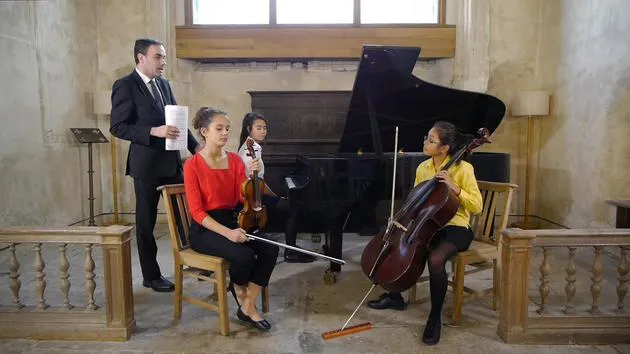
03. Ejercicio con alumnos
Estás aquí7:36
04. Consejos para profesores n.º 2 - Añadir interés
3:36
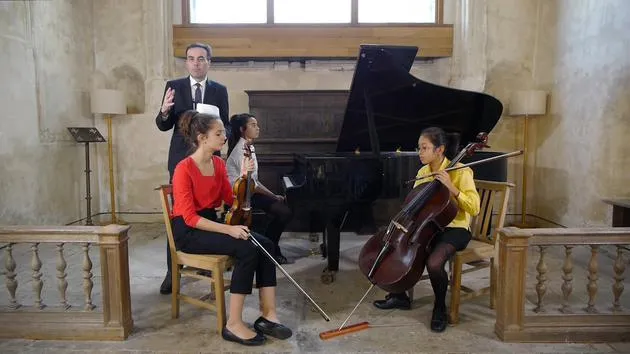
05. Ejercicio con alumnos
7:49
06. Consejos para profesores n.º 3 - Responder a sus necesidades
4:18
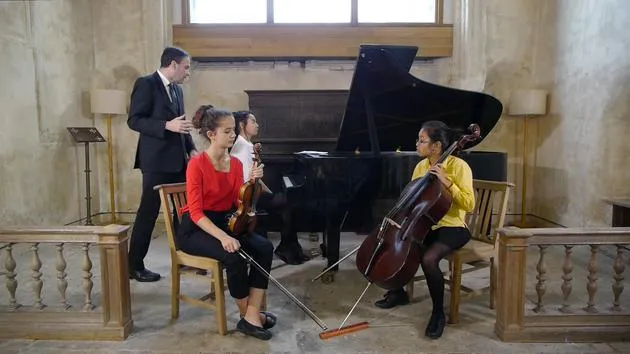
07. Ejercicio con estudiantes
10:19
08. Consejos para profesores n.º 4 - Superar el bloqueo del escritor
4:32
Transcripción de la lección
Creative Ensemble Session: Introduction
So here we are with our first creative ensemble session, the first session of term. The aim is to get your group understanding the principles of small ensemble performance away from the repertoire.
Introductions
We've got three lovely young professional musicians here to help demonstrate some of the techniques.
- Isabella
- Emily
- Nicky
The Ensemble Setup
Here we have the conventional piano trio setup. This group will go on to study their repertoire, Beethoven in the case of this film, but also many other wonderful piano trios in the repertoire.
Remember: This technique is all about how we get a small ensemble of any combination to work together.
These musicians are forming a piano trio, but we could also have a mixed brass and string group, or perhaps a group whose instrumental makeup means there isn't any existing repertoire for them.
Key Concepts: Pulse and Phrase
This first session is about getting started, and the important thing is to familiarize our students with pulse and phrase as concepts that they should already be thinking about in an ensemble context.
Activity: We are going to start with a little musical conveyor belt, which I will give to each player individually. Since I will be playing as well, the tips for teachers will demonstrate the various ways in which this can be led by the teacher.
Isabella, I'd like to ask you first if that's alright. We will be working in our modal harmony of D, specifically the Dorian mode on D.
Task: I'm going to play something at the piano, and I would like you to step onto it when you feel ready.
(Nicky, you can stay where you are; I'll just linger behind you here.) This is going to be very simple, but see if you can really pick up on the pulse of what I play.
Outcome: Fantastic! We're already establishing a flow of pulse. You were listening to what I was doing, and I was, of course, listening to you as well.
Equal Partnership in Ensemble
As the teacher, it's important to set a level playing field here. This isn't about instructing the student; this is about a pure duo.
- Both members are equal partners.
In my opening phrase for Isabella, I aimed to give her something she could really latch onto.
Key Tips:
- The upbeat is crucial.
- Focus on a feeling of lift and continuity.
Addressing Potential Challenges
Later in the film, we'll discuss ways to react to a student and use articulation to help encourage them if the pulse is sagging or if they aren't quite capturing the sense of immediate duo.
Next Participant: Emily
Emily, I'm going to give you a little starter phrase now, which will be quite different from Isabella's.
- Objective: See if you can step onto it.
- Outcome: Fantastic, well done!
The other thing I'm doing here is leading the musical conveyor belt by providing a bit of structure. We need to think about having a beginning, a middle, and an end.
Keep It Simple
- Crucial Note: Do not make the phrases too long.
- Maintain Simplicity: Avoid switching to different keys, complicated melodies, or time signature changes.
Remember: This isn't about counting beats or bars; it's a more organic process rooted in the cycling of pulse.
Engaging Pianists
If you're a piano teacher, consider using this approach to engage your pianists with duo playing, even if you don't yet have any duet repertoire.
Activity: Nicky, our wonderful pianist today, will try this as a duo.
- Setup: I will sit beside you. I'll stick to the notes lower than middle C, and I'd like you to stick to the notes above middle C.
- Goal: Let's try to create a duo from my opening phrase as you step onto it.
Well done! Brilliant!
Importance of Upbeats
The leading of this duo is all about upbeats. Sometimes, I incorporate more than one upbeat to enhance the sense of momentum.
Here's an example phrase to illustrate this idea:
- Instead of just thinking about "four beats," perhaps use syncopation earlier on in the phrase to help establish that forward motion.
Simplicity in Practice
This can all be done very simply, perhaps even just using one hand at the piano.
Key Point: You don't need to be a concert pianist to implement this method successfully.
This emphasizes using five notes simply but effectively.
Modal Harmony in Ensemble
I use modal harmony as it provides a wonderful basis for this kind of work.
- Benefits: Students don't have to worry about clashes or modulation.
- Even in D major, hearing an F sharp against an F natural might sound off, but for our purposes, there's no such thing as a "wrong note" in this situation.
Conclusion: Using modal harmony is not only effective but also very easy to explain.
We'll explore this further in the tips later on.
8 lecciones
0h 46m de lecciones en vídeo estructuradas
Funciones de vídeo avanzadas
Ralentiza, repite un pasaje, sigue la partitura
Móvil, tablet y ordenador
Practica donde quieras
Garantía de satisfacción 100%
30 días de garantía de devolución







