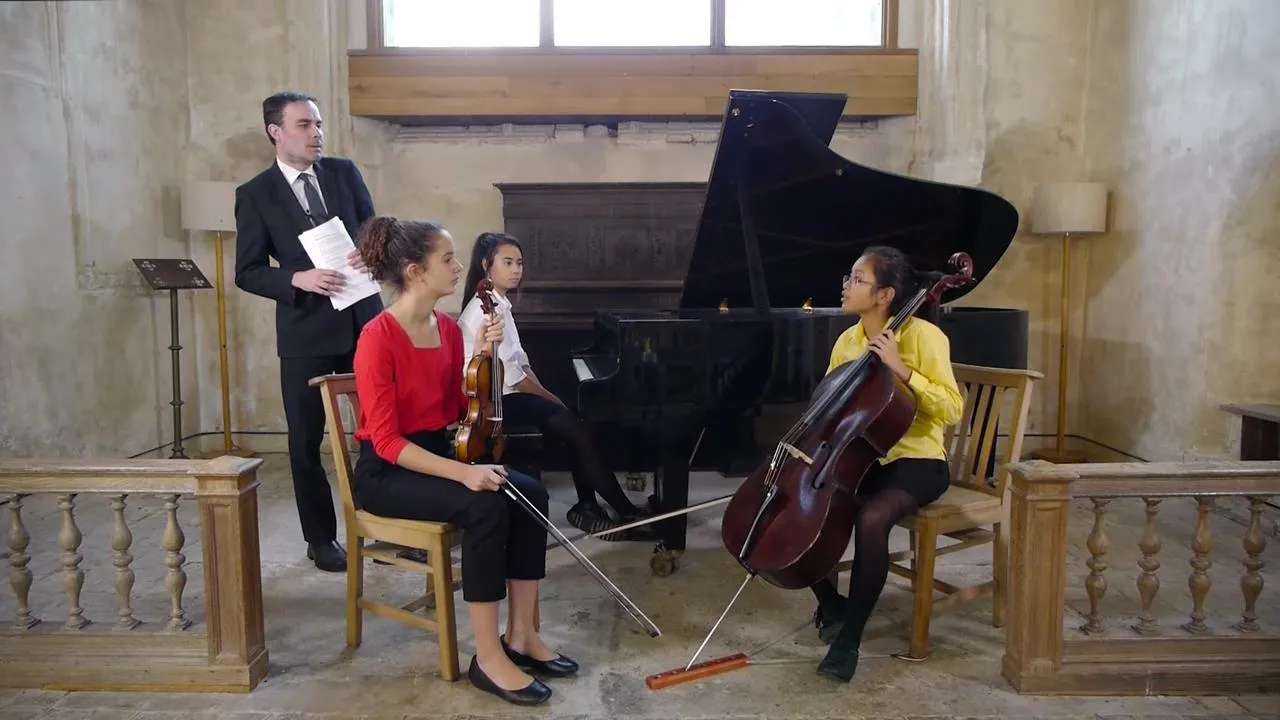
Ejercicio con alumnos
Lesson time: (7min 55sec)
Course preview
This lesson is part of the course Crear pequeños conjuntos creativos
Watch a preview of the full course below.
Lesson transcript:
Creative Ensembles: First Session Overview
Introduction
In our creative ensembles work, the goal for this all-important first session is to grow our new ensemble. With the start of the term, we have this eager group wanting to discover the joys of small ensemble performance.
What we must achieve above all is to allow our students to realize that playing together and forming a texture is the most exciting thing they can do as musicians and performers.
Key Objectives
-
Immediate Engagement: We want to immerse them in the world of ensemble playing without the delay of learning repertoire or focusing predominantly on individual parts. This is crucial to avoid detracting from the ensemble experience.
-
Improvisation Techniques: We will demonstrate how improvisation can plant our students in the heart of an ensemble from the very first moment, encouraging them to think about ensemble music from the inside out.
The Importance of Ensemble Thinking
Even with a score in hand, grappling with notes can result in students approaching it from the outside in. This clinical approach hinders their enjoyment.
Our aim is to capture their excitement right from the start.
Practical Demonstration
We will layer a texture with our piano trio, a quite conventional ensemble, which can be adapted to any combination of instruments, up to nine or ten players. This setup constitutes a small ensemble without a conductor.
Using Modal Harmony and Ostinato
- We will utilize modal harmony and explore the concept of ostinato.
- An ostinato is a very simple repeated phrase.
- Example from Classical Music:
- I often remind students that some of the greatest music is incredibly simple in terms of notes used.
- Mozart's 40th Symphony: This theme, recognized globally, even as a ringtone, uses only three different pitches.
- Example from Classical Music:
Engaging with Students
- As we layer simple ostinati, I will emphasize the importance of listening to one another.
- I will demonstrate this process directly with our students.
Instructions:
-
Ostinato Introduction: I'll demonstrate a basic ostinato.
-
Improvised Patterns:
- Nikki will create a simple note pattern above the ostinato, using one or two adjacent keys or a couple of steps apart.
- Emily and Isabella will follow in this improvisation.
-
No Music in Front: It's crucial that they have no music on their stands, allowing them to focus completely on listening to each other.
Final Thoughts
In just five minutes of our first session, our young musicians have not only performed as a piano trio but have also composed, experienced ensemble dynamics, and started to know one another's musical personalities.
This session plants the seeds of collaboration and understanding among musicians who will hopefully work together for the remainder of the term and beyond.
As a teacher, my role is to guide this simple, pulse-driven process and to react spontaneously to any challenges that arise, ensuring everyone stays engaged and confident.
Congratulations to Nicky, Emily, and Isabella, you've successfully performed and composed in just five minutes!