



Cascade Rag (lección)
Lesson time: (9min 14sec)
En esta lección, Kenny Sultan te enseña a tocar la pieza Cascade Rag en la guitarra acústica.
Course preview
This lesson is part of the course Clases de guitarra de blues tradicional
Watch a preview of the full course below.
Lesson transcript:
Music Lesson: Cascade Rag in the Key of G
Our next song is Cascade Rag in the Key of G. We're getting out of the 12-bar blues format and finally doing a straight rag, or ragtime blues, similar to Gary Davis style songs.
You know, we did Honky Tonk, but that was still really a 12-bar blues. Now we're going from:
- The 5 chord to the
- The 1 chord to the
- The 5 chord to the
- The 1 chord.
Typical rag stuff.
Discussion on Finger Picks
Before we get into it, I want to talk to you about one thing: the use of finger picks. Some of you use them, and some of you don't, but there are some problems associated with them.
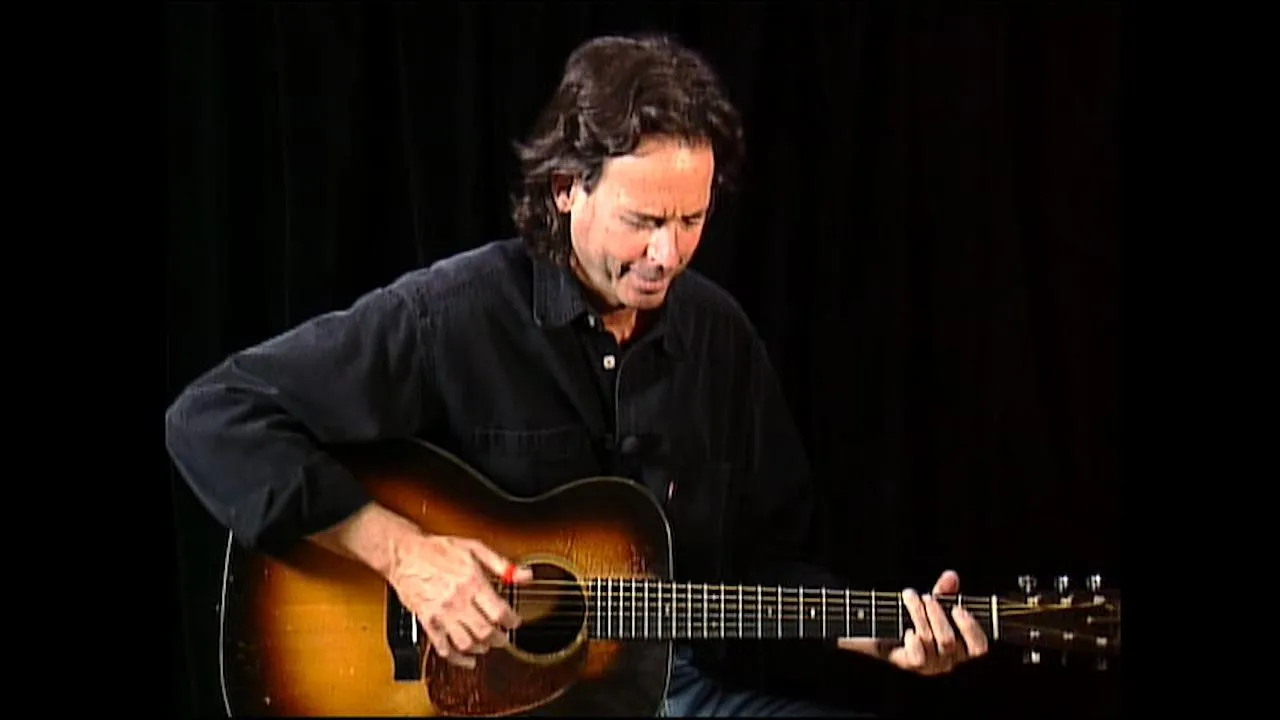
Here's how I wear mine:
- I turn my picks towards my thumb a little bit.
- Notice my thumb pick, I'm wearing it very low.
Reason Behind My Picks' Position
The reason for this is that as I come back into the guitar:
- Most of us don't pick straight up. At least, I don't.
- If you're a classical player, maybe you do, but if you're a funky blues guy or just loose, you kind of pick at an angle.
By picking at an angle, if I wore my pick straight, I would be getting a lot of this obnoxious pick noise.
And the boss man for all these projects hates pick noise. So I had to really talk him into letting me use finger picks. But I play pretty clean with finger picks, and it's worked out really well on the CDs and hopefully on this DVD.
Technique Overview
- By turning them and picking at an angle, my picks are actually coming up straight, avoiding that ugly noise.
- I wear my thumb pick low so I can use my thumb to come underneath the strings and still get some bare flesh when needed.
Playthrough
Now, back to the song:
- D to G
- D seventh to G
- D seventh to G
Run turn around: D minor, okay, so we'll play it through.
What I'm doing there is simply playing a D seventh chord and a G chord and just lifting my finger up on the first string to get that opening E.
Filler Notes
But there's an extra note in there. Something I want to get in is called filler notes. I use this in all my playing. Many people come up to me and say,
"I'm playing what you're playing, but it doesn't sound quite the same."
I finally figured out that I'm adding an extra note every now and then for syncopation.
The true melody of the song would be:
- [Insert Melody Reference Here]
But I'm adding a string right above the string I'm hitting, below it melodically, I guess, in between the bass notes. Watch:
- A lot more funky than...
Remember earlier when we added:
- Octaves to the boogie
- Slaps to the shuffle
- Harmonies to the slow blues
All these things help you play much better and sound much better.
Using Filler Notes
You can't really get these techniques from books, because if you saw it in a book, it would go like this.
But in reality, it's a lot closer to the note and not as loud. You don't really hear it almost. So it's a little filler note practice. I put the string right above the string I'm playing the melody on and add it in every now and then, just a little trick.
Additional Techniques
There was also a little roll kind of from my old banjo days, which I really stunk at. But that's all I'm doing on that run.
And again, on the rolls, it's the same as on the runs:
- Fingers behind the thumb.
Then we're going to add more D's and G's. We're improvising just like anything else.
I'm going to come up the neck and maybe make this D seventh, which is an A seventh, the one we've used all along. Now I'll make this G7, the same D7 position we've used all along.
Simplifying Guitar Playing
I'm really trying to make guitar as simple as I can for you because it really isn't brain surgery. It's not rocket science. Just a few chords, and you just use them:
- C
- G
- Then our ninth.
If those are too hard, you can substitute sevenths: C, G.
And then I go into a thumb roll. Just a roll of the...
And again, the thumb roll, you can miss like that. It's totally cool.
Final Thoughts
The trick with this song is if you're doing it on your own or trying to improvise again, just find two chords:
- A D7 somewhere
- A G or G7 somewhere on the neck.
We've seen it here and here. Basic Travis pick, then we've seen it.
- We could do it here: G to D
- We could do it here: D to G
- You want to get crazy? You could go D, G or absolutely nuts: D seventh G.
So again, a little bit out of the 12-bar form, but still basically sticking to a form: 515151 and a turnaround, leaving you a lot of room to improvise.
Wrap Up
Left hand chords, right hand rolls.
The Cascade Rag. Good luck! Have fun! Play fast!
About the instructor
Kenny Sultan es autor superventas de libros de música y vídeos didácticos sobre guitarra de blues, y es el guitarrista de un dúo de blues junto a Tom Ball. Juntos y por separado han trabajado en incontables bandas sonoras de cine y televisión, anuncios y sesiones. Han aparecido en televisiones de todo el mundo, protagonizaron los anuncios de los “Levi's 501 Blues”, han tocado para audiencias de 300 millones de personas a través de Voice of America y son invitados habituales de la National Public Radio. Han compartido escenario con figuras como Bob Dylan, Stevie Ray Vaughan, The Allman Brothers, Joe Bonamassa, Ray Charles, Joe Cocker, Elvis Costello, y la lista es larga... Como en casa allá donde van, Tom y Kenny encajan en festivales de blues, folk, bluegrass y jazz, y su amplia trayectoria docente los convierte en una elección natural para campus universitarios o salas que programan talleres. Como su música es una mezcla de estilos de raíces americanas, son habituales en el extranjero, donde cosechan críticas entusiastas. Ese mismo bagaje docente es lo que aprovechas aquí. Kenny te introduce en la guitarra de blues tradicional desde cero -patrones de fingerpicking, bajo alternado, turnarounds y los licks clásicos que definen el estilo- para que construyas un auténtico repertorio de blues acústico que de verdad puedas tocar. “Una forma de tocar estupenda.” --Blues Revue “Tan bueno como cualquiera en el blues acústico.” --Sing Out read more