



Renewal (lección)

Lesson time: (10min 30sec)
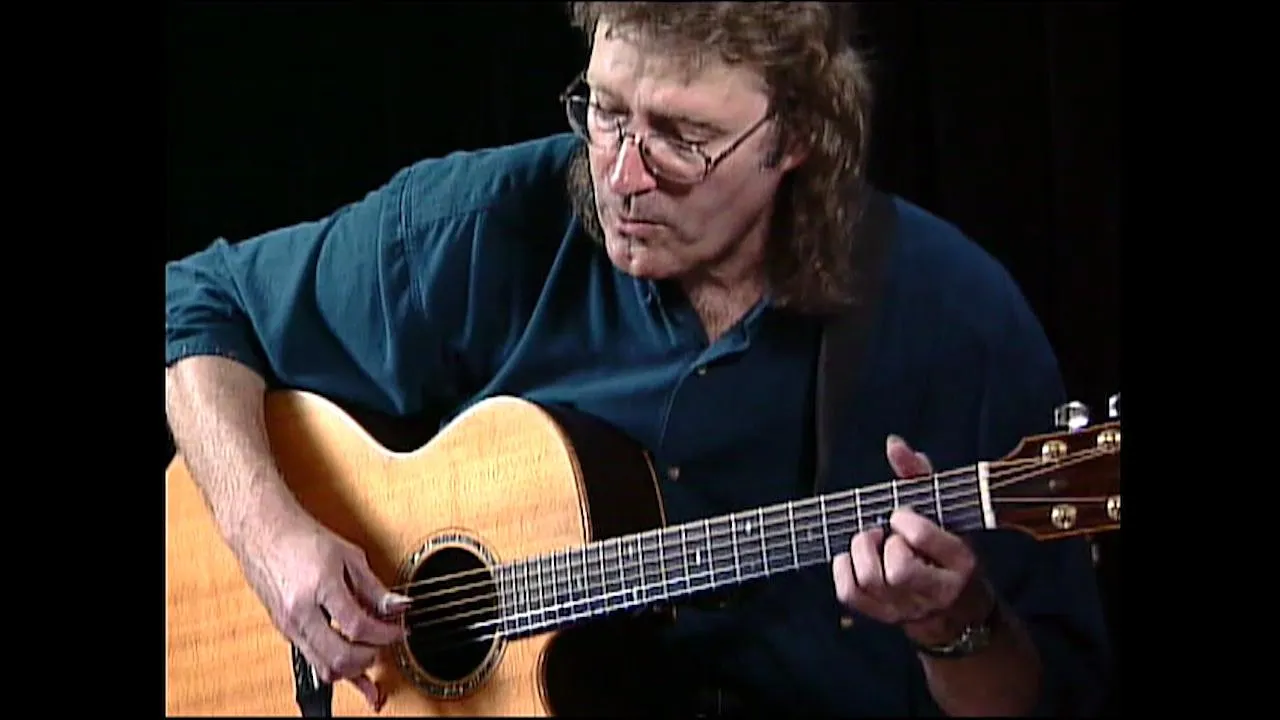
Doug Smith enseña su pieza fingerstyle 'Renewal' en afinación DADGAD (cejilla en el 3), empezando por su majestuosa intro de estilo fanfarria tocada con el pulgar.
Course preview
This lesson is part of the course Guitarra instrumental contemporánea
Watch a preview of the full course below.
Lesson transcript:
Music Lesson: Renewal
Introduction to "Renewal"
The first tune we're going to start with is called Renewal. This is probably one of my favorite pieces that I've written. It is in the DADGAD tuning, which, if you're not familiar with it, consists of D A D G A D.
And obviously, it's capoed on the third fret, putting us in the key of F.
Fanfare Intro
I'd like to start off with the introduction. I thought of this intro as kind of a fanfare to open the tune, and it also serves to close it. It's a majestic-sounding section.
- I'm playing the melody of the fanfare with my thumb.
- Pay attention to my right hand on this.
The main melody goes something like this:
Okay. Then it transitions into something else, but the thumb continues that pattern.
The index (I) and middle (M) fingers are covering the second and first strings, respectively.
I hesitate to say this, but it almost doesn't matter which order you play the I and M fingers in, as long as you achieve that kind of sparkly open fifth above what the melody is doing.
Here's how it sounds:
I'll play it slowly.
Key Technique
Now, there's one tricky part that I want to mention. Since the thumb is playing the melody, there's a section where two sixteenth notes occur right together.
Here's the tricky part:
- I want both of those played with the thumb. That's how I typically execute it.
- Following that, the next note is a background note. I also play that with the thumb to leave the I and M fingers in position.
So, what I'm doing here is:
- Playing these notes strongly
- Going back with the thumb to play this note softly.
This creates a neat little trick.
So once again, let's highlight that section:
It goes ba da da, which is actually what's going on, but you don't notice it that way.
Left Hand Position
Now that was the right hand. I want to discuss what the left hand is doing here.
- It's in second position.
- This means your first finger should be lined up at the second fret.
For the introduction:
- My first finger is on the second fret of the third string.
- For practically the entire introduction, I leave it there. The only exception is when I need to lift it once for an open string.
Take a look at the left hand:
- You'll notice it stays down.
- Then I lift it, and it stays down again.
I use my second finger here and then lift it off for the final riff. One thing I didn't mention is there's usually a hammer-on I do right here, which adds some flavor.
The Groove
After the introduction, I settle into a two-bar groove that repeats:
- My I and M fingers switch to the second and third strings, with the thumb taking over the lower three strings (in pitch).
It sounds like this.
My first finger remains where it was.
Then we come to the main verse, which starts like this:
da da da da da da da.
Melody vs. Harmony
The trick is to ensure that the melody is prominent so it doesn't sound like a mishmash of notes.
- Remember, even though this is nice for me, the essence of this part is the harmony.
- Ensure both melody and harmony are clearly brought out.
I was exaggerating there, but my thumb covers those three strings while the index finger plays in some background notes.
B Verse
Next, let's move on to the B verse. Here, I want to highlight a three-note line:
- Those three notes are on different strings, and I don't want them to ring into each other.
Sometimes that's a good effect for a harp-like sound, but in this case:
- When you hit that note,
- Play the next note.
- Lift this finger off when striking the final note.
- Mute the third string.
This ensures the line comes out clearly.
It goes like this:
Okay. That repeats and then we go through the main verse again, ending with...
The Middle Section
Now we arrive at the middle section, which I refer to as the Phil Spector section. This is because I use a bass line that reminds me of his "wall of sound" bass drum.
- This has to be kept up consistently.
- Usually, when I perform it, I try to throw in a backbeat with my nail, assuming you have a pick guard.
For the melody:
I'm just playing octaves, with a simple line using my middle finger. You must ensure that you keep the thumb bass line going, figuring out which melody notes align with which bass notes.
- They should play together, together, together, together.
- The rest of the time, they syncopate in between the beats, especially.
This syncopation continues throughout the entire middle section.
Fast Run & Flourish
Towards the end of the middle section, there's a fast run.
- I use a combination of hammered-on notes while alternating with my thumb and finger.
That's pretty much it!
The only other thing is the flourish at the end, but I'll cover that technique in another song, Out of the Darkness.
So, give it a try and have fun with it!
About the instructor
Doug Smith es un guitarrista acústico de fingerstyle ganador de un Grammy y antiguo vencedor del Winfield International Fingerstyle Guitar Competition, cuya forma de tocar apareció en la película August Rush. Su estilo bebe del folk, el clásico y el jazz, y ha compartido escenario con intérpretes como Tommy Emmanuel, Laurence Juber y Andy McKee. En su curso de MusicGurus "Contemporary Instrumental Guitar" desglosa las técnicas que hay detrás de sus arreglos a solo. read more